Friday, January 02, 2009

The Historical Jesus and New Testament Theology

Does the historical Jesus belong to Christian Origins or New Testament Theology? Bultmann made the historical Jesus the presupposition for New Testament Theology whereas others such as Joachim Jeremias and N.T. Wright have made him the starting point for it. More recently, Bob Gundry has argued that the traditional Jesuses of the Gospels are more important than a reconstructed historical Jesus. Why does New Testament Theology even need a historical Jesus when it has the portraits of Jesus in the canonical Gospels?

First, we start with the recognition that the Gospels are theological biographies and contain historical memories and a theological interpretation of those memories for communities in the Greco-Roman world. While their narratives as a whole contain theological texturing, it is their redaction of historical materials that often tells us of their theological purposes. Thus, in order to see the theology we often have to look for the history. Second, the Gospels themselves are part of the process of the reception of the historical Jesus and the Easter event in Christian communities. Third, the Gospels point in a pre-Easter direction and provide us with information about the historical sequence of events that constituted Jesus' ministry and the circumstances leading to his death. Even the Fourth Gospel with more of the vox than verba of Jesus still retains a degree of historical authenticity that is said to be validated by the testimony of the Beloved Disciple. Fourth, as long as we believe that theological utility is not tied to historical authenticity, then we have no fear of the historical Jesus. Alternatively, the historical Jesus is theologically significant in terms of showing that Christians cannot be docetists and rooting God's revelation of himself in his Son in the theatre of human history.

In other words, the historical Jesus is a crucial component of the canonical Jesus because (1) the canonical Gospels include the impact of the historical Jesus, and (2) the historical Jesus is only available through the testimony and confession of the early church's faith.

Wednesday, December 31, 2008

N.T. Wright's Response to John Piper!!!

Here is Howard Marshall's endorsement: "This book is a magisterial response to the recent spate of criticism directed at Tom Wright for his theology of justification. He introduces readers to the debate and outlines his position without engaging in polemic against his opponents. This sprightly and gracious, yet robust, work is Tom Wright's carefully argued and scripturally based response to those who think that he has deeply misunderstood Paul's doctrine of justification… This is definitely one of the most exciting and significant books that I have read this year… Strongly commended!"

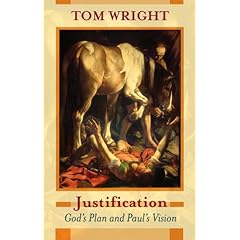
Soon to be published by SPCK (in the UK, Feb 2009) and by IVP (in the USA, July 2009) is N.T. Wright's new volume: Justification: God's Plan and Paul's Vision and I've been privileged enough to have a copy of the proofs. This book is a response to many of Wright's North American critics and to John Piper's The Future of Justification in particular. It is not a point for point reply to Piper but a general articulation of what Wright really thinks about justification with some hand-to-hand combat with Piper (as well as others such as Carson and Seifrid) along the way. Wright gives a very forthright defence of his position, but is certainly not acrimonious or uncharitable towards Piper. I'm not going to offer a review or even quote it at length here since the proofs might still be tinkered with before publication and I don't want to spoil the surprise for everyone.

1. Outline of the Book.

Introduction
Rules of Engagement
First-Century Judaism: Covenant, Law and Lawcourt
Justification: Definitions and Puzzles
Galatians
Philippians, Corinthians, Ephesians
Romans
Conclusion

2. Value. This book is vintage Wright with his easy-to-read sermonic prose, exegesis of the texts weaved into a master theological narrative, and provocative one liners through out. If you've read What Saint Paul Really Said and Paul in Fresh Perspective not everything here is new. However, Wright provides some helpful nuancing of his views and provides further rationale for his challenge to the dominant positions in Protestant dogmatics. Let me give two spoilers: (1) Wright wonders what Protestant theology would have been like if we read Romans and Galatians in light of Ephesians and Colossians rather than the other way around. If the Reformers were gripped by the major themes of Ephesians then perhaps there would never have been a split between Rom. 3.28 and 3.29, no marginalization of Romans 9-11, we would have a tangible rationale for linking the sola gratia of the gospel and the proleptic unity of all mankind in Christ (from Ephesians 2-3), and perhaps even modern German Lutherans would not have been so dubious about Pauline authorship of Ephesians! (2) And, what I've been harping on about myself, God's plan to deal with the root problem of sin and God's purpose to bring Jew and Gentile together are not mutually exclusive. Importantly, Wright communicates with great verve and genuine pathos that what ultimately matters for him is that we do not pursue any perspective (Wright, Old, New, or otherwise) but settle for nothing less than Paul's perspective!

3. Reflections. While it may sound schizophrenic to some, I genuinely enjoy both the works of Piper and Wright. I find ample grounds to affirm and disagree with various portions of their respective volumes on justification. John Piper is the Martin Lloyd Jones of our generation through his faithful exposition of God's word and his mix of calvinistic doctrine, charismatic energy, and theocentric piety. N.T. Wright does for the evangelical churches what Rudolf Bultmann did for the mainline churches a generation ago, viz., showing them how NT Theology can enrich their understanding of the God who has revealed himself in Jesus the Christ. Regardless of whether one gravitates towards Wright's or Piper's unpacking of Paul, you cannot help but enjoy the sparks that fly when these two great modern Pastor-Scholars cross swords over the great Apostle. Just as iron sharpens iron we can genuinely benefit from watching this melee (which though it has been rigorously fought has remained Christian in candour all the same) unfold as we are forced to test old assumptions and new proposals about Paul's understanding of salvation. Importantly we should avoid idolizing or anathematizing either protagonist; instead, we should do what Paul counsels in 1 Thess. 5.21 "test all things and hold on to that which is good". So around January 2009 have a fresh browse of Piper's The Future of Justification and then in February or July get yourself a copy of Justification: God's Plan and Paul's Vision and have a read of that with some Spanish torizo, mango stilton cheese, and a bottle of Spanish Tempranillo! Wright's forthcoming book is a satisfactory rejoinder to Piper and, much like an Aussie Merlot, should be carefully evaluated, slowly sipped, and above all enjoyed!

Ros Clark on Song of Songs

WTS-Philly grad and current HTC Ph.D student, Ros Clarke, has a big and juicy essay on Song of Songs at BeginningwithMoses.com. She concludes: "The Song provokes a greater love for Christ, a deeper admiration for the land, a more passionate desire for the consummation of our marriage, a more confident assurance in our beloved status and a more patient endurance as we wait for our coming king. Perhaps if we understood this better, we might begin to see a resurgence in the pulpit popularity of this, the greatest of all songs".

Tom Wright reads Humpty Dumpty

Thanks to Jason Hood for writing up this funny little gem of a story.

Tom Wright reads Humpty Dumpty (In the Spirit of Bultmann Reads Mother Goose)

Written in Durham Cathedral, dedicated to Rowan Williams.

Humpty Dumpty sat on a wall

Clearly the writer alludes to the Temple. This echoes other lines in early 2nd nursery literature, such as Mother Hubbard’s cupboard (the “storehouse” of the Temple) and the bone (resurrection life) which she sought for her dog (“Gentiles”). “But when she got there, the cupboard was bare and the poor little doggie had none.” The temple had nothing to offer the Gentiles, and they thus remained in their state of Adamic sin and decay. So here, too, one suspects the Temple and its “wall” are bankrupt. The next line, then, does not surprise:

Humpty Dumpty had a great fall

Again, this is patently an echo of the Temple’s destruction, doubtless with the intent of leading the reader to ponder the eschatological recreation of the Temple. Since Humpty stands for the Temple, he seems to be sharing in the divine identity, functioning as the locus of God’s presence, not outside, but within creation. Of course, this fall is an exile of sorts, a removal from the locus of God’s presence. The tension is palpable: how will humpty’s story not turn out dumpty? In other words, this line presupposes what I have called elsewhere the great metanarrative of humpty, not least the promise of resurrection.

But all the king’s horses and all the king’s men couldn’t put humpty together again.

So the Temple will be built again, but not by human hands. Many have undertaken to suggest that this passage runs counter to a belief in resurrection. But this atomistic reading of the text lacks imagination. Of course, it is the king himself who will put humpty together again, so that the metanarrative will not fail. After all, Humpty is the place where he is resident with his creation. But the failure to recreate Humpty does not negate all human effort for creation, which should be done in light of the proleptic nature of the king’s restoration of humpty and all creation.

2009 is Calvinfest Time

As the new year is about to dawn remember that 2009 will be Calvin's 500th birthday. And everyone is having a Calvinfest. So if you belong to the congress of card carrying calvinists or just have a soft spot for nerdy little frenchmen who like to gab about God, then you need to attend at least one Calvin conference this year (they will be more common than Star Bucks on Main Street) and get on board with Princeton Theological Seminary's programme "A Year with the Institutes".

The Princeton site states:

Princeton Seminary, through its Center of Continuing Education, will provide a daily reading schedule and text of a three-to-six-page section of the 1559 version of the Institutes for each day of 2009, except Sundays and Christmas Day, online on its web site (www.ptsem.edu). The readings, using the McNeill/Battles translation of the Institutes, thanks to permission from Westminster John Knox Press, will also be provided in audio format, as a podcast, with sections read by oral performers from around the country. Michael Brothers, an assistant professor of speech communication in ministry at Princeton Seminary, will direct this part of the project.

Each week an invited scholar or pastor will provide a reflection paper on that week's readings on the web site, and participants will be able to comment on both the readings and the reflection papers.

The project was the brainchild of Princeton Seminary's Christian education assistant professor Gordon Mikoski, who decided to read through the Institutes as part of his Christian devotional practice to commemorate the anniversary year of Calvin's birth. As he told friends and colleagues about his idea, they wanted to join him.

"While browsing through the Westminster John Knox book display at the American Academy of Religion meeting in November, I came upon new copies of the Institutes," Mikoski said. "It occurred to me that reading them cover-to-cover from January 1 through December 31, 2009 would be an appropriate way to honor Calvin's life and work."

Mikoski believes such disciplined reading of the Institutes can remind the church of its rooting in God, not itself. Calvin wrote that "we are not our own; insofar as we can, let us forget ourselves and all that is ours. Conversely, we are God's: let his wisdom and will therefore rule all our actions; let all parts of our life accordingly strive toward him as our only lawful goal." (Institutes 3.7.1)

Mikoski's project was enthusiastically received by the Erdman Center of Continuing Education, which is sponsoring a number of events in 2009 to celebrate the Calvin anniversary. The first of these is 2009's first global Calvin conference, "Calvin and the Church Today," January 20-23, 2009. For more information on these events, visit www.ptsem.edu/calvin2009.

Princeton Seminary hopes pastors, lay people, and scholars will take this opportunity to read and interact with the work of a theological giant in the Reformed tradition, with a community of Christians across the church and the world.

In addition to Mikoski and Brothers, steering committee members for the project include students Jason Santos, Michael Gyura, Katherine Douglass; Raymond Bonwell, director of programs for the Center of Continuing Education; Barbara Chaapel, the Seminary's director of communications; and Joyce MacKichan Walker, a member of the pastoral staff of Nassau Presbyterian Church in Princeton.

First Annual Australasian Conference

The first annual Australasian conference for the academy and the church will take place in Brisbane, Australia on the 30th of June to the 3rd of July 2009. The Annual Australasian Christian Conference (AACC) exists to stimulate research and publication by evangelical christian academics. The AACC has two Tracks. Track 1 provides biblical scholars with an opportunity to present research in the areas of biblical studies, systematic theology, ethics and church history. Track 2 provides a forum for academics working in the Humanities, Sciences and Engineering to explore issues at the intersection of Christianity and their specific discipline. To facilitate interaction with academics outside our geographical region the AACC has invited two scholars of international standing to deliver the plenary addresses in 2009: Richard Bauckham and David Baker. Brisbane (aka Brisvegas) is a great city and this looks like it will be a great conference. It is sponsored by the Queensland Theological College and the Australian College of Theology.

Tuesday, December 30, 2008

Southern Baptist Scholar Takes to Rugby

I'm glad to see that my good friend Jim Hamilton of SBTS has finally seen the light and repented of his godless affection for NFL and has taken to rugby (rugby is played by real men as opposed to NFL which is played by pillow biting nancy boys with helmuts). In fact, he now plays for Edinburgh and Scotland. According to the Telegraph newspaper he's ready for a tall order in up and coming matches. We need more biblical scholars who can ruck and maul which is excellent preparation for fighting through the crowds to get to the bargains at the book exhibits on the last morning of SBL (the skill is also useful for Southern Baptist deacons meetings).

Saturday, December 27, 2008

Why I have to sleep more!

I am a fairly active writer and people often ask me how I do it. Part of the answer is that I've always had bad insomnia so I try to put it to use by writing or reading late at night rather than just laying in bed for hours until the sleep fairy knocks me over the head. However, since having viral meningitus last August I've found it easier to sleep at night as my energy levels around 1.00 a.m. are not what they used to be. But my good friend Scot McKnight has put me onto a Time Magazine article which suggests that if I don't sleep more, I'm going to have a heart attack one day. So I'm off to sleepy boboes!

Advice for Your Viva

If you are Ph.D candidate (esp. in the UK) there is alot you should do in preparation for your viva. Now at the University of Queensland where I studied they did not hold a viva vox as part of the examination process for the Ph.D degree. Still, I've been involved in several vivas now as an examiner and I have some advice that you should heed:

1. Make sure you understand the examination process and the viva. Most universities should brief you on this, but if they don't, make the effort to know what the process, rules, and possible results will be.
2. Re-read your thesis several times. Read it from the perspective of your worst-case-examiner. For me, and I did the historical Jesus and the Gentiles with a Wrightesque perspective, I imagined Bob Funk as my examiner. [I owe this advice to Bob Webb].
3. Rehearse your viva either with your supervisor or with a friend who knows your work well enough. A mock viva can be one of the best things you do before the event.
4. In your viva, be confident, don't get aggressive or defensive, don't waffle, and don't be afraid to say "I don't know". Stick to your guns where possible, but if you know that you've been bested on some point (hopefully a minor one), gracefully concede.
5. Finally, and this is my pet hate, make sure you can read the texts in the original languages. In vivas that I do, I always get students to translate some of the primary source material that they've been working with (I know other examiners do it too). So if you're doing 1 Corinthians, Matthew, or Revelation, you should be able to read the Greek text from whoa to go as if it were English! I've done a few vivas now where the student had struggled to read Greek texts that they were working on. Now if you struggle with Greek then you should not be in a Ph.D programme, but if you did fool them on your Greek profficiency in your admission, then you should be working your butt off to bring your Greek or Hebrew up to speed. So with that advice in hand, I swear before blessed Benny 16 that I will slap in the face with a soggy fish the next Ph.D student I orally examine who cannot translate thlipsis!

PBS Documentary On-line

Maybe I'm a bit late on this, but the PBS documentary From Jesus to Christ: The First Christians is now available on-line. Not a bad doco; sober commentary, narrator referees some of the competing views, no crank scholars, and good visuals.

Friday, December 26, 2008

Book Notice: Prayer Coach

James L. Nicodem
I have struggled to pray consistently since moving out of church ministry and into academics. I don't mean when I was in full-time church ministry prayer was an easy discipline for me; it never has been. But prayer seemed much more central to my vocation then and I was intentional about my prayer life. Once I stepped out of vocational church ministry my prayer life took a big hit and unfortunately it has yet to recover. 

I have found there are so many activities that take me away from praying. To be honest, it would be more accurate to say there are so many other pursuits I choose over praying. It is an issue of priority. I would rather begin reading the latest important article or book, write a paragraph or two, practice my Hebrew or German, revise a course syllabus or blog. I so often choose to do something other than pray. By this choice I deem the other things more necessary. This tendency isn't because I don't know the importance of prayer or know how to pray. It's not a matter of poor theology or lack of skill. No. My problem isn't what I don't know, its simply that I don't pray. 

I recommend the book Prayer Coach because it is just the kind of book I need. It's not a book so much about theology or skill, although both are adequately represented, as it is a book about the praying. Perhaps Bill Hybels's blurb says it best: "This book had a singular effect on me. It made me want to pray more". 

I recommend this book for a personal reason as well. The author Jim Nicodem is a personal and dear friend of mine and my pastor.  I have an up close and personal knowledge of the man behind the book. Jim is the founding pastor of Christ Community Church in the suburbs of Chicago and not only was I on his ministry staff in the late nineties, we continue to call CCC our church home. For more than a decade I have come to know that Jim is a pray-er. A Wheaton and TEDS (MDiv & DMin) graduate, Jim is an intellectual. But his passion is not theory; it is practice. Jim is passionate about and gifted at teaching the Bible. More than anything, however, Jim wants folks to live the teaching they know. Over lunch recently I told him that I really appreciate the tactility of his teaching (I don't think I put it like that over lunch). And it is just the kind of preaching/teaching I need to hear. While I am often content to think theoretically, he has little patience for mere intellectual gymnastics. I need this kind of influence in my life. I hope this book is the first of many from his pen or is it keyboard. 

It is important to put the book in its proper context however, so the reader has the right expectations when picking it up. Jim's book is squarely in the evangelical pietistic stream of the Protestant faith. For example, there is no attempt to put his approach to prayer in the context of the wider prayer traditions of the Church, although reflecting many of the same priorities, e.g. "Patterns" (ch. 3). For these one should consult either 

Phillis Tickle's book The Divine Hours: Prayers for Autumn and Wintertime or better 

Yet, Jim's interest is not this context and his work should not be judged for its omission. Rather Jim brings to bear on the topic of the practice of prayer in very real-concrete discussions both his over a quarter-century's experience as a pastor and more importantly his almost a half-century's walk with Christ. His writing is personally revealing and engaging to boot. 

The book is divided into four parts: (1) The Busters. Here Jim discusses several obstacles to praying. On list are things like not planning to pray, sin in the life of a believer, and a lack of passion. (2) The Basics. Here Jim discusses the importance of patterns in praying, responding to promptings and the need for a passionate speech when praying. (3) The Building Blocks. In this section, Jim develops his own and improved form of the well-known ACTS (Adoration, Confession, Thanksgiving and Supplication). His is CHAT: Confess, Honor, Ask and Thank. Perhaps the most important point is that his list is comprised of verbs implying the importance of action. (4) The Beneficiaries. Jim discusses five categories of persons that will be affected by our prayers: our children, church leaders, accountability partners and Satan. There is a useful appendix of biblical names, titles and attributes of God for use in honoring God. 

The only disappointing part of the book for me, and only because I am a Bobby Bowden fan, is Bowden's foreward. When one has to say, "That's enough about me; now on to this book", with only five lines to go, there is something slightly awry. Nevertheless, Go FSU (Florida State University)! They play in a bowl game today against the University of Wisconsin.

Augustine on Translation, the Study of Languages, and the LXX

Thanks to Archaic Christianity, I found these interesting quotes from Augustine's On Christian Doctrine book 2 on Bible translation, the importance of study of the biblical languages, and the Septuagint.

6. And hence it happened that even Holy Scripture, which brings a remedy for the terrible diseases of the human will, being at first set forth in one language, by means of which it could at the fit season be disseminated through the whole world, was interpreted into various tongues, and spread far and wide, and thus became known to the nations for their salvation. And in reading it, men seek nothing more than to find out the thought and will of those by whom it was written, and through these to find out the will of God, in accordance with which they believe these men to have spoken.

16. The great remedy for ignorance of proper signs is knowledge of languages. And men who speak the Latin tongue, of whom are those I have undertaken to instruct, need two other languages for the knowledge of Scripture, Hebrew and Greek, that they may have recourse to the original texts if the endless diversity of the Latin translators throw them into doubt. Although, indeed, we often find Hebrew words untranslated in the books as for example, Amen, Halleluia, Racha, Hosanna, and others of the same kind. Some of these, although they could have been translated, have been preserved in their original form on account of the more sacred authority that attaches to it, as for example, Amen and Halleluia. Some of them, again, are said to be untranslatable into another tongue, of which the other two I have mentioned are examples. For in some languages there are words that cannot be translated into the idiom of another language. And this happens chiefly in the case of interjections, which are words that express rather an emotion of the mind than any part of a thought we have in our mind. And the two given above are said to be of this kind, Racha expressing the cry of an angry man, Hosanna that of a joyful man. But the knowledge of these languages is necessary, not for the sake of a few words like these which it is very easy to mark and to ask about, but, as has been said, on account of the diversities among translators. For the translations of the Scriptures from Hebrew into Greek can be counted, but the Latin translators are out of all number. For in the early days of the faith every man who happened to get his hands upon a Greek manuscript, and who thought he had any knowledge, were it ever so little, of the two languages, ventured upon the work of translation.

22. Now among translations themselves the Itala is to be preferred to the others, for it keeps closer to the words without prejudice to clearness of expression. And to correct the Latin we must use the Greek versions, among which the authority of the Septuagint is pre-eminent as far as the Old Testament is concerned; for it is reported through all the more learned churches that the seventy translators enjoyed so much of the presence and power of the Holy Spirit in their work of translation, that among that number of men there was but one voice. And if, as is reported, and as many not unworthy of confidence assert,(2) they were separated during the work of translation, each man being in a cell by himself, and yet nothing was found in the manuscript of any one of them that was not found in the same words and in the same order of words in all the rest, who dares put anything in comparison with an authority like this, not to speak of preferring anything to it? And even if they conferred together with the result that a unanimous agreement sprang out of the common labor and judgment of them all; even so, it would not be right or becoming for any one man, whatever his experience, to aspire to correct the unanimous opinion of many venerable and learned men. Wherefore, even if anything is found in the original Hebrew in a different form from that in which these men have expressed it, I think we must give way to the dispensation of Providence which used these men to bring it about, that books which the Jewish race were unwilling, either from religious scruple or from jealousy, to make known to other nations, were, with the assistance of the power of King Ptolemy, made known so long beforehand to the nations which in the future were to believe in the Lord. And thus it is possible that they translated in such a way as the Holy Spirit, who worked in them and had given them all one voice, thought most suitable for the Gentiles. But nevertheless, as I said above, a comparison of those translators also who have kept most closely to the words, is often not without value as a help to the clearing up of the meaning. The Latin texts, therefore, of the Old Testament are, as I was about to say, to be corrected if necessary by the authority of the Greeks, and especially by that of those who, though they were seventy in number, are said to have translated as with one voice. As to the books of the New Testament, again, if any perplexity arises from the diversities of the Latin texts, we must of course yield to the Greek, especially those that are found in the churches of greater learning and research.

Note in this last quote, Augustine asserts the inspiration of the Septuagint as a Bible specifically for the nations. What is more, Augustine's version of the superiority of the Greek texts over the Latin witnesses is the exact opposite of Ambrosiaster.

Thursday, December 25, 2008

Xmas Greetings from Euangelion

A blessed advent celebration to all the readers and bloggers out there from me and Joel!

For Christmas I got an excellent present from my wife, this tie, with the words of Gal. 2.20 inscribed on it.

For some peculiar reason, channel 4 in the UK has given an alternative Christmas address from Mahmoud Ahmadinejad and the full text is available at Ruth Glendhill's blog (she is not amused).

May I leave you all this Christmas eve with the words of Athanasius: "He became what we are that we might. become what he is".

Monday, December 22, 2008

The Genealogy of Jesus: The Musical

Jason Hood, Ph.D student at HTC, is preparing for his viva and has decided to explain his thesis on Matthew's genealogy to his oral examiners via the medium of song (personally, I'd like to see him do it through the medium of interpretive dance, but that's for him to decide). Any way, here's Jason's thesis set to music:


Just kidding, it's not really Jason (though it does look a bit like him), but this you-tube clip (HT Justin Taylor) reminded me of Jason anyways!

Sunday, December 21, 2008

Book Notice: Seeking the Identity of Jesus

Richard Hays and Beverly Gaventa (eds.)
Seeking the Identity of Jesus: A Pilgrimage
Grand Rapids, MI: Eerdmans, 2008
Available at Amazon.com

A recent Eerdmans volume from a series of interdisciplinary seminars held at the Centre for Theological Inquiry (Princeton) is Seeking the Identity of Jesus edited by Beverly Gaventa and Richard Hays. It includes sections on "Sources and Methods", "The Testimony of the Biblical Witness", "the Testimony of the Church", and "Epilogue: Who is Jesus Christ for us Today?". In the opening chapter, "Seeking the Identity of Jesus", Gaventa and Hays begin by examining the conflicting images of Jesus in scholarship and culture including the personal saviour Jesus and the Jesus of liberal theologies related to the Jesus Seminar and Gnostic spiritualities. I liked this quote about the Jesus Seminar: "This portrait was of a strikingly non-Jewish Jesus, a laconic wandering sage who loved witty aphorisms but had no interest in Israel's heritage or destiny, and no interest in leading a new religious movement" (p. 2). Amen! The Identity of Jesus Project at CTI, in contrast to the Jesus Seminar, came to believe that: "Jesus is best understood not by separting him from canon and creed but by investigating the ways in which the church's canon and creed provide the distinctive clarification of his identity. The church's ancient ecumenical creeds are not artificial impositions of Scripture but interpretative summaries of the biblical narratives. Therefore, they offer us an overarching sense of the meaning of the whole Bible, and of Jesus' place within that story" (p. 5). The highlight of the chapter is Hays and Gaventa's listing of the convergences between the various contributors: (1) Jesus of Nazareth was a Jew; (2) The identity of Jesus is reliably attested and known in the Scriptures of the Old and New Testaments; (3) The Entirety of the canonical witness is indispensable to a faithful rendering of the figure of Jesus; (4) In order to understand the identity of Jesus rightly, the church must constantly engage in the practice of deep, sustained reading of these texts; (5) To come to grips with the identity of Jesus, we must know him as he is presented to us throught the medium of narrative; (6) The trajectory begun within the New Testament of interpreting Jesus' identity in and for the church has continued through Christian history; (7) Because Jesus remains a living presence, he can be encountered in the community of his people, the body of Christ; (8) Jesus is a disturbing destabilizing figure; and (9) The identity of Jesus is something that must be learned through long term discipline. So far it's a great book and I'll blog on anything more interesting that I come across.

Saturday, December 20, 2008

Pontius Pilate: Nazi from the Blue Oyster Bar

Before my ministry in biblical studies and before my time as a paratrooper/military intelligence operator, I was a budding lyricist who wanted to write musicals for the Westend and Broadway. So I've always loved musical threatre, esp. that with religious significance. I've always said that Jesus Christ Superstar is Rudolf Bultmann set to music! Any ways, I've seen numerous productions of JCS and the most "interesting" portrayal of Pontius Pilate comes from the 2000 TV version. Here Pilate looks like a Neo-Nazi from a gay bar (i.e. the blue oyster bar - James Crossley told me about it). Speaking of James, I might even think of proposing a paper on JCS and Bultmann to the international SBL section on "Bible and Music" which he co-chairs.

George Eldon Ladd and his Drive to be Significant

I am reading the recent biography on George Ladd, A Place at the Table: George Eldon Ladd and the Rehabilitation of Evangelical Scholarship in America. My co-blogger reviewed the book on the blog back in June. See his post for a full review of the book. Here I want to reflect on his intense struggle to be recognized, affirmed and significant. While the accuracy of D'Elia's portrait of Ladd will be for others to decide, the story D'Elia tells is both compelling and dare I say common. D'Elia describes Ladd's struggle with his own inadequacies as a "wound that had existed in Ladd's psyche from his earliest days, one that had grown virtually unabated during his adult life" (p. 180). This wound became nearly mortal after receiving a negative review of his 1963 book Jesus and the Kingdom by Norman Perrin. As D'Elia describes it, this event was a turning point in Ladd's academic life and a self-preceived failure from which he never recovered. 

What drives us in our study? What compels us to earn MA's, ThM's and Ph.D.'s? What motivates us to write and present and publish? If I am honest I have been driven by much deep things than a quest for truth or a historical interest or even a spiritual hunger. While all these play a part in my motivation, a more profound and often unrecognized force is at work: my own insecurity and need to be significant. My need to be recognized and affirmed and to be viewed as a contributor. I can say that I understand why Ladd was so devastated by Perrin's negative review. I too feel the tendency within myself to be obsessive about the reaction of others. I too know the emotional ups and downs associated with scholarly acceptance. 

Thursday, December 18, 2008

Longenecker and Paul's Tension with Judaism

Longenecker does better than either the traditional or New Perspective in analyzing the "supposed" tension with Paul's Jewish heritage, that is at least in one place in his little book on Paul--his view on the law and the work of Christ, for example, is not consistent with this however (pp. 93-96). 

Rather than a tension with the legalistic, works-based religion of Judaism in view of the gracious message of the Gospel (traditional) or the nationalistic and ethno-centric religion of Judaism in view of the universal and transcultural Gospel (NP), Longenecker said it was a tension of eschatological fulfillment. He writes:
The primary tension of Judaism, which dominates all the Old Testament and Jewish thought generally, is that of covenant promise and anticipated fulfillment. The religion of Israel is a religion of promise, with consummation reserved for the coming of the Messiah and the Messianic Age. And it was this tension, rather than any having to do with ethics, motivation or universalism, which Paul found resolved in commitment to Jesus of Nazareth as God's promised Messiah -- the Messiah rejected, crucified, risen and now exalted. 

The Ministry and Message of Paul, p. 30.

Gifford Lectures 2009 - Alister McGrath

The prestigious Gifford Lectures, which are held at the four ancient Scottish universities of Edinburgh, Glasgow, St. Andrews and Aberdeen, were established under the will of Adam Lord Gifford (1820-1887), a Senator of the College of Justice in Scotland. His bequest allows the University to invite notable scholars to deliver public lectures on natural theology. Since the first lecture in 1888, Gifford Lecturers have been recognized as pre-eminent thinkers in their respective fields. Among the many gifted lecturers are Hannah Arendt, Niels Bohr, Etienne Gilson, Werner Heisenberg, William James, Max Mueller, Iris Murdoch, Reinhold Niebuhr, Albert Schweitzer and Alfred North Whitehead.

The 2009 Giffords will be delivered by Alister McGrath, Professor of Theology, Religion and Education at King's College, London. Professor McGrath's series is entitled A Fine-Tuned Universe: Science, Theology and the Quest for Meaning and will look at some of the deepest questions of life in a stimulating and controversial way.

All six lectures will take place in King's College in Aberdeen Centre at 6pm on the following dates: 10th, 12th, 17th, 19th, 24th & 26th of February. For further details on the lecture series and Professor McGrath himself, please go to www.abdn.ac.uk/gifford and http://www.abdn.ac.uk/gifford.

Book Notice: Vlachos, The Law and the Knowledge of Good & Evil

Chris Vlachos
The Law and the Knowledge of Good & Evil:
The Edenic Background of the Catalytic Operation of the Law in Paul

Pickwick Publications, Eugene, OR: Wipf & Stock, 2008.

Available at Amazon.com


First Corinthians 15:56, "The sting of death is sin, and the power of sin is the law," is both puzzling and neglected. It is puzzling since there appears to be no precursor in 1 Corinthians to the law-critical statement found there. It is neglected because of its size. Nevertheless, the short verse offers the opportunity to analyze in a rudimentary state Paul's law-sin notion that appears full-blown in Romans, and the absence of a polemical setting allows scholars to examine a law-critical statement issued during a polemical lull. In The Law and Knowledge of Good and Evil, Vlachos weighs attempts to explain the presence of 1 Cor 15:56 in 1 Corinthians and argues that the Genesis Fall narrative, where the tempter plied his seductions by way of the commandment, provides the theological substructure to Paul's understanding of the law's provocation of sin. In doing so, Vlachos contends that Paul reaches the historical high water mark of his polemic against the salvific efficacy of the law by locating a law-sin nexus in Eden, and, contrary to some recent perspectives on Paul, he argues that the edenically informed axiom in 1 Cor 15:56 suggests that Paul's fundamental concern with the law was rooted in primordial rather than ethnic soil. While studies of Paul and the law have tended to bypass Eden, The Law and Knowledge of Good and Evil breaks ground by moving the argument beyond Second Temple Judaism to the Genesis Fall account, where the prohibition against partaking of the knowledge of good and evil led to the knowledge of sin.