From time to time I meet folks frustrated, phased, and frazzled by church life. People who cannot bear to see the church compromised by cultural forces to the left and right but just don't know how to do anything about it and feel like leaving church for some kind of monastic de-churched existence. For such folks there is a good little quote from James Lloyd Breck, an Anglican leader in 1800s, who said: "It is base cowardice to run away from the church because she is not what she ought to be, and thereby leave her to those who care naught for her claims" (cited in Todd Hunter, The Accidental Anglican, 21-22). For others, they are de-churched because God does not pay off. They've been really good and nice Christian folk, accumulating millions of kudos with church camps, memory verses, and following the rules. And then something bad happens - divorce, loved one dies, or whatever - and God does not bless their absence of immorality with freedom from suffering or misfortune. Turns out that God was not indebted to them for their mostly good behavior and they leave God like he's a slot machine that won't pay up. For those guys and gals, see an excerpt from Matt Chandler's sermon on the "de-churched".
Tuesday, April 26, 2011


Monday, April 25, 2011
12 Ways to Make Arminianism Cool Again
Rachel Held Evans blogs on 12 Ways to Make Arminianism Cool Again.
1. Petition Microsoft to make Arminian an actual word so that bloggers ranting about the pros and cons of Armenians don’t sound like complete racists.
2. Create a Stuff Arminians Like blog. Entries could include: love, freedom, and “secretly wondering if we’re not elect.”
3. Three words: Driscoll. Boyd. Cagefight.
4. Instead of the “Gospel Coalition,” we’ll form the “Gospel Welcoming Committee.”
5. Get Roger Olson some thick-rimmed glasses and a pipe and send him to Catalyst.
6. The Calvinists have their own flower, so why shouldn’t Arminians? But instead of TULIP (“total depravity, unconditional election, limited atonement, irresistible grace, and perseverance of the saints”) we’ll adopt the DAISY (depravity of all, atonement for all, inclusion of all, salvation is a gift,you can accept or reject).
7. Start referring to Donald Miller as “Arminian Donald Miller.” (I don’t know if he’s actually an Arminian, but it’s worth a try.)
8. To counter the “young, restless, and Reformed” movement we’ll create the “middle-aged, Arminian, and not-in-the-mood-to-argue ” movement.
9. Start a “I bet we can find 1 million people who don’t want to be predestined to hell” Facebook group.
10. Launch an Arminianism Awareness Day to address some of the common misconceptions about Arminians—that we think grace is earned, that we have a “man-centered” theology, that we’re all dispensationalists, that just because we lost that one argument with our Calvinist roommate back in 2003 we’re always wrong.
11. Calvinists make T-shirts that say “Jonathan Edwards is my homeboy.” Arminians can make T-shirts that say “Arminius is my homeboy…but not in such a way that I uncritically accept everything he teaches” (because we’re nuanced like that).
12. Keep talking about how real love requires freedom while extending kindness and grace to those with whom we disagree…because living your theology is more important than arguing it.
Sunday, April 24, 2011
Love Wins 5

I continue my interaction with Rob Bell’s book. Today we come to the third chapter and the topic of hell.
The central point of this chapter is to argue that hell is a real place. But, and most importantly, the reality of hell is not only or even primarily a future place. Hell is present in the world today. Hell is the outcome of people’s choices when they reject “the good and true and beautiful life” God has for them.
Here’s a statement of summary:
Aside from the Bible’s teaching on the subject, do you think this idea of hell is a sufficient answer to humanity’s universal longing for justice?
Now for my quick hits.
1. Hell is not for the victims; what a victim of a hate crime or a rape or genocide has had to endure can be absolutely called “hellish”, but hell is not for them. Hell’s purpose is the final judgment of evil in any form: human and non-human—angels and people.
2. Jewish people at the time of Jesus, and Jesus himself, had no problem believing in eternal punishment. I suspect that most oppressed people don’t.
3. There is plenty of ancient Jewish evidence about hell that would make the most graphic images of hell in the New Testament look like watercolor paintings. I could give references if you want them.
4. Gehenna, to the best of our knowledge, was not a “trash dump”. There’s not one shred of evidence to support this idea that has become self-evident.
5. In the Bible, restorative punishment, punishment whose purpose is to restore, is generally corporate and only for Israel in the OT. What I mean here is that individuals are not the objects of restorative punishment in the OT. Much is made of Ezekiel’s vision of the restoration of Sodom (Ezek 16:44-58) in the chapter. Rob overreaches to make his point. A careful reading of the passage reveals that Ezekiel is speaking of Sodom corporately. The city will be restored with Samaria and with Jerusalem. In the NT, members of the church are chastised in order that they might be restored. There’s no scenario presented that gives even the hint that the unrighteous suffer divine judgment in order to bring them to faith and salvation. See Romans 1:18-32.
6. As the presence of heaven has broken in to the present the present age in the coming of Jesus, so too has the presence of hell. God’s wrath, indeed, is presently being poured out in the present (Rom 1:18-32). But this is not hell.
7. The warnings of judgment on the lips of Jesus transcend the Jewish War of 68-70 and the destruction of Jerusalem and the temple. I am in no way suggesting that these were not within the scope of the judgment, but they do not exhaust the reality of the judgment Jesus predicted.
8. The interpretation of the parable of the Rich Man and Lazarus told in Luke 16 is formative for the teaching on hell espoused in the chapter. Rob's reading just doesn't stand up under scrutiny. You can look it over for yourself. In the parable Jesus is teaching that deeds of mercy or lack there of in this life are determinative for the life to come. What one does in this life determines where one will spend the life to come and that final state is unalterable.
In addition, a brief word is required on the interpretation of the phrase “aion kolazo” (“eternal punishment”) in Matthew 25:46. First, the word “kolazo”. The term in Matt 25:46 is the noun not the verb, but both are only used twice in the NT (verb Acts 4:21; 2 Pet 2:9; noun 1 Jn 4:18; Matt 25:46). In none of its uses either in the verb or noun form does it speak of “pruning” or does it refer to a restorative punishment. Second, Rob again, as in the chapter on heaven, insists that Jews didn’t have a category for the idea of forever. This is just wrong. Let me show you a passage where the concept of forever is meant in a context of divine punishment: Revelation 20:10 and 14-15.
Another observation about these passages is the assumption that the lake of fire is not only for God’s explicit enemies. Anyone whose name is not written in the “book of life” will suffer the same fate with the devil, the beast and the false prophet. A so-called neutral position (even giving someone the benefit of the doubt) for John is implicit support for God’s enemies. As someone said once, “You’re either with us, or with them”.
Finally, it appears that Hades, hell that is, is not the same thing as the “lake of fire”. If we harmonize Jesus’ parable about the Rich Man and Lazarus in Luke 16 with the teaching of Revelation here, we would have to say that the Rich man who died and was in Hades in his first death, will be thrown into the lake of fire in the “second death”.
For earlier posts for Love Wins see: Post When your wife . . ., 1, 2, 3, 4.
If you find this post helpful, please share it with others.
The central point of this chapter is to argue that hell is a real place. But, and most importantly, the reality of hell is not only or even primarily a future place. Hell is present in the world today. Hell is the outcome of people’s choices when they reject “the good and true and beautiful life” God has for them.
Here’s a statement of summary:
And that’s what we find in Jesus’ teaching about hell—a volatile mixture of images, pictures, and metaphors that describe the very real experiences and consequences of rejecting our God-given goodness and humanity. Something we are all free to do, anytime, anywhere, with anyone (73).Before reading my bullet point comments, think about the idea:
Aside from the Bible’s teaching on the subject, do you think this idea of hell is a sufficient answer to humanity’s universal longing for justice?
Now for my quick hits.
1. Hell is not for the victims; what a victim of a hate crime or a rape or genocide has had to endure can be absolutely called “hellish”, but hell is not for them. Hell’s purpose is the final judgment of evil in any form: human and non-human—angels and people.
2. Jewish people at the time of Jesus, and Jesus himself, had no problem believing in eternal punishment. I suspect that most oppressed people don’t.
3. There is plenty of ancient Jewish evidence about hell that would make the most graphic images of hell in the New Testament look like watercolor paintings. I could give references if you want them.
4. Gehenna, to the best of our knowledge, was not a “trash dump”. There’s not one shred of evidence to support this idea that has become self-evident.
5. In the Bible, restorative punishment, punishment whose purpose is to restore, is generally corporate and only for Israel in the OT. What I mean here is that individuals are not the objects of restorative punishment in the OT. Much is made of Ezekiel’s vision of the restoration of Sodom (Ezek 16:44-58) in the chapter. Rob overreaches to make his point. A careful reading of the passage reveals that Ezekiel is speaking of Sodom corporately. The city will be restored with Samaria and with Jerusalem. In the NT, members of the church are chastised in order that they might be restored. There’s no scenario presented that gives even the hint that the unrighteous suffer divine judgment in order to bring them to faith and salvation. See Romans 1:18-32.
6. As the presence of heaven has broken in to the present the present age in the coming of Jesus, so too has the presence of hell. God’s wrath, indeed, is presently being poured out in the present (Rom 1:18-32). But this is not hell.
7. The warnings of judgment on the lips of Jesus transcend the Jewish War of 68-70 and the destruction of Jerusalem and the temple. I am in no way suggesting that these were not within the scope of the judgment, but they do not exhaust the reality of the judgment Jesus predicted.
8. The interpretation of the parable of the Rich Man and Lazarus told in Luke 16 is formative for the teaching on hell espoused in the chapter. Rob's reading just doesn't stand up under scrutiny. You can look it over for yourself. In the parable Jesus is teaching that deeds of mercy or lack there of in this life are determinative for the life to come. What one does in this life determines where one will spend the life to come and that final state is unalterable.
In addition, a brief word is required on the interpretation of the phrase “aion kolazo” (“eternal punishment”) in Matthew 25:46. First, the word “kolazo”. The term in Matt 25:46 is the noun not the verb, but both are only used twice in the NT (verb Acts 4:21; 2 Pet 2:9; noun 1 Jn 4:18; Matt 25:46). In none of its uses either in the verb or noun form does it speak of “pruning” or does it refer to a restorative punishment. Second, Rob again, as in the chapter on heaven, insists that Jews didn’t have a category for the idea of forever. This is just wrong. Let me show you a passage where the concept of forever is meant in a context of divine punishment: Revelation 20:10 and 14-15.
Rev. 20:10These two texts are related and express a vision of the final fate of God’s enemies. In the first text were told that the devil, the beast and the false prophet will be “thrown” into the “lake of burning sulfur” to be “tormented day and night. This torment according to John will be “for ever and ever”. This phrase is created by repeating the word aion twice. It means something like “for ages upon ages”. In this way John is expressing the idea behind our term “forever”. While the term aion may mean a distinct period of time with a beginning and an end, it can be and is used by biblical authors to express an unending period or set of periods.
And the devil, who deceived them, was thrown into the lake of burning sulfur, where the beast and the false prophet had been thrown. They will be tormented day and night for ever and ever.
Rev. 20:14-15
Then death and Hades were thrown into the lake of fire. The lake of fire is the second death. 15 All whose names were not found written in the book of life were thrown into the lake of fire.
Another observation about these passages is the assumption that the lake of fire is not only for God’s explicit enemies. Anyone whose name is not written in the “book of life” will suffer the same fate with the devil, the beast and the false prophet. A so-called neutral position (even giving someone the benefit of the doubt) for John is implicit support for God’s enemies. As someone said once, “You’re either with us, or with them”.
Finally, it appears that Hades, hell that is, is not the same thing as the “lake of fire”. If we harmonize Jesus’ parable about the Rich Man and Lazarus in Luke 16 with the teaching of Revelation here, we would have to say that the Rich man who died and was in Hades in his first death, will be thrown into the lake of fire in the “second death”.
For earlier posts for Love Wins see: Post When your wife . . ., 1, 2, 3, 4.
If you find this post helpful, please share it with others.
Saturday, April 23, 2011
Lucky Sheilas!
First people to worship the risen Jesus were women (Matt 28:9).
First people to proclaim the resurrection to others were women (Matt 28:10).
Lucky sheilas!
The Installation of the Priest King

The resurrection (and exaltation) of Jesus are frequently correlated with Psalm 110 in the New Testament. In fact, Ps 110 is the most frequently quoted OT text in the NT!
1 The LORD says to my lord:
“Sit at my right hand
until I make your enemies
a footstool for your feet.”
2 The LORD will extend your mighty scepter from Zion, saying,
“Rule in the midst of your enemies!”
3 Your troops will be willing
on your day of battle.
Arrayed in holy splendor,
your young men will come to you
like dew from the morning’s womb.
4 The LORD has sworn
and will not change his mind:
“You are a priest forever,
in the order of Melchizedek.”
5 The Lord is at your right hand;
he will crush kings on the day of his wrath.
6 He will judge the nations, heaping up the dead
and crushing the rulers of the whole earth.
7 He will drink from a brook along the way,
and so he will lift his head high.
(NIV 10)
The thing you have to remember is that David is the speaker of the Psalm. So Yahweh says to David's Lord: "Sit at my right hand until I make your enemies a footstool," meaning that one in David's line will be greater than David. Why? Because the coming Davidide will be a king on with unprecedented authority and he will be a priest in the order of Melchizedek.

Melkizzi who? Melchizedek the priest-king of Salem. He is mentioned only in three places in the Bible: Genesis 14, Psalm 110, and Hebrews 5-7. The coming Lord to whom David looks forward to will be the ultimate mediator as he converges the royal and priestly functions in his person. He is like the priest king of Jerusalem whom Abraham honored with tithes.
But keep in mind the convergence of priestly and royal roles was not limited to a messianic interpretation of Melchizedek. During Jesus' own day, the Roman emperor Tiberius minted coins with his image on them which said Pontifex Maximus (high priest). He was the ruler of the empire and the representative before the gods. He was highest religious authority of the empire in addition to his military and political hegemony too.
One thing that Resurrection and Ascension day tell us is that there is no other intermediary between God and his people. Jesus is installed as priest and king for all eternity. No emperor, no clergyman, and no temple stands in between us and God. We are a kingdom of priests and we are the holy temple of the Priest King Jesus Christ.
"Zion, don't hang on the cross!"
 So last night our church had a Good Friday service. In the middle of the large lobby, just outside the 2500 seat auditorium, a cross was displayed. The cross was probably about 20 feet long and the span of the crossbeam was probably 10 feet. The top of the cross was propped up about 4 feet so that the whole thing was on an incline. Draped across the central beam was a scarlet silk clothe. This was a power image as it set in the middle of the huge dimly lit room.

Zion, my four year old son, was told that there was a cross and he got excited. "Daddy, there's a CROSS!" he said with as much enthusiasm as he would have had if it were an ice cream cone. "Daddy, let's go see the cross!", he shouted. Everyone in earshot of him in that crowded lobby would have heard his voice. So we went and looked at the cross.
As we were examining it, beginning at the lowest end and working our way to the top, I continued to repeat, "Son, you can touch the cross, but don't pull on the red clothe". Zion is extremely tactile so he's got to touch and experience everything and he's impulsive (I wonder where he gets those qualities from . . . his mother I'm sure).
As we moved to the top of the cross, I looked away for just a second and when I turned back to look at him, Zion was hanging on the top of the cross, his feet dangling off the ground about a half inch. Without thinking I blurted out, "Zion, don't hang on the cross!".
As soon as it came out of my mouth I realized how funny that must have sounded. My son was hanging on the cross.
A Roman executioner's stake is not where you want your son hanging--whether in a church lobby on a Good Friday night or outside the city walls of Jerusalem the night of passover.
Yet that is exactly where God wanted his.
For God so loved the world that he gave his only son, that whosoever believes in him should not perish but have eternal life - John 3:16
Friday, April 22, 2011
Good Friday is Really Good!
Unlike the UK and USA, Good Friday is a public holiday in Australia -- and rightly so! Good Friday is good.
Here's a great vid for thinking about the cross.
After that check out Scot McKnight's reflection An Atoning Death.
And if you doubt the importance of the Christus Victor view of the atonement then go and sing a few lines from the hymn Christ Alone: "And as he stands in victory, sins curse has lost its grip on me!".
Happy Good Friday!
Yankees and Baseball
 Has any noticed its baseball season and the Yankees are in first in the American League East?!
For those that don't know me very well--this will be of no surprise to my friends--I am huge baseball fan and particularly a Yankees fan. Now before you begin to hurl insults at me and label me a bandwagon fan, I come by this fandom honestly--I grew up in New Jersey. I remember the Yankee teams of the late 70's with Reggie Jackson. These are my first memories of watching baseball. My dad was a Phillies fan however, and my first game was at the old Veteran's Stadium in Philly. But it was too late, I was a Yankees fan!
We'll we are 16 games into the young 2011 season and there are two excellent trends in the American League East.
First, the Yanks with a record of 10 and 6 are in first by 2.5 games.
Second, the Red Sox are in last place with a record of 7 and 11.
First, the Yanks with a record of 10 and 6 are in first by 2.5 games.
Second, the Red Sox are in last place with a record of 7 and 11.
Go Yanks!
Thursday, April 21, 2011
NTW Version (Update)
Thanks to Mason we have more info on the NTW translation lifted from his New Testament for Everyone series. The translation will formally be called The Kingdom New Testament: A Contemporary Translation. I think that is better than King's Version since the translator is not a king and you can hardly say that King Jesus authorizes this 2011 version in the same way that King James authorized the 1611 version!

Wednesday, April 20, 2011
D.A. Carson Festschrift
Prof. D.A. Carson (TEDS) was given his Festschift last Tuesday night by John Piper, John Woodbridge, and Lane Dennis. You can read about at it the TGC post and read John Piper's tribute of appreciation to Carson.
Tuesday, April 19, 2011
NTW Version
Thanks to Mark Stevens it looks as if N.T. Wright has produced his own NT translation. No, it's not called the "NTW Version" or even the "Bishops's Bible" (that's already been taken). It is called The King's Version and is slated to come out in September 2011 with Harper Collins. It arguably stands in the tradition of James Moffatt who was a Scottish scholar who produced his own translation of the New Testament (and eventually Old Testament) and it even had its own commentary series that accompanied it, i.e. the Moffatt New Testament Commentary. You can see the one on Hebrews at Google Books by, you guessed, James Moffatt.
Sunday, April 17, 2011
The Gospel Coalition on Love Wins

At the recent Gospel Coalition Conference here in Chicago, a session was dedicated to discussing Rob Bell's Love Wins. There are two links: one is Don Carson's talk on universalism and the other is a round table discussion with Don Carson, Kevin DeYoung, Tim Keller, Stephen Um, and Crawford Loritts.
This at the very least should be very interesting and likely useful stuff. I'm listening to it today. I don't think Love Wins offers a straightforward universalism -- pluralism most definitely, universalism no. It would be correct I think to call the view hopeful universalism; but Love Wins does not claim that Hell will be ultimately evacuated. For the book, Love wins out because God, in his love, allows people to choose Hell and that, primarily for Rob Bell's argument, in this life.
This at the very least should be very interesting and likely useful stuff. I'm listening to it today. I don't think Love Wins offers a straightforward universalism -- pluralism most definitely, universalism no. It would be correct I think to call the view hopeful universalism; but Love Wins does not claim that Hell will be ultimately evacuated. For the book, Love wins out because God, in his love, allows people to choose Hell and that, primarily for Rob Bell's argument, in this life.
Stewarding the Garden: Reflections on Yard Work
 I just love the spring! Well who doesn't right. This is especially true of those of us who live in climates where moderate temperatures disappear for a good six months. Even though yesterday we saw snow showers in the Chicago suburbs, there is no doubt spring is here in North America [Now I know for our readers down under, spring is a thing of the past and your in fall].
This is the first year we've owned a home and its been great fun being outside yard work. We don't have a big yard by any means, but we've got several beds that need tending. So I've been spreading fertilizer, raking leaves, and edging the beds. Right now I'm looking at a pile of mulch in my driveway that a dump truck put there, to the delight of my two four year olds I should add, that needs to be spread.
I find that working out in my yard is very satisfying. For me it has to do with the act of completing something that I can enjoy. It is appreciating the fruit of labor. It is getting dirty and being sore after working a rake, shovel or edger for an afternoon.
Question: What is it about yard work that is so satisfying to you?
Jesus and the Eucharist 4
 We’ve been working our way through Brant Pitre’s recent book Jesus and the Jewish Roots of the Eucharist: Unlocking the Secrets of the Last Supper
 .
Chapter three presents the subject of the New Passover. You might recall that in his second chapter, the subject of your last post, he made the point that at the time of Jesus many Jews were expecting a “new Exodus”: an end-time deliverance that would outshine the first Exodus out of Egypt. Chapter three builds on this by suggesting that the new Exodus, as with the first one, would be kicked off with a new Passover event, one that would again outshine the first. Why would this be relevant to Jesus and the Eucharist meal? Because Jesus’ last meal with his disciples in the upper room was most likely the Passover meal eaten at the start of the Sabbath on the 14th day of the Jewish Month of Nissan. Brant states,
On that night, Jesus was not just celebrating one more memorial of the exodus from Egypt. Rather, he was establishing a new Passover, the long-awaited Passover of the Messiah. By means of this sacrifice, Jesus would inaugurate the new exodus, which the prophets had foretold and for which the Jewish people had been waiting (49).Brant believes that knowledge of the Jewish background of the Passover both biblically and in the context of first-century Judaism is crucial for understanding the meaning of the Lord’s Supper. He takes his readers on a very brief and readable survey of the details of the Passover meal.
The Passover ceremony involved five steps as outlined in Exodus 12.
Step 1. Choose an unblemished male lamb.At the time of Jesus, a few significant changes to the ceremony had taken place. It should be emphasized when studying Jesus it is not the biblical framing of teaching, but how those teachings were interpreted and practiced in the first century that is most important. Brant notes four relevant alternations.
Step 2. Sacrifice the lamb
Step 3. Spread the blood of the lamb on the home as a “sign” of the sacrifice.
Step 4. Eat the flesh of the lamb with the unleavened bread.
Step 5. Every year, keep a Passover as a “day of remembrance” of the exodus forever.
1. The Passover sacrifice was now made in the temple in Jerusalem. In the Bible the lambs were sacrificed and eaten in the home of the Israelites in Egypt, but at the time of Jesus these two activities were split and the sacrifice was required to be done in the Jerusalem temple by the Levites. The implication is obvious: you could only celebrate the Passover in Jerusalem. This made for a very busy and bloody day of sacrifice at the temple leading up to the Passover meal. Brant points out impression that would have been left on all those who attended the Passover. This was a brutal sacrifice.
2. The Passover lamb was “crucified” in the process of the sacrifice. Brant appeals to a little known tradition that in the process of the sacrifice two stakes were thrust through the lamb which resembled a crucifixion. This element it must be admitted cannot be historically verified to represent the practice of first-century Jews. Still, if it is correct Brant is right to conclude:This an aspect of the Passover in his day that is neither mentioned in the Bible nor part of the modern-day Jewish Seder, but which as the power to shed light on Jesus’ conception of his own fate (64).
3. The Passover at the time of Jesus became a way to participate in the first Passover. The manner of this contemporizing of the event took shape in traditions that accompanied the Passover meal. The Mishnah, a third-century Rabbinic text, tells us that in the midst of the Passover meal, the son would ask the father, “Why is this night different from other nights?”. This tradition is still practiced today in the Seder. The Passover meal was a way for Jews in every generation to participate in the exodus.
4. Jewish traditions that admittedly date much later than the New Testament but might represent views in the air in the first century, link the Passover feast to the coming of the Messiah and the dawn of the age of salvation. “The Messiah comes on Passover night, and God will redeem his people on that same night” (68).
All of this then forms the frame for seeing Jesus and the Passover meal correctly. Brant suggests that the key is to pay attention to the similarities and differences between the Jewish Passover meal, as described in the Jewish sources, and the meal Jesus had with this disciples recorded in the synoptic gospels. The major observation drawn from a comparison is that Jesus alters the Jewish Passover by placing himself at its center, as the sacrificial lamb. Jesus instituted a “new Passover”.
By means of his words over the bread and wine of the Last Supper, Jesus is saying in no uncertain terms, “I am the new Passover lamb of the new Exodus. This is the Passover of the Messiah, and I am the new sacrifice” (72).Now the pay dirt for Brant in all of this is that according to the ancient biblical tradition, the lamb was to be eaten. Central to the Passover ceremony was the consumption of the flesh of the lamb. As Brant puts it, “the sacrifice of the Passover lamb was not completed by its death. It was completed by a meal, by eating the flesh of the lamb that had been slain” (74).
Brant’s interpretation is very interesting and at many points is profound and instructive. He’s done a great service to us to so clearly spell out the Jewish context of the Passover meal and to draw out connections between Jesus’ last meal with his disciples and the practice of the Passover. Even if not all his connections can be validated, understanding the Eucharist as the Passover of the Messiah is no doubt rich in meaning.
There is one thorny historical issue in all of this that should at least be registered. The question of whether the last supper was the actual Passover meal or a meal on the night before Passover is still a scholarly quandary. John’s Gospel, on the one hand, has the meal on the night before the Passover so that Jesus dies at the time of the sacrifices. On the other hand, the Synoptic Gospels clearly have Jesus’ meal as the Passover. The historical issues are nearly intractable. And while hypotheses have been suggested to harmonize the two accounts no one hypothesis has won the day. What one can say, nevertheless, is that Jesus’ death is associated in all the Gospels with the Passover.
For earlier posts see: Jesus and the Eucharist 1, 2, 3.
Writing Style 2
 In the second lesson of Joseph Williams and Gregory Colomb's book, Style: Lessons in Clarity and Grace (10th Edition)
 , the question of grammatical rules is the topic. They argue that a scrupulous focus on following rules and being grammatically "correct" is misguided.
They put grammatical rules for English into three categories:
1. Real Rules – these are rules that do matter and must be followed. They are the rules that make English English (e.g. articles precede nouns).
2. Social Rules – these are rules that separate standard usage from nonstandard usage. Schooled writers follow these naturally. Only those for whom English is not their first language have to think about these.
3. Invented Rules – these are rules that grammarians have created which they think we should follow. Most of these date from the last half of the eighteenth century. A good example of these kinds of rules is the “split infinitive”.
Williams and Colomb’s advocate a careful, but balanced approach to the invented rules. They write with some irony,
But if you try to obey all the rules all the time, you risk becoming so obsessed with rules that you tie yourself in knots. And sooner or later, you will impose those rules—real or not—on others. After all, what good is learning a rule if all you can do is obey it? The alternative to blind obedience is selective observance. But you then have to decide which rules to observe and which to ignore (14).So which rules should you follow and which can you ignore? It goes without saying that Real Rules must be followed and that Social Rules will usually be obeyed out of habit. But when it comes to Invented Rules, selective use is recommended.
What then should be the overarching concern when it comes to grammatical rules if it is not to be a scrupulous rule keeper? The primary concern should to be your audience. Some audiences expect a more elegant sophisticated style of writing, while others a more straightforward style. For the former, paying attention to Invented Rules that have come to represent a more elegant style will win over your audience. This list of rules includes:
1. Don’t split infinitives.I think what this lesson is driving at is that what we should be aiming for in our writing is not correctness but clarity. And if we can throw in a little grace and elegance all the better.
2. Use whom as the object of a verb or preposition.
3. Don’t end a sentence with a preposition.
4. Use the singular with none and any.
See first post: Writing Style 1
Saturday, April 16, 2011
Love Wins 4
 I’m continuing to work my way through Rob Bell’s book Love Wins: A Book About Heaven, Hell, and the Fate of Every Person Who Ever Lived
 and in this post I want to think about chapter two which is titled “Here is the New There”. The topic of the chapter is heaven.
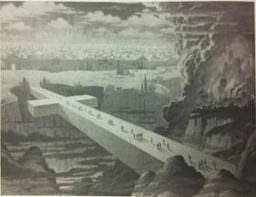
It seems to me that the central issue in this chapter is the misconception that heaven is “somewhere else”. This misguided and unbiblical perspective, according to Rob, is captured graphically in the picture that used to hang in his grandmother’s home. He says the painting tells a story:
So, the dominant question of this chapter is: what is the correct biblical story of heaven? This question then provides a corrective for the two additionally related questions: Where is heaven and what kind of person will get there?
There are a number of points of detail that could be dealt with in this post. As you might expect this is one of the more length chapters in the book. I will make some brief comments about a few things at the end, but am going to focus more attention in this post on Rob’s reading of the story of the “Rich Young Ruler”, which for all intents and purposes, is the center piece of the chapter.
 To correct this “mistaken notion” about heaven [I put this phrase in quotes because it’s a quote from Tom Wright’s Simply Christian—Tom’s been asserting for years and it is no doubt where Rob has gotten it--most comprehensively in Surprised by Hope], Rob turns to the gospel’s story of the “Rich Young Ruler” as told in Matthew 19:16-22 (see parallels in Mark 10:17-22 and Luke 18:18-23).
In the story, Rob finds the truth about heaven. When the young man asked Jesus the question, “What good thing must he do to have eternal life?”, he wasn’t asking about how he gets into heaven when he dies. According to Rob, neither this man nor Jesus ever thought about the future in terms of “going to heaven” when you die. Jesus did not come to make it possible for people to a heaven somewhere else.
To validate this contention, Rob springboards off the story of the Rich Young Ruler to teach a lesson on eschatological views (ideas of the end times) in first-century Judaism. He paints a unified picture of how Jews of Jesus’ day thought about the “end of the world”. Drawing on the Old Testament, Jesus’ Scriptures, Rob shows that ancient Jews thought of history in terms of two ages: the present (this) age and the age to come. He points out that the Greek word translated as “eternal” in the phrase “eternal life” (Matt 19:16) can mean more than one thing, but more significantly, he denies that the term can mean what we most often think it means: “forever” (see discussion below). Instead, Rob suggests that the first of these meanings is best captured with a term like “age”, which he defines as “a period of time with a beginning and ending” (32).
Rob’s point in all this discussion is to show more correctly what the young man was asking Jesus. He wasn’t asking to “go to heaven”; rather he was asking, “How do I participate in the New Age?” As Rob summarizes:
Most importantly, however Rob seems to miss the main point of Jesus response which quite rightly is the last word: “follow me” (19:20). It was not a summons simply to sell all he had and give to the poor. Jesus wasn’t primarily going after his “greed” as Rob thinks. Jesus called him ultimately to “follow”. Obedience is ultimate yes, but it’s also Jesus oriented. The man had to follow Jesus and was unwilling to do so, bottom line.
Nevertheless, I think Rob's comment is insightful and profound: “Jesus takes the man’s question about his life then and makes it about the kind of life he’s living now” (41). This is a significant insight. If you don’t follow Jesus now (this presupposes a lifestyle of ultimate obedience), you won’t be with him then. Heaven isn't simply about someday; its a present reality. Jesus does "blur the lines"; he does merge "heaven and earth".
Now very briefly a few more things:
1) The discussion of “eternal”, aionios, has serious problems. Rob wants to deny that the word aionios ever means what we think of “forever”. This is both right and wrong. It is true that ancient Jews would not have had the same notion of forever as we do, but to say that they could not have thought in terms of forever and that they did not use this word to denote that conception is flat out wrong. Also, there is no evidence to support Rob’s idea that aionios means “intense” (see pg 57). No lexicon of the Greek language supports such an understanding.
2) Rob seems to assume in his retelling of the story of the Rich Young Ruler that the man will participate in the eternal life no matter what. The only question is: Of what will his participation consist? As Rob poses the question “How do you make sure you’ll be part of the new thing God is doing? How do you best become the kind of person whom God could entrust with significant responsibility in the age to come?” (40). This is perhaps the assumption behind his erroneous idea that in heaven fire will purify you and make you fit to “handle heaven” (50). Rob wants to argue that Jesus didn't teach about “getting into" heaven or the age to come. Instead Jesus taught about being “transformed, so that we can actually handle heaven”.
I have to say it, this is just nonsense. Jesus, in point of fact, primarily taught on what Rob says he didn’t. Reflecting on the young man’s refusal Jesus even states, “only with difficult will a rich person enter the kingdom of heaven . . . it is easier for a camel to go through the eye of a needle than for a rich man to enter the kingdom of God” (19:23-24). They’ll be no flames in heaven making you fit for it. Jesus does not assume that the young man will be there. Jesus makes the distinction between following Jesus in the here and its reward and “inheriting eternal life”, which is simply another way of saying enter, in the here after (19:29). There is a difference between the two. And being in one does not mean you’ll be in the other. But how you live in the one will determine your presence in the other. You'll enter the other by how you live in the present.
3) The discussion of “treasure” and whether treasure is static or dynamic (43-47) is baffling to me. What is ironic is while arguing for a view of heaven rooted in a first-century Jewish mindset, the topic of “treasures in heaven” is untethered from any such rootedness. It seems that Jesus himself promised “static” rewards (19:28).
4) Definition of “heaven”:
Heaven is a complex biblical idea however. There is a heaven that is distinct from the earth. They are not the same place. Right now God is in heaven and at the time of his choosing he’ll turn the eschatological calendar sending Jesus to finish the work. Yet, in the meantime because of Jesus’ resurrection life and the gift of the Spirit in the church, heaven can be enacted in this time and in this place through the work of the church. Where the church steps, heaven’s footprint is left.
This finally brings us to the question of who is in heaven. First, it needs to be said that Jesus does call people to "enter heaven", although we need to define that term appropriately. The story of the Rich Young Ruler itself shows this. Second, the saints in both the Old and New Testament times are in heaven right now. When we die, if we have entrusted ourselves to Jesus [if we follow Jesus], we’ll be in heaven immediately. This however is not the last word and it might not have been what Jesus the the young man were discussing as Rob points out. Heaven will unite with a renewed earth and it’s this harmony that the Bible foresees as the final state, eternal life. Eternal life is both a quality of life (Rob’s point) and a quantity of life (forever).
For earlier posts for Love Wins see: Post When your wife . . ., 1, 2, 3.
If you like this post please share it with others.
It’s a story of movement, from one place to the next, from one realm to another, from death to life, with the cross as the bridge, the way, the hope . . . But the story also tells us something else, something really, really important, something significant about the location. According to the painting, all of this is happening somewhere else . . . I show you this painting because, as surreal as it is, the fundamental story it tells about heaven—that it is somewhere else—is the story that many people know to be the Christian story (23).Rob believes this story is an unbiblical story. And this unbiblical story has led to two errant consequences. First, because of the story of “heaven somewhere else”, questions related to heaven are generally otherworldly. For example, a question like “what will we do in heaven?” is characteristic of this kind of thinking. Second, the story creates an imbalanced emphasis on the question of who’s in heaven and who isn’t.
So, the dominant question of this chapter is: what is the correct biblical story of heaven? This question then provides a corrective for the two additionally related questions: Where is heaven and what kind of person will get there?
There are a number of points of detail that could be dealt with in this post. As you might expect this is one of the more length chapters in the book. I will make some brief comments about a few things at the end, but am going to focus more attention in this post on Rob’s reading of the story of the “Rich Young Ruler”, which for all intents and purposes, is the center piece of the chapter.
 To correct this “mistaken notion” about heaven [I put this phrase in quotes because it’s a quote from Tom Wright’s Simply Christian—Tom’s been asserting for years and it is no doubt where Rob has gotten it--most comprehensively in Surprised by Hope], Rob turns to the gospel’s story of the “Rich Young Ruler” as told in Matthew 19:16-22 (see parallels in Mark 10:17-22 and Luke 18:18-23).
In the story, Rob finds the truth about heaven. When the young man asked Jesus the question, “What good thing must he do to have eternal life?”, he wasn’t asking about how he gets into heaven when he dies. According to Rob, neither this man nor Jesus ever thought about the future in terms of “going to heaven” when you die. Jesus did not come to make it possible for people to a heaven somewhere else.
To validate this contention, Rob springboards off the story of the Rich Young Ruler to teach a lesson on eschatological views (ideas of the end times) in first-century Judaism. He paints a unified picture of how Jews of Jesus’ day thought about the “end of the world”. Drawing on the Old Testament, Jesus’ Scriptures, Rob shows that ancient Jews thought of history in terms of two ages: the present (this) age and the age to come. He points out that the Greek word translated as “eternal” in the phrase “eternal life” (Matt 19:16) can mean more than one thing, but more significantly, he denies that the term can mean what we most often think it means: “forever” (see discussion below). Instead, Rob suggests that the first of these meanings is best captured with a term like “age”, which he defines as “a period of time with a beginning and ending” (32).
Rob’s point in all this discussion is to show more correctly what the young man was asking Jesus. He wasn’t asking to “go to heaven”; rather he was asking, “How do I participate in the New Age?” As Rob summarizes:
They did not talk about a future life somewhere else, because they anticipated a coming day when the world would be restored, renewed, and redeemed and there would be peace on earth (40).For Rob the point is more a question of how the man participates in this new world God will bring about when he turns the eschatological calendar. Jesus’ answers the man in the way one would expect a Jewish rabbi would: “live the commandments”. “God has shown you how to live. Live that way” (40). The man responds that he does keep the Mosaic commands. As an aside, the man was not saying he was perfect, but that he was living a Torah-observant life within the Covenant God had established with Israel on Sinai. But as Jesus had already been teaching that this kind of obedience was not enough. Here I am alluding to the Sermon on the Mount (Matthew 5-7) where Jesus intensifies the Mosaic commandments as the Messianic Teacher of the Torah. The so-called “antithesis” in Matthew 5, where Jesus discussed the commands of the Mosaic Torah with “you’ve heard it said, but I say to you”, could be given the title “Yes and More”. The man then was likely right to ask the “what else must I do” question and it was probably stimulated by Jesus’ own teaching.
Most importantly, however Rob seems to miss the main point of Jesus response which quite rightly is the last word: “follow me” (19:20). It was not a summons simply to sell all he had and give to the poor. Jesus wasn’t primarily going after his “greed” as Rob thinks. Jesus called him ultimately to “follow”. Obedience is ultimate yes, but it’s also Jesus oriented. The man had to follow Jesus and was unwilling to do so, bottom line.
Nevertheless, I think Rob's comment is insightful and profound: “Jesus takes the man’s question about his life then and makes it about the kind of life he’s living now” (41). This is a significant insight. If you don’t follow Jesus now (this presupposes a lifestyle of ultimate obedience), you won’t be with him then. Heaven isn't simply about someday; its a present reality. Jesus does "blur the lines"; he does merge "heaven and earth".
Now very briefly a few more things:
1) The discussion of “eternal”, aionios, has serious problems. Rob wants to deny that the word aionios ever means what we think of “forever”. This is both right and wrong. It is true that ancient Jews would not have had the same notion of forever as we do, but to say that they could not have thought in terms of forever and that they did not use this word to denote that conception is flat out wrong. Also, there is no evidence to support Rob’s idea that aionios means “intense” (see pg 57). No lexicon of the Greek language supports such an understanding.
2) Rob seems to assume in his retelling of the story of the Rich Young Ruler that the man will participate in the eternal life no matter what. The only question is: Of what will his participation consist? As Rob poses the question “How do you make sure you’ll be part of the new thing God is doing? How do you best become the kind of person whom God could entrust with significant responsibility in the age to come?” (40). This is perhaps the assumption behind his erroneous idea that in heaven fire will purify you and make you fit to “handle heaven” (50). Rob wants to argue that Jesus didn't teach about “getting into" heaven or the age to come. Instead Jesus taught about being “transformed, so that we can actually handle heaven”.
I have to say it, this is just nonsense. Jesus, in point of fact, primarily taught on what Rob says he didn’t. Reflecting on the young man’s refusal Jesus even states, “only with difficult will a rich person enter the kingdom of heaven . . . it is easier for a camel to go through the eye of a needle than for a rich man to enter the kingdom of God” (19:23-24). They’ll be no flames in heaven making you fit for it. Jesus does not assume that the young man will be there. Jesus makes the distinction between following Jesus in the here and its reward and “inheriting eternal life”, which is simply another way of saying enter, in the here after (19:29). There is a difference between the two. And being in one does not mean you’ll be in the other. But how you live in the one will determine your presence in the other. You'll enter the other by how you live in the present.
3) The discussion of “treasure” and whether treasure is static or dynamic (43-47) is baffling to me. What is ironic is while arguing for a view of heaven rooted in a first-century Jewish mindset, the topic of “treasures in heaven” is untethered from any such rootedness. It seems that Jesus himself promised “static” rewards (19:28).
4) Definition of “heaven”:
Sometimes when Jesus used the word “heaven” he was simply referring to God, using the word as a substitute for the name of God. Second, sometimes when Jesus spoke of heaven, he was referring to the future coming together of heaven and earth in what he and his contemporaries called in the age to come. And then third—and this is where things get really interesting—when Jesus talked about heaven he was talking about our present eternal, intense, real experiences of joy, peace, and love in this life, this side of death and the age to come (58-59).Taking these points in turn. First, only Matthew has Jesus do such a thing; in other words in none of the other Gospels does Jesus replace “God” with the term “Heaven”. This may just have been Mathew’s preference and not much can be assumed than from this about Jesus’ usage. It is true that Matthew uses “heaven” this way. Second, while this is somewhat true. Ancient Jews and early Christians still maintained the distinction between heaven and earth. When saints died they went to heaven from where they will return with Jesus at the end of the age. Collapsing the distinction between heaven and earth to the extend Rob does is unbiblical. If Paul is right “to be absent from the body is to be present with the Lord” then there is a heaven somewhere else at least until the time of Jesus second coming. Jesus did pray that God’s will be done on earth as it is in heaven, but that has yet to occur. Third, this category of heaven is an illusion. Neither Jesus nor any biblical writer defines heaven this way.
*
So what is the final word on Love Wins and heaven? I think it is right to critique the story that the portrait tells with which the chapter opened. I don’t think the picture truthfully represents the biblical story of salvation because the story the picture tells is truncated. I'll say only here that God’s ultimate place for humans is a renewed earth. God is going to make all things new (Rev 21) and the New Jerusalem comes down out of heaven to earth. As I make this point, I am surprised that Rob didn’t discuss Revelation 21-22 in the chapter. It’s absence startling.Heaven is a complex biblical idea however. There is a heaven that is distinct from the earth. They are not the same place. Right now God is in heaven and at the time of his choosing he’ll turn the eschatological calendar sending Jesus to finish the work. Yet, in the meantime because of Jesus’ resurrection life and the gift of the Spirit in the church, heaven can be enacted in this time and in this place through the work of the church. Where the church steps, heaven’s footprint is left.
This finally brings us to the question of who is in heaven. First, it needs to be said that Jesus does call people to "enter heaven", although we need to define that term appropriately. The story of the Rich Young Ruler itself shows this. Second, the saints in both the Old and New Testament times are in heaven right now. When we die, if we have entrusted ourselves to Jesus [if we follow Jesus], we’ll be in heaven immediately. This however is not the last word and it might not have been what Jesus the the young man were discussing as Rob points out. Heaven will unite with a renewed earth and it’s this harmony that the Bible foresees as the final state, eternal life. Eternal life is both a quality of life (Rob’s point) and a quantity of life (forever).
For earlier posts for Love Wins see: Post When your wife . . ., 1, 2, 3.
If you like this post please share it with others.
Subscribe to:
Posts (Atom)