Thursday, July 29, 2010

Love Sechrest on Paul's Gospel and Race Relations

I just received a copy of Love L. Sechrest, A Former Jew: Paul and the Dialectics of Race (LNTS 410; London: Continuum, 2009), and this is what she says in her conclusion:

"Even as whites empty themselves of their privilege as an expression of interdependence and mutuality in Christ, the scandal of Paul's gospel would require that, for the sake of Christ, blacks embrace an identity that eschews a group-centered focus on social, economic, and political righteousness to a body-of-Christ-centered focus on these and other issues. Specifically, it means that Christian blacks would foreswear 'nation building' in the church as a substitute for kingdom building in the world, nation building that exchanges the gospel for the American dream. In other words, living life as if race were a matter of theology instead of skin colour means that both whites and blacks would have to live life as blood traitors, who each consider the needs of the other over their own, and the needs of Christian kinfolk above all others - no matter what their skin color. White-born and black-born Gentile Christians could only manage such selfless feats of imagination through humble acceptance of the facts of identity mentioned above. Christians no longer favor bonds of allegiance to their birth identity (Phil. 3.3-9; 1 Cor. 12.2); they are ever-conscious that they all are Gentiles who have adopted an alien history and have been transformed into an alien race (Gal. 3.26-29); and they know and live in the transformed reality that is created by God's grace and mercy (Rom. 11.17-24)."

Wednesday, July 28, 2010

Justification by Faith and Racism

I have a guest post over at the Institute on Justification by Faith and Racism.

See my earlier post about some issues on racism and the PCA also raised at the Institute blog.

Tuesday, July 27, 2010

First and Second Things

I came across this C. S. Lewis quote today and found it quintessentially Lewis in its fresh insightfulness.
The woman who makes a dog the centre of her life loses, in the end, not only her human usefulness and dignity but even the proper pleasure of dog-keeping. The man who makes alcohol his chief good loses not only his job but his palate and all power of enjoying the earlier (and only pleasurable) levels of intoxication. It is a glorious thing to feel for a moment or two that the whole meaning of the universe is summed up in one woman--glorious so long as other duties and pleasures keep tearing you away from her. But clear the decks and so arrange your life (it sometimes feasible) that you will have nothing to do but contemplate her, and what happens? Of course this law has been discovered before, but it will stand re-discovery. It may be stated as follows: every preference of a small good to a great, or partial good to a total good, involves the loss of the small or partial good for which the sacrifice is made (Readings for Meditation and Reflection, pgs. 14-15).

I especially find the line about the "earlier levels" of intoxication amusing and his analogies so apt.


Monday, July 26, 2010

Daniel Kirk on the Authorship of the Pastoral Epistles

Over at Storied Theology, Daniel Kirk posts some thoughts on authorship of the Pastoral Epistles. The best discussion on that topic around was the exchange between Stan Porter and Robert Wall in BBR back in 1997.

Sunday, July 25, 2010

Vincent Smiles on the gospel in Galatians

Vincent Smiles writes:

In Galatians the gospel is the invasive and invincible power of God, which is presently at work in the world to complete God's plan of salvation. It is God's "call" (Gal 1:6, 15; 5:7), to which Paul and every human authority or sacred tradition are subject. The gospel is for the whole world, and its subject all humans to itself on the same terms. That is why the negative judgment on law, as on all human wisdom and philosophy (cf. 1 Cor 1:20-25), also lies at the heart of the gospel, particularly in the context of Galatians. This negative edge to the gospel is an aspect of the gospel as grace, for it is only when humanity is revealed in its utter nakedness before God that God's grace can truly be known as grace. The gospel, so to speak, clears the ground for itself; it sheds the light that simultaneously exposes and dispels the darkness of the human condition. It is the gospel, which is simultaneously judgment and grace, that enables Paul so freely to interpret the law and so radically set it aside.

Vincent M. Smiles, The Gospel and the Law in Galatia: Paul's Response to Jewish-Christian Separatism and the Threat of Galatian Apostasy (Collegeville, MN: Liturgical, 1998), 28.

Go to the Library

Dear Crossway College students, watch this clip. It explains why you should go to the library:


Saturday, July 24, 2010

Software Review: Logos 4

I'm a big lover of Bible Software, indeed I am dependent upon it. I've already done a length review of BibleWorks and Joel has done a thorough review of Accordance. But now it's time to complete the trifecta and do a review Logos 4 Platinum Edition. I trialed using Logos 4 for some lecture prep on "Doctrine of God", sermon prep on 1 Corinthians, and some research on 1 Esdras.

The first big thing I should say about Logos 4 (platinum) is what you get in the library. There are some gems here:

  • Transcriptions of MSS: Phil Comfort & David Barrett, The Text of the Earliest Greek Manuscripts - including P46, 66, 52.
  • Editions of the Gk NT including: NA26, UBS4, Tischendorf and Westcott & Hort.
  • Translation of the DSS (Martini) and transcriptions of the Cairo Geniza Targumic Fragments.
  • Aramaic Papyri: A. Cowley
  • B. Metzger, Textual Commentary on the Greek New Testament
  • K. Aland, Synopsis of the Four Gospels
  • Lexical Resources: BDAG, EDNT, TDNT, and Louw-Nida.
  • Church History: Ante-Nicene, Nicene, and Post-Nicene Fathers.
  • Apostolic Fathers: editions by Michael Holmes and K. Lake.
  • Apocrypha and Pseudepigrapha: editions by R.H. Charles
  • Texts: editions of LXX, Peshitta, Vulgate
  • E. Tov's interlinear Hebrew and Greek of the LXX
  • Reference works: Eerdmans Bible Dictionary, Harper Bible Dictionary, Eerdmans Dictionary of the Bible, Oxford Dictionary of the Christian Church, The Encyclopedia of Christianity (4 vols.), The Context of Scripture (3 vols.).
  • A selection of Paternoster Biblical Monographs.
  • Full commentary series:BECNT, NIGTC, NAC, Pillar NTC.
  • Philo and Jospehus - in English but only Philo is available in Greek.
  • I should also add that there is an array of resources available on their pre-pub site that has some classics, out of print resources, new books, commentaries, and monographs.

Even better the entire library is searchable.

Second, I like the Logos interface (though it took some getting used to). I really liked the idea of typing in a biblical reference like "Revelation 22" and then being only one click away from the commentaries by Beale (NIGTC) and Osborne (BECNT) that cover those verses. Also instantaneously available are pre-written handouts, list of OT quotations in the NT, media resources, and link to sermon audios!

Third, the exegetical guide (that's a tab in Logos) includes instantaneous links to the apparatuses of critical editions, grammars, lexical info, interlinears, and more. Quite a sweet suite!

Fourth, the right-click on Greek words opens a whole host of available info including various forms, semantic domains, occurrences of the word in the NT, etc.

I found that Logos is well suited to those engaging in academic study, esp. given the sheer mass of resources in its library. But it is perhaps best suited to those doing serious Bible study, sermon prep, or preparing lessons for ministry, more so if they already have a divinity degree and need some resources and tips to help them get back into the grove of serious Bible study without a a prof to prod them along. If I had to make additions to Logos 4 it would be English and Greek editions of the NT Apocrypha, Lampe's Patristic Lexicon, and texts from Migne (though some are available for individual purchase at the pre-pub site).

J.I. Packer on Justification

Justin Taylor quotes a famous short dictionary article by J.I. Packer on justification:

“[God] reckons righteousness to them, not because he accounts them to have kept his law personally (which would be a false judgment), but because he accounts them to be united to one who kept it representatively (and that is a true judgment)”

—J. I. Packer, “Justification,” in Evangelical Dictionary of Theology, ed. Walter A. Elwell [Grand Rapids, MI: Baker, 1984], p. 596.


If you buy into the concept of "union" and "representation," then the notion of justification as resting on the imputed merit of Jesus Christ starts to fall apart.

Paul's Rule - David Rudolph

A year ago I published a short piece in the Evangelical Covenant denominational magazine Covenant Companion titled "Weighing the Words of Paul". There I highlighted the one rule Paul says he lays down in all his churches. The rule is found explicitly, although not exclusively, in 1 Cor 7:17-21:
Each of you should continue to live in whatever situation the Lord has placed you, and remain as you were when God first called you. This is my rule for all the churches.
My good friend and professor at the Messianic Jewish Theological Institute has written a significant scholarly piece on Paul's rule that has been recently published electronically in the Journal of the Studies in Christian-Jewish Relations titled "Paul's 'Rule in All the Churches' (1 Cor 7:17-24) and Torah-Defined Ecclesiological Variegation".
I encourage you to read this importnat essay.

The "New Atheists" and the Dawkins Delusion

The Dawkins Delusion?: Atheist Fundamentalism and the Denial of the Divine (Veritas Books)This past spring (Apr 11) the Chicago Tribune published an interesting (albeit troubling?) article in the called "Young and Atheist". The article was a multi-page story about the Atheists, Agnostics and Free Thinkers (AAFT) group at Northern Illinios University.

NIU is the primary target of our college ministry at Christ Community Church the university where I am college pastor. It is a university embedded in mid-western farmland with over 18, 000 undergrads plus another few thousand grads and post-grad students. The AAFT group only boasts of meetings of around 10-25 people according to the article, but it is significant that they are getting the attention of a major newspaper like the Tribune. One may be justified in thinking that the Tribune had something of an agenda in devoting so much print to a rather insignificant story. There could very well be an interest in doing more than reporting culture here. This skepticism notwithstanding, the story does raise the issue of Atheism on campuses in the US and I imagine this would true also in universities around the Western world.

The story's primary point is that atheism is on the rise among the young and educated and these are a different breed of atheist than those of a former generation. Far from being belligerent, these atheists are "kinder, gentler religious skeptics". According to the story these young atheists are more interested in joining forces with their theistic neighbors to do humanitarian work than to engage in a debate.

Truth be told, I am no apologist and I avoid debates like the plague. So I’m glad that the new atheists are not generally interested in arguments. Still, the Tribune story points to the fact that books like the God Delusion by Richard Dawkins have emboldened young skeptics to “come out” of the closet so to speak. Now I have not read Dawkins’ book, but I have read Alister and Joanna McGrath’s response to the God Delusion published this year by InterVarsity, The Dawkins Delusion? The main take away for me from this very brief book was that to many, even those who are atheists, Dawkins has written a polemical book that is both thin on evidence and shaky in its scholarly integrity. While I don’t suppose a person fond of Dawkins’ book will wish to read the McGraths, I think it is a useful read for those of us who are uninitiated in these topics.

The most disturbing point raised by the article in the Tribune was the story of a young woman whose faith in the Christian God was shaken by the “non-fiction aspects of the novels ‘The Da Vinci Code’ and ‘Angles [sic] & Demons’" and by “her Internet research into world religions”. The fact that emerging adults are allowing these things to be the primary influence for their views of the Christian God is horrifying.  We as the church need to do a much greater job of communicating and providing a relevant alternative to this strong cultural propaganda.

Wednesday, July 21, 2010

The Incident at Antioch and the Making of Paulinism

Here's a segment from the conclusion of my "Antioch" article:

In the incident at Antioch we confront the first public expression of Paulinism understood as the antithesis between Christ and Torah. This paradigmatic shift from Torah to Christ as the locus of God’s saving actions was impregnated in Paul’s Damascus road experience, publicly debuted in Antioch, unleashed with the fury of a scorned woman in Galatia, clinically applied in 2 Corinthians 3, given its mature and prudent form in Romans, and eventually lent itself towards the genesis of two competing theologies of proto-orthodoxy and Marcionism in the second century that both claimed ancestry from Paul. This Paulinism is aptly captured by Martin Hengel:

For him, the encounter with the Resurrected One near Damascus set before him the question of the law or Christ in the form of a soteriological alternative. For Judaism of that time the Torah was in manifold expression the essence of salvation, and could be identified with the fundamental religious metaphor, “life”. Since the opposition between Torah and Jesus of Nazareth had made him into a persecutor, now the relationship between Christ and Torah had to become a fundamental issue, in which the inversion of the opposition immediately because apparent: he, the Resurrected One is zwh& for those who believe (2 Cor 4:11-12; cf. 2:16).[1]

While I demur from Hengel’s treatment of the incident at Antioch for the reasons given above, I remain convinced that Hengel has tapped into the nerve of Paul’s thought and demonstrated the radical stance of Paul and the Torah that made him the controversial figure that he was. Yet this Christ-Torah antithesis needs some qualifications as I suspect that it does not mean what many Protestant commentators think it means. It does not mean that Jewish Christians should cease observing the law, nor does it mean that the Torah has nothing binding on the ethical life of Gentile Christians. Rather, the advent of Christ means that his death and resurrection has effected the end of ages and broken the link between law, sin, and death. Christ turns the condemnation of the law into justification. Christ made the curse of the law into redemption. Faith in Christ is the testimony of the law and yet faith in Christ places believers beyond the jurisdiction of the law. Christ terminates the Mosaic dispensation in order to fulfil the Abrahamic hopes. Christ serves the circumcision by making Gentiles heirs of the Patriarchs.


[1] Martin Hengel, “The Stance of the Apostle Paul Toward the Law in the Unknown Years Between Damascus and Antioch,” in Justification and Variegated Nomism: Volumes 2 – The Paradoxes of Paul, eds. D.A. Carson, P.T. O’Brien, and M.A. Seifrid (Grand Rapids, MI: Baker, 2004), 84.

Saturday, July 17, 2010

Fake Reviews by Historian

BBC News reports how a leading historian who wrote anonymous reviews on the Amazon website praising his own work and criticising rivals is to pay libel damages and costs. I wonder how this could affect reviews in biblioblogdom, especially anonymous reviews of books.

Friday, July 16, 2010

Film+Theology - An Education

Orientation to the film
One reviewer calls An Education a “beguiling little film that, with deceptive restraint and forthrightness, opens up worlds of roiling [disturbing], contradictory emotions” (Ann Hornaday, Washington Post). The “near perfect cinematic experience”, An Education, is a 2009 independent British coming of age drama film.

The film was directed by Danish born director Lone Scherfig who has only directed one other English-language film: the comedic drama Wilbur Wants to Kill Himself (2002) shot in Scotland. She co-wrote and directed the film.

British born Nick Hornby who has written novels and adapted them for the screen wrote the screenplay for An Education. To his credit are the films High Fidelity, About a Boy and Fever Pitch. Fever Pitch incidentally was in its prior form a story about an Englishman’s obsession with the Arsenal Football Club in London. It was later adapted in the US and Jimmy Fallon played an obsessive Red Sox fan.

In this case, Horby didn’t write the story however. It was adapted from Lynn Barber’s memoir of the same name. Barber is a journalist in London and published a ten-page memoir in the literary magazine Granta in the spring of 2003 about her two-year relationship as a 16-year Oxford University bound old school girl with a thirtysomething con-man named “Simon”.

Hornby’s screenplay is to a considerable degree true to the original memoir. The film is the product of a close collaboration between Scherfig and Hornby. In an interview Scherfig admits to “touching [the screenplay] less than I ever have anything I've worked with”. And she remarks about her role as director of this film:

[I]t was about being loyal and trusting that the story would be strong enough to carry a film. If you don't do that or think that way, you probably shouldn't direct something like this. Nick is extremely orderly. There are no set-ups that don't have payoffs; everything is there for a reason, or if it's not, it's really entertaining. That's quite a good reason, too. So it's not that I just didn't want to fix things. It's also because I didn't really feel I had a right to or reason to.

The story is set in the pre-Beatles era of the early 1960’s (1961 to be exact) in the sleepy London suburb of Twickenham. Jenny Millar (played by Carey Mulligan) is a 16-year-old student preparing for University in England’s version of a prep school. She is obsessed with things French and dreams of a sophisticated life beyond the overbearing protection of her father Jack (played by Alfred Molina) whose equally obsessed with his daughter learning Latin and getting into Oxford.

One rainy day, while walking home with her cello, Jenny meets David Goldman (Peter Saargard). Her life is never the same. David introduces her to the sophisticated life she dreamed of and even after realizing his money comes by way of shady business she willingly continues to enjoy the life that he offers her.

Without giving more away, she gains an education in life that ultimately compliments her bookish education.

Here’s what Lynn Barber wrote of her experience on which the film is based:

What did I get from Simon? An Education – the thing my parents always wanted me to have. I learned a lot in my two years with Simon. I learned about expensive restaurants and luxury hotels and foreign travel, I learned about antiques and Bergman films and classical music. All this was useful when I went to Oxford – I could read a menu, I could recognize a fingerbowl, I could follow an opera. I was not a complete hick. But actually there was a much bigger bonus than that. My experience with Simon entirely cured my craving for sophistication. By the time I got to Oxford, I wanted nothing more than to meet kind, decent, straightforward boys my own age, no matter if they were gauche or virgins. I would marry one eventually and stay married all my life and for that, I suppose, I have Simon to thank.

Spiritual themes
Life Education. The film asserts that to truly learn, one must experience things personally. There are lessons that books just can’t teach you and these lessons are the most important ones. Jenny signs up willingly for the seminar in real life David offers her. She willingly embraces the curriculum of art galleries, the opera, night clubs, race tracks and international travel. What could be (perhaps should be) a stomach curling story of a sexual predator is turned into a story of a coming of age by the very able screen writer and director. And all of this is supported by Jenny’s parents and particularly her father who is, in the end, less determined that she go to Oxford than he is that she (and he) achieve an upgrade in social class.

So as you watch the film think about the education Jenny receives through her relationship with David. How does the perspective of personal experience jive with the biblical worldview?

Sexual revolution of the 1960’s. The film asserts that the radical societal changes of the 1960’s (often referred to as the “Sexual Revolution”) had positive elements and, all in all, made a positive contribution to the maturing western world. The most significant element of the changes, as illustrated in the film, was the dramatic shift away from traditional values. This change affected sexuality and sexual behavior, birthed feminism and women’s rights and was the cultural condition for the passage of the civil rights legislation.

The sexual revolution made personal freedom and the quest to find “one’s self” outside of what had been traditionally elements of adult identity—academic education, marriage and family—an obsession.

Jenny’s coming of age story is a symbol for the coming of age of the culture. The message is essentially: “Ok there were some excesses and not all aspects of it were positive, but generally we are better off having lived through it.”

To many, the sexual revolution of the 60’s paved the way for the progress of the 80’s, 90’s, 00’s and beyond.

As you watch the very stylized presentation of the era, think about what contributions the societal changes made both positively and negatively.

The seduction of sophistication. One of the memorable lines in the film is Jenny’s comment that she wants to spend time with “People who know lots about lots”. This line and the story touches on a mystery of adolescence. In the quest for autonomy and the desire to have the trappings of adulthood, one of adolescence’s strongest impulses is sophistication.

As the film shows, there is something seductive about the freedom of adulthood. This sophistication is often expressed as the fantasy of relationship with older people.

As you watch the film thing about why sophistication is so seductive. What does a biblical worldview offer by way of critique of this fantasy?

“Action is character”. The film asserts at one point explicitly and throughout implicitly that what is important is not one’s words but one’s actions when it comes to knowing who a person really is.

The negative consequences (or lack of) from our past mistakes. The film presents Jenny’s exploits with David having certain consequences. Some of these are even seen as positive. However, in the end she is not all that worst for ware as she achieves her dream of going to Oxford after all. What’s more, she’s all she more mature with a wide breadth of life experience.

Barber herself however noted the negative consequences of her experience when she wrote:

But there were other lessons Simon taught me that I regret learning. I learned not to trust people; I learned not to believe what they say but watch what they do; I learned to suspect that anyone and everyone is capable of “living a lie”. I came to believe that other people – even when you think you know them well – are ultimately unknowable. Learning all this was a good basis for my subsequent career as an interviewer, but not, I think, for life. It made me too wary, too cautious, too ungiving. I was damaged by my education.

About this lack of real consequences, one reviewer commented,

In the film’s historical view Jenny is a generational pioneer, and Ms. Scherfig and Mr. Hornby make some effort to reckon the costs of her exploration as well as the thrills. Tears do flow after the Champagne is all drunk. But the filmmakers themselves seem too intoxicated by the mystique of the period to take full account of the sad, bleak aspects of the story they have to tell. At crucial moments the movie recoils from its own implications and finds a default tone of wry comedy when something more stringent and difficult is called for . . . It’s a pleasure—which I don’t mean as a compliment (A. O. Scott, NY Times).

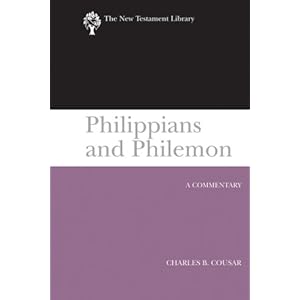
Book Notice: Philippians & Philemon by Charles Cousar

Charles B. Cousar
Philippians and Philemon: A Commentary
NTL; Louisville, KY: Westminster John Knox, 2009.
Available from Amazon.com in the USA and Alban Books in the UK.

Charles Cousar has done several works on Paul including an introduction to Paul's letters, Paul's theology of the cross, and a commentary on Galatians. This volume is a very brief but readable commentary on Philippians and Philemon that situates them both in the context of Paul's Ephesian ministry in the mid-50s.

In the introduction, Cousar is uneasy about the purported compilation theories where Philippians is made up of several letters that have been synthetically compiled into one. He thinks, with M.D. Hooker, that it easier to attribute the sudden changes in the letter to Paul himself than to an editor. On the place and date of writing, I was pleasantly surprised and glad to see that Cousar assigns it an Ephesian provenance. He is correct in that it is hard to reconcile Paul's view in Romans that he has no further work left to do in the eastern regions (Rom. 15.22-29) and hold to Paul's intent to visit Philippi after his release from imprisonment Rome (Phil. 2.24). That would mean dating Philippians 52-55 AD. Cousar believes that the primary purposes of Philippians are (1) to report on his situation in captivity to relieve the anxiety of the Philippians; (2) express gratitude for their recent gift through Epaphroditus; (3) to commend Epaphroditus to them; and (4) to encourage them to remain united in the face of opposition. On the Christ Hymn, Cousar rightly regards its purpose as an ethical exhortation to humility. He rejects a strictly Adamic reading of the hymn where Christ is another Adam who does not seek equality with God, but humbles himself as the true bearer of God's image. Cousar notes that morphe is not strictly synonymous for eikon and what Jesus grasped after seems to be something that he already had, but did not exploit, rather than something that he grasped after. He regards the passage as allowing for a "traditional reading of the preexistence of Christ". Cousar also regards Paul's boast in Phil. 3.4-6 as including his inherited credentials and achieved credentials. The soteric imagery indicates that "Being incorporated into Christ" is the vantage point from which he now sees himself. I also agree with Cousar that dia pisteos Christou can serve as a shorthand for the obedient self-surrender of Jesus. On Philemon, Cousar also assigns it to Ephesus in the mid-50s. I concur with Cousar's reconstruction of the situation that Philemon is not a runaway slave, but is an estranged slave seeking the help of his master's friend to be reconciled.

I have to say that this volume is rather terse compared to other volumes in the NTL series. It is only 106 pages long and the Philemon commentary is only five and a half pages! Though I have to say that it is an easy read, gives opinions on all the disputed matters in a concise way, and I agree with nearly all of Cousar's opinions on the critical issues. So despite its brevity, it does have some value. But there is no escaping the fact that it looks like this volume is out of place in the NTL series esp. when compared to the far more thorough volume on Colossians by Jerry Sumney. I still prefer the Philippians commentaries by Bockmuehl, O'Brien, Fee, and Hooker, but this one will sit nicely on the shelf.

American Journal of Theology

The latest issue of the American Journal of Theology is out with several interesting article. Aussie will be interested in a review of Paul Barnett's Jesus and the Logic of History by one of my doctoral students David Wenkel.

Thursday, July 15, 2010

Christ-exalting, Self-forgetful, Shamelessness

I had the privlege of preaching at Calvary Memorial Church in Oak Park, IL this past weekend. I preached on Matthew 15:21-28, the story Jesus and the Canaanite Woman. The sermon is available to download. It's title is Christ-exalting, Self-forgetful, Shamelessness.

Wednesday, July 14, 2010

Peter Tomson on Gal. 2.11-14

The two most persuasive cases that I've read on Gal. 2.11-14 are by Mark Nanos and Peter Tomson. Note these quotes from Tomson (pp. 222-30):

"The agreement involved mutual trust and respect: neither party would interfere with the commission of the other. Paul could expect the others not to intervene in his 'Law-free gospel' for gentiles, just as James and Peter could count on his non-involvement with their Law-abiding gospel to the Jews. This conclusion is utterly important: Paul implies here that his 'Law-free gospel' for Galatian gentiles was founded on his respect for Law-observance by Jewish Christians. All would be well as long as two separate domains remained. Problems might arise where they overlapped, or in other words, where Jews and gentiles were living and eating together, as at Antioch. Thus the question was: can Jews and gentiles eat together without endangering either the Law-observance of the former or the freedom from the Law of the latter? James' representatives apparently thought they could not, but Paul and Barnabas, as well as other Antioch Jews and Peter, thought they could. According to Gal 2:11-13 the majority of Jews of Antioch, as Peter and Barnabas and also Paul, thought it possible for Jews and gentiles to eat together without transgressing the Jewish Law."

"The conclusion is that here Paul does not urge Peter to join him again in a non-Jewish way of life. On the contrary: he urges for a Jewish life which does not force gentiles to judaize, in line with the agreement."

"If Paul really would have violated the food laws and induced others to do so in the presence of Barnabas, Peter and the Antioch Jews, he would have made the agreement [Gal. 2.1-10] null and void and his apostolate impossible."

Things to Click

Around the blogosphere:

At RBL, William Arnal reviews James Crossley's book Jesus in an Age of Terror.

Larry Hurtado announces the Centre for the Study of Christian Origins now has its own blog.

Michael Gorman reviews James Dunn's Christianity in the Making at the journal Interpretation.

Mike Koke talks about Gospel Communities and reflects on Bauckham's thesis.

Jim Allman continues his interesting series about the Lord's Supper.

Tuesday, July 13, 2010

Tom Wright in the House of Bishops

Tom Wright gives an amusing spiel about safeguarding dissenters in the COE's recent decision to go ahead with women bishops.


HT: Rachel Marszalek

Thursday, July 08, 2010

Protest at Appointment of N.T. Wright to St. Andrews

The Scottish Sun and the Scotsman both report a Glaswegian Episcopal Priest protesting the appointment of Bishop N.T. Wright to a Professorship at St. Andrews University for his opposition to gay ordination (HT: James Crossley).

There are two ironies here:

(1) In the USA Tom Wright is regarded in some circles as the greatest threat to orthodoxy since Marcion, yet in the UK he's chastised as a traditionalist and no one gives a flying donut roll about his views of Paul.

(2) The liberal left is, well, not really liberal (i.e. generous). They talk and cry about "inclusiveness", "diversity", and "tolerance" which is their gospel, and yet they are not willing to include those who have a different vision of human sexuality, ethics, and religion than they do! And yet they have the gall to call evangelical Christians hypocrites.