Showing posts with label Theology. Show all posts

Saturday, June 19, 2010

Film + Theology - 2012

Last night we launched a new event with our college ministry CRAVE. Inspired by Mars Hill Church's Cinemagogue, we started our own version of Film and Theology.

Film + Theology: What are we doing here?
Since this is officially our first Film + Theology event I want to take a few minutes at the beginning to answer the question: What is Film + Theology? What are we doing here? Film and Theology is a forum where we can (1) appreciate and enjoy the artistic impulse God has given to humans as expressed in film; and (2) critically engage culture. Here at Christ Community Church we believe that humanity is created in the image of God. God’s image in humans is multifaceted, but one particular aspect of it is our creative impulse. God has given humanity the ability to be artistic and create and tell stories. Film and story telling in our view should be enjoyed and celebrated as a gift.

Today, however, there is no more powerful vehicle for cultural propaganda than the movie theater. Films present ideas in the form of stories or worldviews. I heard some say recently that today’s local multiplexes are modern day pulpits where thousands flock weekly and let film directors and screen writers influence the way they think, feel and live. Films are one way modern culture artistically expresses itself. But films also shape culture. Films should be enjoyed then, but they should also be thoughtfully consumed. 

Film and Theology seeks to provide a space in which to engage the cultural messages that films communicate and put them into dialogue with a Gospel-centric Christian worldview.

2012 – Orientation to the movie
2012 was co-written and directed by German-born filmmaker Roland Emmerich. Emmerich has distinguished himself as a premier filmmaker in the disaster genre with movies such as Independence Day (1996), Godzilla (1998) and The Day After Tomorrow (2004) to his credit. Emmerich’s films have grossed more than $3 billion worldwide making him the country’s 14th highest grossing director of all time. Emmerich has the reputation of being one of “the few directors capable of consistently making critically-derided movies that nonetheless [make] enormous amounts of money”.

His film 2012 is no different. While critics of the film were generally negative (apparently only 40% gave a positive review according to Rotten Tomatoes), its first weekend at the box office earned a total of $290 million worldwide and ultimately grossed nearly $768 million making it the 5th-highest grossing film in 2009. Some film critics as expected lambast it, while others—the likes of Roger Ebert, called it the “mother of all disaster movies” concluding that the movie “gives you your money’s worth” and asserting that the movie is “as good as a disaster movie can be”. In other words, if you like disaster movies, you’ll love this one. What these box office receipts say is that Emmerich’s movie 2012 was consumed by a worldwide audience no matter what the critics said. This film is representative of the power of a movie in that (1) it reaches the many and not just the few, and (2) it is revolutionary in that it invades diverse cultures creating a common.

2012 – Spiritual themes
2012 is a popcorn film and although the film has significant weaknesses at the level of script and plot it does raise several interesting spiritual themes.

You may assume that the primary theme of the movie is the end of the world. The title of the film leads to the belief that the central idea of the movie relates to the Mayan myth of the world coming to an end in 2012. This myth has been made popular in recent years when it was noted that the Mayan calendar only has 5,125 years with the last year ending on 12/12/2012. However this is in fact a mistaken notion. As Emmerich himself explains in an interview, the Mayan element came after the initial seed idea for the movie was being developed. For the movie the contribution of the Mayan myth is simply that the “fact that the Mayan calendar ends”. “This gave us the year”, Emmerich says. The Mayan myth provided the day that the global flood was to take place. On that day, as well see in the film, a solar storm leads to changes in the Earth’s core with the result that the earth’s crust is displaced creating super-tsunamis that flood the earth. So what was the seed-idea for the movie? The film’s seed-idea actually was a “global flood”, a “modern retelling” of the Noah’s ark story. “We came up with this idea that maybe a global flood would be a great movie because we could do a retelling of Noah’s Ark in a modern way”. In Emmerich’s words, “the whole third act is more a different kind of movie [than a disaster movie]. It’s about who will survive in the arks”. In fact, for Emmerich the movie is “about” decisions about who is gets on the arks and who gets left behind.

At its simplest, 2012’s story is about people who know the world is coming to an end by a global flood and people who do not. The people who know secretly build ships they call “arks”. So Emmerich’s “Noah” is a US led coalition of countries who secretly build ships and don’t tell anyone. The governments realize that the disaster is coming much sooner than they had anticipated and it becomes a race to get to the ships which were constructed in Tibet in the Himalayas.

When the catastrophe begins worldwide disaster is experienced illustrated onscreen by the destruction of recognizable landmarks with a notable emphasis on the demolition of Christian-Catholic sites. One Catholic reviewer pointed out that while the Sistine Chapel, St. Peter’s basilica and Rio de Janerio’s Christ the Redeemer statue are destroyed, Kaaba in Mecca, Islam’s most sacred site isn’t, at least on screen. He wryly commented, “because, you know Christians, don’t do fatwas”.

In Emmerich’s flood story, interestingly, God is absent. If there is a god figure in the film it is science or better nature. Emmerich attempts to strip humanity down to the point where faith makes little-to-no difference. He says, “Yes, it’s good to be spiritual, but praying in the face of disaster will not stop the disaster. Fate, luck and coincidence might help you survive, but not prayer”. “When you destroy the Vatican or the Jesus in Rio, you tell people, even God can’t help you”. For Emmerich the film becomes a question of morality, what is right and wrong, absent of God: “It comes down to what should people do in a situation like that, what is morally right to do”.

Within this large frame there are characters typical of the disaster drama. For example John Cusack’s character, Jackson Curtis, is the cliché of the average guy; he’s a deadbeat divorced father of two. In addition to being less than successful at family life, Curtis is a fledging science-fiction writer whose writing career is at bottom when we first meet him on screen. Through the disaster, however, Curtis finds redemption through heroic acts. Courageously he sets out on a perilous journey to get his family to the arks and in the end finding his marriage and family relationships are restored.

Another character is the eccentric Charlie Frost (played by Woody Harrelson) a radio talk show host-cum-apocalyptic preacher (a John the Baptist type) who lives in his Winnebago in Yellowstone National Park awaiting the end of the world. He promulgates over the airwaves a conspiracy theory that few if any believe. It seems, however, ironically he is the only other person beside the government that knows what’s going on. 

While this kind of movie does not reward careful character analysis, it does raise several spiritual themes worth engaging. I suggest that following as representative.

1. End of the world - What should a Christian’s response be to doomsday predictions? And what is the appeal of disaster films? Why are they so wildly popular worldwide in spite of the severe criticism by reviewers?

2. Faith in the midst and in the face of disaster - What can faith do in the midst of and in the face of disaster?

3. Morality absent of God - What is morality without God? On what bases did the characters in the film determine right and wrong absent of God?

4. Global flood - How do the global floods of the Bible (Gen 6—9) and 2012 compare?

Tuesday, March 31, 2009

More New Blogs from Australia on Science and Theology

I have come across yet another Aussie blogger who is into all things Science, Philosophy, and Theology, and the engagement between the three. Roger Morris, who a medical doctor on the Sunshine Coast (I've been there and believe me it is appropriately named!), has started a blog called, Faithinterface.com which he introduces as: "The purpose of this blog is completely selfish - to allow me to bang on about my great love, the interface between science, philosophy and Christian theology. But it is also an opportunity to engage in discussions about these matters with others of all worldviews within the blogosphere. "

Monday, March 30, 2009

New Blog on Theology, Science, and Culture

Ross McKenzie is one of the world's leading quantum physicists and he's also a Christian and an Australian (and let's face it, it doesn't get much better than that!). Anyways, he has a blog called: Solio Deo Gloria: Thoughts on Theology, Science, and Culture which is worth checking out. He is also associated with the Faraday Institute for Science and Religion.

Monday, January 05, 2009

Augustine, Calvin, and Barth

Augustine, Calvin and Barth find themselves waiting outside the throne room on the Day of Judgement.

Augustine goes in first, and after half an hour comes out and says to the others: 'It was wonderful! I had all the mysteries of sin, grace and salvation explained to me!'

Next, Calvin goes in, comes out an hour later and says to the others: 'It was wonderful! I had all the mysteries of election, predestination and divine sovereignty explained to me!'

Finally, Barth goes in. After two hours, God comes out and says to the others: 'I've still got no idea what he is talking about!'

Thanks to my colleague Jamie Grant for that one!

Thursday, December 18, 2008

Gifford Lectures 2009 - Alister McGrath

The prestigious Gifford Lectures, which are held at the four ancient Scottish universities of Edinburgh, Glasgow, St. Andrews and Aberdeen, were established under the will of Adam Lord Gifford (1820-1887), a Senator of the College of Justice in Scotland. His bequest allows the University to invite notable scholars to deliver public lectures on natural theology. Since the first lecture in 1888, Gifford Lecturers have been recognized as pre-eminent thinkers in their respective fields. Among the many gifted lecturers are Hannah Arendt, Niels Bohr, Etienne Gilson, Werner Heisenberg, William James, Max Mueller, Iris Murdoch, Reinhold Niebuhr, Albert Schweitzer and Alfred North Whitehead.

The 2009 Giffords will be delivered by Alister McGrath, Professor of Theology, Religion and Education at King's College, London. Professor McGrath's series is entitled A Fine-Tuned Universe: Science, Theology and the Quest for Meaning and will look at some of the deepest questions of life in a stimulating and controversial way.

All six lectures will take place in King's College in Aberdeen Centre at 6pm on the following dates: 10th, 12th, 17th, 19th, 24th & 26th of February. For further details on the lecture series and Professor McGrath himself, please go to www.abdn.ac.uk/gifford and http://www.abdn.ac.uk/gifford.

Saturday, May 24, 2008

Theology in Alexandria

In reading over the Moore College news letter, I was warmly surprised to read about a new theological college that has been opened up in Alexandria, Egypt. It is called the Alexandria School of Theology and is under the auspices of the Anglican Diocese of Egypt, North Africa and the Horn of Africa. I read this on the website:

"Our inspiration actually reaches back to the early centuries of Christianity. In the late second century AD, the first Christian school in history was established in Alexandria, Egypt. It was known as the Catechetical School and taught the Christian faith to inquirers, children and new converts. Its teachers wrote works in biblical studies and theology. Among the leaders of the School were Clement and Origen who, with others, were greatly used by God to spread the Gospel both in Egypt and far beyond. Today, we at the Alexandria School of Theology wish to emulate the best of what the early Catechetical School represented. Although almost two millennia have passed and times have changed, our Lord’s great commission to disciple the nations remains unchanged. It is our prayer that AST will be an instrument in the hand of God to spread the Gospel throughout our region and to equip men and women to serve in the Kingdom of God both in ordained and lay ministry."

Recently, Thomas Oden has said that he's committing the rest of his life to unearthing the great Theologians of ancient Africa. How joyous it would be if Africa was to again become a nourishing well of orthodox theology!

Saturday, March 01, 2008

Ben Myers is Biblioblogger of the Month

My good Aussie friend, Ben Myers of the blog Faith and Theology, is biblioblogger of the month. Ben is one of the smartest guys I know and I believe he will have a significant impact on the theological scene internationally. Not bad for a guy who has never done a theology degree and has Ph.D on John Milton!

Friday, November 09, 2007

SJT Lecture

Some of you might be interested to know that Bruce L. McCormack of PTS will be delivering the Scottish Journal of Theology Lectures at St Andrews University the week of December 3-6, 2007. His lectureship is titled 'The Eternity of the Eternal Son: A Reformed Version of Kenotic Christianity', and will include four lectures.

Thursday, September 20, 2007

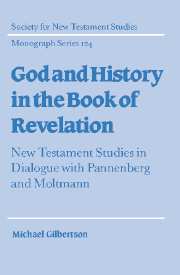
Book Review: God and History in the Book of Revelation


Michael Gilbertson
God and History in the Book of Revelation:
New Testament Studies in Dialogue with Pannenberg and Moltmann (SNTS 124; Cambridge: CUP, 2003).
See google books for a quick read.
See Amazon.com for purchase.

Blurb from Cambridge: "This is an interdisciplinary study which constructs a dialogue between biblical interpretation and systematic theology. It examines how far a reading of the Book of Revelation might either support or question the work of leading theologians Wolfhart Pannenberg and Jürgen Moltmann on the theology of history, exploring the way in which the author of Revelation uses the dimensions of space and time to make theological points about the relationship between God and history. The book argues that Revelation sets the present earthly experience of the reader in the context of God’s ultimate purposes, by disclosing hidden dimensions of reality, both spatial - embracing heaven and earth - and temporal - extending into the ultimate future. Dr Gilbertson offers a detailed assessment of the theologies of history developed by Pannenberg and Moltmann, including their views on the nature of the historical process, and the use of apocalyptic ideas in eschatology".

My Review (forthcoming in EuroJTh 17.1)

Summary: This volume represents a cross disciplinary study between biblical interpretation and systematic theology. The author examines to what degree a reading of the Book of Revelation supports or undermines the theologies of Wolfhart Pannenberg and Jürgen Moltmann on the theology of history. He does this by exploring the way in which the Book of Revelation employs the dimensions of time and space in order to establish a conception of God’s relationship to history. The author concludes that Pannenberg and Moltmann’s theologies are both continuous and discontinuous with the Book of Revelation and its approach to God and history.

The objective of Gilbertson’s study is to examine the relation of the divine reality to the world of historical events. In chapter one, Gilbertson opens with discussion of twentieth-century debates about the relationship between history and faith. He surveys the work of Ernst Troeltsch who argued that the historical-critical method could not accommodate divine interaction with the world, Rudolf Bultmann who posited a strict dichotomy between history and God via his neo-Kantian dualism that separated fact from value, Wolfhart Pannenberg who advocated that the divine self-communication occurs through historical events, and finally he surveys Jürgen Moltmann who endeavoured to draw the horizons of God’s ultimate future and the human present together in order for their to be real hope in Christian thought.

In chapter two, Gilbertson examines the relationship between scripture and systematic theology. He draws attention to Krister Stendahl’s two-stage model which begins with the descriptive task of biblical theology followed by the practice of a normative systematic theology in order to prevent theological commitments from damaging the interpretation of the text. Gilbertson questions, however, whether ‘descriptive’ and ‘normative’ are really antithetical and whether the differentiation between what the text ‘meant’ and what it ‘means’ is really straightforward. Instead, Gilbertson prefers Nicholas Lash’s dialectic model of a more dynamic interface between exegesis and theology. On the role of scripture in theology, he accepts Alister McGrath’s defence of the cognitive-propositionalist approach which maintains an external referent in the story of Jesus.

Gilbertson addresses the overall perspective of Revelation in chapter three by focusing on Revelation’s representation of history, the rhetorical situation of the text, and the genre of Revelation. He examines preterist, historicist, and salvation-historical accounts of Revelation’s representation of history and finds fault with all three. Instead, Gilbertson argues that the framework of Revelation is temporal (= not about abstract principles) yet not chronological (= not about speculative future events). He locates the text in an environment that was not necessarily in crisis but the Seer aims to reveal the true nature of the situation to his readers. Accordingly, Gilbertson rejects seeing the symbology of Revelation as functioning as a psychological mechanism designed to induce certain states. He maintains that due regard should be given to the truth claims that the text makes. Thus, however the rhetorical function of the book is construed it must remain rooted in the truth-claims that the book itself makes about reality. On genre, Revelation is an apocalypse, though lacking some features of an apocalypse (e.g. pseudonymity), and the Seer attempts to influence his audience by locating the earthly present in the context of ultimate spatial and temporal horizons.

Chapters four and five deal with the spatial and temporal dimensions of Revelation. Gilbertson argues that Revelation is concerned with ‘the expansion of spatial horizons to include a transcendent spatial reality and the expansion of temporal horizons include transcendent temporal reality’ (p. 82). He finds that the juxtaposition of 2:1–3:22 and 4:1–11 create a dissonance between the crisis situation of John’s audience and the absolute sovereignty of God. This dissonance is resolved, spatially, by the future descent of the New Jerusalem from heaven to earth, and temporally, by the everlasting sovereignty of God being manifest on the earth at the same time. Although, as he points out, this imagery can also intensify the dissonance since the spatial and temporal transitions are yet to take place.

Gilbertson then compares his findings about Revelation with the theologies of Pannenberg and Moltmann in chapter six. He focuses on the dynamics of history, proleptic revelation, eschatological consummation, and the relationship of the present to the eschatological horizon. He notes the differences between Pannenberg and Moltmann not the least of which is that Pannenberg emphasizes the unity and coherence of history with God’s self-revelation, while Moltmann emphasizes discontinuity and contradiction between the present historical reality and the coming of God. Beyond this, Gilbertson adds a caveat that the conceptual worlds of John of Patmos and twentieth century theologians such as Pannenberg and Moltmann are very different, but what they have in common is a theology whose orientation is towards the ultimate future and the impact of this ultimate future upon the present. Where Pannenberg and Moltmann appear to depart from Gilbertson’s analysis of Revelation, is that the Seer can identify God’s rule as a hidden reality, whereas for Pannenberg and Moltmann, God’s rule is of the future.

In his conclusion, Gilbertson finds Pannenberg and Moltmann’s theology as being continuous and discontinuous from his analysis of Revelation. In line with the intention of the text, Moltmann and Pannenberg both posit a vision of the ultimate power of God that will ultimately shape the future but such power is for the moment hidden and not publicly manifest. Overall, a theological reading of Revelation is both a welcomed and profitable exercise if done with historical sensitivity and theological acumen. Gilbertson does both fairly well and succeeds in bringing the disciplines of biblical and theological studies together. The only misgiving I have is that while Gilbertson rejects Stendahl’s two-stage model for biblical and systematic theology, in the end his monograph is a perfect example of it as he moves from analysis of the text of Revelation (chapters 3–5) to systematic observations (chapter 6). Apart from that, this volume is a good example of how biblical interpretation and systematic theology can and should be brought together.