Raphael Golb, son of scholar Norman Golb, was convicted for identity theft for his on-line impersonation of scholars. Read the details at AP.
Thursday, September 30, 2010


Publication from Wheaton N.T.Wright Conference
The proceedings from the Wheaton Theology conference are scheduled to be published by IVP and will be available in March 2011. It is called Jesus, Paul, and the People of God: A Theological Dialogue with N.T. Wright. See the page here.
Wednesday, September 29, 2010
The original Autographs
I'm currently wondering about the value of the concept of the original "autographs" as the locus for a doctrine of biblical inspiration. A number of issues come to mind:
1. Text-critics debate whether their task is to reconstruct the original autographs or simply an "initial text" (i.e., the earliest recoverable edition of a text).
2. The death of Moses in Deuteronomy 34 is obviously secondary (Moses didn't write about his own death) and was written up after the event and not by Moses.
3. The LXX edition of Jeremiah is significantly shorter that MT Jeremiah. That means that the Hebrew Vorlage underlying LXX Jeremiah was also considerably briefer that MT Jeremiah. MT Jeremiah, though considered by Jews and Christians as the canonical edition, may then constitute an expansion of an earlier Hebrew edition of Jeremiah.
4. The Psalter probably experienced some redaction at the level of the collection as a whole when it was formed into books with phrases added like "people of his pasture" and perhaps the superscriptions added as well.
5. The best witnesses to The Lord's Prayer in Matt 6:13 omit the words, "For thine is the kingdom, the power, and the glory, forever and ever, amen" and so most modern critical editions omit the words as do most English translations. And yet, the words are still widely used in Christian prayers today despite not being in the autographs.
6. The western text of Acts is 10% longer than other witnesses and some scholars have speculated that Luke produced two editions of Acts, the second one a slightly expanded and embellished version. If so, which one was the autograph?
As a text-critic, I'm not willing to give up on the autographs, even if I cannot guarantee 100% that we have them fully reflected in modern editions (but I think we must be pretty darn near close if not on target for the most part). Yet there are instances where the text that we consider canonical, inspired, infallible, and authoritative is probably not identical to what the authors themselves probably wrote. Thus, I'm starting to think that the theologically significant text for a doctrine of inspiration is not the autographs, but the Bible as it has been received in the church.
Monday, September 27, 2010
New Blog: Zurich Connection
My good friend Joe Mock, a Presbyterian minister in Sydney, has launched his own blog dedicated to the study of the Zurich reformers Zwingli and Bullinger. The blog is called Zurich Connection. Do check it out.
Sunday, September 26, 2010
Book Notice: Eric Metaxas: Bonhoeffer: Pastor, Martyr, Prophet, Spy
 As people (or it could just be me) we have a tendency to read our hero’s life-story believing that if we stood in their shoes we would have acted or reacted in the same way. I can’t say that about Bonhoeffer. In Eric Metaxas’s new biography of Dietrich Bonhoeffer, Bonhoeffer: Pastor, Martyr, Prophet, Spy
 , I saw myself several times, but not in Bonhoeffer.
I stood among the shallow-minded Union Theological Seminary students whom Bonhoeffer encountered in New York. At 25 years old, Bonhoeffer was already eons ahead of them both academically and spiritually. He wrote that the Union students:
Talk a blue streak without the slightest substantive foundation and with no evidence of criteria … They are unfamiliar with even the most basic questions. They become intoxicated with liberal and humanistic phrases, laugh at the fundamentalists, and yet basically are not even up to their level (pg. 99).This quote has stuck with me since finishing the book. If I’m honest I find myself talking the same theological blue streak and exhibiting an equal deficiency of depth, insight and self-awareness. I see in myself a lack of maturity and charity and humility and biblical and theological wisdom. Bonhoeffer was the opposite, and as a young man he possessed all of these qualities.
Concerning the book, there are a lot of qualities deserving of comment (narrative style, judicious insight, interaction with sources, organization), but I wish to highlight three.
First, Bonhoeffer was a theologian. His life as a theologian and pastor, calls into question the dichotomy between the pastor’s role to preach and live theology, on the one hand, and the scholar’s role to produce theology on the other. Bonhoeffer was both. Perhaps Bonhoeffer offers a refreshing example of pastor-theologian to a new generation of pastors who wish to construct theology within the context of the church. Bonhoeffer’s work called the church to obedience rather than compromise, and that summons could only be invoked from a deep theological well.
Second, Bonhoeffer embraced ambiguity. Progressing through the narrative, I noticed Bonheoffer’s willingness to accept the murkiness of espionage and conspiracy as discipleship to Jesus. To Bonhoeffer, the ethical implications of faith weren’t separated into simple, clean-cut categories. In other words, killing the Furor was perceived to be God’s will. This provides an ethically uncomfortable question for us to consider (albeit in a comfortable vacuum): What if God’s will is “wrong”, as it’s normally understood? Bonhoeffer was willing to courageously pray and think through these unthinkable difficulties to discern God’s will, and then to put those conclusions into concrete action.
Third, Bonhoeffer was mature. In his relationship with his finance, his decision making, his view of responsibility, his spiritual disciplines, and his ability to endure great suffering that led to death, Bonhoeffer was sustained by Jesus Christ and His body. As you read his letters and books, you interact with a mature person in Jesus Christ.
Metaxas has done an excellent job in bringing us Bonhoeffer’s life-story. We need people like Bonhoeffer, ethically thoughtful, theologically rich, and responsibly Christian. His life challenges complacency, while drawing attention to Jesus Christ, His presence today, and discipleship to Him.
Review by guest contributor: Jameson Ross
Mikeal C. Parsons on Luke's Paul in Luke: Storyteller, Interpreter, Evangelist
 I got to know Mikeal Parsons while he was on sabbatical during my Cambridge years. What year now slips me. I found Mikeal to be a great guy and someone who was both engaging and generous. Recently I picked up his book on Luke which is in the Hendrickson series Luke: Storyteller, Interpreter, Evangelist. I really like the series. I have used the two books Warren Carter has writen on Matthew and John for classes I've taught. Parson's book is quite different that Carter's two and is not really ideal for an introduction to the book. However this is not a criticism of the books since Parson's makes it plain in the introduction that he has not intended it to be such a book.
Parsons uses the format of Storyteller, Interpreter, Evangelist to focus his discussion on the Greco-Roman context of Luke's Gospel and Acts. One of its chief concerns is to show the role of ancient rhetoric in Luke's writing. Parson's chapters are informative and insightful. Parson's also has a very interesting chapter on the concept of "friendship" and "physiognomy" in the Greco-Roman world and Luke-Acts.
One of the most important sections of the book as far as I'm concerned is his discussion of the relationship between the Paul of Acts and the Paul of the Pauline Letters. For me these 16 pages (123-39) are worth the price of the book. In this section Parsons critiques the standard view that the Paul of Acts is irreconcilably different than the Paul of the letters.
As an aside, teaching a course on Paul I run into this issue a great deal. As recently as this semester I've had to lecture on this topic because one of the textbooks I'm using for the course Pamela Eisenbaum's Paul Was Not a Christian assumes just such a negative stance toward the Paul of Acts. In her study she excludes Acts as evidence for reconstructing Paul.
Parson's however shows by an unconventional means that Luke's Paul would have appeared familiar to the authorial audience who had known Paul through his letters. Parson writes:
We conclude that the authorial audience who knew Paul through his letters (and probably knew him only through those letters) would have recognized Luke's portrait of Paul as a reliable, though enriched and expanded, presentation of that same Apostle who through his rhetoric, miracles, suffering, adn throught, proclaimed that "God was in Christ reconciling the world unto himself" (p. 139).I would only quibble with Parson's discussion of the Torah in Paul and Acts (pp. 137-8). The discussion is weakened by the assumption that Paul's on-going relationship to the Torah was not motivated by theological conviction but rather expediency as evidenced in Timothy's circumcision (Acts 16:1-3) and Paul's statements in 1 Cor 9:19-23.
Monday, September 20, 2010
Reformed Stuff
For those Reformed folks out there note the following:
An interesting short essay by John Frame on Law and Gospel (HT: Jason Hood). This reminds me that I can do magic in Presbyterian churches. I can turn Presbyterians into Baptists simply by setting bread and wine before them on a table. I can also turn some Presbyterians into Lutherans just by uttering the words "Law" and "Gospel".
Michael Horton has a new theology book coming out call The Christian Faith which is previewed at Koinonia.
By far the best little introduction to Reformed Theology that I've come across in recent years is by R. Michael Allen. The chapter on creeds and confessions and their proper use alongside Scripture is worth the price of the book!
Preview of Dale Allison's New Book
James McGrath provides a quick preview of Dale Allison's forthcoming book on Constructing Jesus for those into historical Jesus studies.
N.T. Wright Reads Humpty Dumpty
Thanks to Jason Hood at SAET, you can read a N.T. Wright interpretation of the Humpty Dumpty story.
Best Pope Protester Ever
Here's a cool photo from Scotteriology about the most theologically informed Pope Protester in the UK.
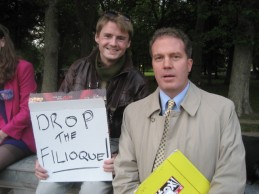
You need to know a bit of Latin, some medieval theology, and the date 1054 AD in order to get it! Otherwise, look it up on OrthodoxWiki.
Friday, September 17, 2010
Scripture Memorization
Thanks to a Crossway student, Sam "Periscopes" Duncan, we listened to a message from John Piper in chapel yesterday about Scripture memorization. Watch it here. Piper spends 15 minutes reciting several biblical texts from the OT and NT. His performance of Romans 8 is very powerful and it goes to show the power of aural/oral delivery of the biblical writings. One of the best things that I ever did as a young Christian was spend time memorizing a bunch of Bible verses in a pack made by the Navigators. I still think of Psalm 119.9, 11: "How can a young man keep his way pure, by living according to your word ... I have hidden your word in my heart that I might not sin against you".
John Dickson - The Christ Files
Be ready for this when the DVD comes out! It's an excellent doco by the uber-talented John Dickson.
Projects for 2011 - Gospels and Romans
I'm winding up my research for 2010. All I have left to do is to polish up my ETS and IBR papers and a write dictionary article on John and the Synoptics . Next year will involve editing a Four Views book for Zondervan and co-editing the 2010 Tyndale Fellowship volume in memoriam of Prof. Martin Hengel with Jason Mason.
For me, 2011 is going to be the year of Gospels and Romans. Projects I'll be working on include:
Jesus is the Christ: The Messianic Testimony of the Gospels (Paternoster).
This volume examines how the messiahship of Jesus functions in the narrative and theological horizon of the individual Gospels. It examines their apologetic, kerygmatic, and evangelistic usage of messianic themes. It includes developing some articles I've previously published in Reformed Theology Review.
The Gospels of the Lord (Eerdmans)
This volume looks at the formation of the Gospels in the setting of the early church including chapters on "gospel to Gospel", "Jesus Tradition", "Formation of the Gospels in Early Church", "History and Theology", with some stuff on canonical versus historical approaches to interpreting the Gospels. I also hope to add in some excursus on things like "Q", "Text of the Gospels in the Second Century", and "An Evangelical and Critical Approach to the Gospels", plus a section on how to read the non-canonical Gospels.
On Romans, I intend to sink my teeth into a Romans commentary in the Regula Fidei series for Zondervan. But along the way I'm also writing an essay on Romans and Imperial Perspectives (IVP) and an introduction to Romans for a text book on Paul (Eerdmans).
Gospels and Romans sounds like a cool year ahead indeed. Though I'm starting to think that it might pay to do some stuff on the Catholic letters some time soon for my own benefit more than anything else!
Forthcoming Paul Books
This last year I've been focusing on Paul in the context of the early church. How does Paul relate to other Christian groups? What did other Christians think of Paul? How was Paul an influencer of and influenced by other Christian views? What was Paul's legacy in the early church? As such, I've been involved in editing two volumes with my guru-swami-ninja-jedi buddies Joel Willitts and Joey Dodson to tackle these issues in two volumes with a cast of all-star contributors:
1. Michael F. Bird and Joel Willitts, Paul and the Gospels: Christologies, Conflicts, and Convergences (LNTS 411; London: Continuum, 2011) - 21 April 2011.
This volume attempts to situate the Apostle Paul, the Pauline writings, and the earliest Christian Gospels together in the context of early Christianity. It addresses the issue of how the Christianity depicted in and represented by the individual Gospels relates to the version of Christianity represented by Paul and the Pauline writings.
Paul and the Gospel of Mark
Michael F. Bird (Crossway College, Australia)
James G. Crossley (University of Sheffield, UK)
Paul and the Gospel of Matthew
Joel Willitts (North Park University, USA)
Paul Foster (Edinburgh University, UK)
Paul and the Gospel of Luke
David Morlan (USA)
Stanley Porter (McMaster Divinity College, Canada)
Paul and the Gospel of John
Mark Harding (Australian College of Theology, Australia)
Colin Kruse (Melbourne School of Theology, Australia)
Paul and the Gospel of Thomas
Joshua J. Jipp (Emory University, USA)
Christopher Skinner (Mount Olive College, USA)
2. Michael F. Bird and Joseph R. Dodson, Paul and the Second Century (LNTS 412; London: Continuum, 2011) - 21 April 2011.
This volume looks at the imprint and influence that the writings of the Apostle Paul had in the second century examining the Pauline corpus in conjunction with key second century figures and texts, such as Ignatius, Polycarp, and the Epistle of Diognetus. As such this volume is an exercise in the Wirkungsgeschichte or ‘effective-history’ of Paul. It investigates the impact of Paul’s legacy and examines how this legacy shaped the Christianity that emerged in the second century as represented by the Apostolic Fathers, the early Christian Apologists, and among Gnostic and Judeo Christian groups.
Introduction: Joseph R. Dodson (Ouachita Baptist University, USA)
Paul and the Pauline Letter Collection: Stanley Porter (McMaster Divinity College, Canada)
Paul and Ignatius: Carl Smith (Cedarville University, USA)
Paul and the Letter of Polycarp: Michael Holmes (Bethel University, USA)
Paul and the Epistle of Diognetus: Michael F. Bird (Highland Theological College, UK)
Paul and Marcion: Todd Wilson (George W. Truett Seminary, USA)
Paul and Justin Martyr: Paul Foster (Edinburgh University, UK)
Paul and Valentinian Interpretation: Nick Perrin (wheaton College, USA)
Paul and Judeo-Christians: Joel Willitts (North Park University, USA)
Paul and the Apocryphal Acts: Andrew Gregory (Oxford University, UK)
Paul and Irenaeus: Ben Blackwell (Durham University, UK)
Paul and Tertullian: Andrew Bain (Queensland Theological College, Australia)
Paul and Women: Pauline Hogan (Sir Wilfred Grenfell College, Canada)
The Triumph of Paul or Paulinism in the Second Century?: Mark Elliott (St. Andrews University, UK)
Paul and the Pauline Letter Collection: Stanley Porter (McMaster Divinity College, Canada)
Paul and Ignatius: Carl Smith (Cedarville University, USA)
Paul and the Letter of Polycarp: Michael Holmes (Bethel University, USA)
Paul and the Epistle of Diognetus: Michael F. Bird (Highland Theological College, UK)
Paul and Marcion: Todd Wilson (George W. Truett Seminary, USA)
Paul and Justin Martyr: Paul Foster (Edinburgh University, UK)
Paul and Valentinian Interpretation: Nick Perrin (wheaton College, USA)
Paul and Judeo-Christians: Joel Willitts (North Park University, USA)
Paul and the Apocryphal Acts: Andrew Gregory (Oxford University, UK)
Paul and Irenaeus: Ben Blackwell (Durham University, UK)
Paul and Tertullian: Andrew Bain (Queensland Theological College, Australia)
Paul and Women: Pauline Hogan (Sir Wilfred Grenfell College, Canada)
The Triumph of Paul or Paulinism in the Second Century?: Mark Elliott (St. Andrews University, UK)
Thursday, September 16, 2010
Review of Introducing Paul by Guy Waters
Over at Reformation21, Guy Waters of RTS has a review of my book Introducing Paul. I think it is a very fair review but with expected points of contention over "incorporated righteousness" vis-a-vis "imputed righteousness". There were some pointed questions by Waters and I appreciate that he has taken the time to understand what I was trying to say. He observes correctly that what I'm putting forward is not quite the standard Reformed view, but nor am I in the N.T. Wright camp. Waters raises a good question about what is the "righteousness" that believers are incorporated into or have imputed to them. Now I'm 100% convinced that it is not the merit of Jesus or his entire life of obedience. I've just gone and read again over Romans 5 and I see how people can think that, but it is clear that this is not explicitly said in the text. Jesus' "one act of righteousness" results in justification, but the one act of righteousness is not something that is imputed as the grounds of justification (Rom 5.18-19). My advice here is to look at the meaning of "righteousness" in 5.17 and 21 before going into 5.18-17. In Rom. 5.17, 21, righteousness refers to a salvific status not to a substance or merits that can be infused/imputed (delete as preferred). It is thereafter that we see in Rom. 5.18-19 that Jesus' act of righteousness (i.e., his sacrificial death) leads to justification and by his obedience believers will (note future tense) be righteous at the final day. Yet there is no explicit statement of imputation here and the righteousness in 5.19 might be transformative as well as forensic (see Schreiner's Romans commentary on this which is particularly helpful). I have a little rhyme: "No matter how much may people try, kathistemi does not mean logizomai." So Depending on the context of Romans 3-5, I think "righteousness" can refer to (1) The status of being righteous, (2) Deemed to have fulfilled a covenant relationship, or (3) Salvation generally. I think we are incorporated into the status that the Father gives to his Son in the resurrection (i.e., a verdict of righteous). Then by virtue of union with him we also share by implication in his faithfulness that was the basis of his vindication. So what is true of the Messiah is now reckoned to be true of the people of God. It is this implication that I think makes imputation legitimate. If we are in Christ than what is true of him is true of us, including the faithful execution of his messianic vocation as the second Adam, Son of God, and true Israel.
Tuesday, September 14, 2010
Critical Assessment of Rosner's "Paul and the Law", Part 3
Who is the Christian of whom Rosner speaks?
Perhaps this will appear to you to be a quite unusual question at first. Of course Christians are followers of Jesus Christ both Jew and Gentile you might say. This certainly seems to be the way Rosner is using the term. He states in the conclusion: “although Jews are under the law, believers in Christ are not” (p. 418). This understanding of identity in Paul however is anachronistic and false. It is true that in one place Paul distinguishes Jew, Gentile and the ekklesia of God (1 Cor 10:32). But this type of categorization is exceptional and whatever it might mean, it does not denote the so-called “third race” theology prevalent in the some circles today. Paul’s categories for identity are binary sets: Jew and Greek, male and female, and slave and free (Gal 3:28). For the sake of argument, even if the term "church" were taken as a category for Paul alongside the ethnic distinctions, the term "Christian" was not.
Rosner’s study exhibits this common category error and consequently the thinking does not reflect the complexity of the issue adequately. The result of this weakness is that his conclusion that “a major shift in the way the people of God relate to the law” has occurred for Paul cannot be sustained. While it may be true, the argument in this essay is too weak to establish it.
Let me put my point in a simple a question: Was a Jewish believer in Jesus at the time of Paul a Jew or a Christian?
Monday, September 13, 2010
Critical Assessment of Rosner's "Paul and the Law", Part 2
Before I discuss the essay in any of its details, which I'll do, I want to address a few of the key assumptions Rosner brings to the essay. Now I write this well aware that Brian is reading these posts. So I hope to be irenic in my evaluation and that the points I raise will spur on the conversation. Moreover, I trust that Brian will feel comfortable pointing out errors, when there are such, in my representation of his perspective. I think it is good to write with the awareness that the person along with whom you are thinking is present. And I want to thank Brian for an interesting and thought provoking essay. So here we go.
First, there is an assumption that one can create affirmations of Paul’s thought from non-assertions. Rosner refers to this kind of evidence as “implicit” and treats it on the same level with Paul’s, one might say, “explicit” evidence. However, whatever the “implicit” evidence might offer it is in no way equal in weight to the explicit. The whole essay is an argument from silence. Perhaps in no other situation does ones larger construct of Paul come into play than when one seeks to create a “compelling story” (p. 417) from silence. And for this reason it is just as well that implicit evidence is “largely overlooked in treatments of Paul” (p. 417).
Second, to refer to the implicit evidence as “omissions” is to interpret the evidence, non-evidence really, before actually reading it. To label the so-called silences as “omissions” reveals a position on the question before setting out to answer it. It assumes at least in part that Paul decided to leave out something he might have on other occasions or times included. Anyone who has preached the same message to different audiences will understand that one may “omit” information in one setting that was appropriate in another. However, why should we characterize the non-evidence as omissions? By the way, I’m even having trouble knowing what terms to use to refer to Rosner’s evidence.
One other assumption, although this bleeds over into point of view, is the categories with which this essay functions. Rosner seems boil the groups down to either Jew or Christian and concludes that Paul says one thing about Jews and another about Chrsitians. This bipolar perspective on the constituency of Paul’s communities and early Christianity is in need of critical evaluation. Paul himself stands as one who is BOTH a Jew and a believer in Jesus. Paul’s language about himself in the context of Romans 2, which is the focus of Rosner’s essay, moves easily between Jew (notice the first person references – e.g. 2:5) and Christ believer. These then are not airtight categories of identity. Thus, the bottom line is Rosner’s assessment at the end of the day falls down primarily because of its lack of sophistication with respect to Paul’s understanding, and indeed the situation on the ground in the first century, of Christian identity.
Saturday, September 11, 2010
Critical Assessment of Rosner's "Paul and the Law", Part 1
I will write a few posts in response to Brian Rosner's recent article in JSNT. The title of the article is “Paul and the Law: What he Does not Say” (32.4, pp. 405-19). Here's the first set up post.
Rosner notes three kinds of evidence in Paul’s letters that have a bearing on one’s view of Paul’s understanding of the relationship of the law to the Christian: what Paul says, what Paul does with the law and what Paul does not say about the law. As his starting point, Rosner refers to a quotation from Betz’ Galatians commentary, claiming that Paul never says Christians are to “keep” or “obey” the Torah. He affirms Betz’s idea that Paul carefully distinguishes between the ‘doing’ of the Torah which is not required of Christians and the ‘fulfilling’ of the Torah which is.
The article’s purpose is to use Paul’s silences as a means of ascertaining his view on a Christians relationship to the Torah. He wishes to extend Betz observation. To this end he turns his attention to Romans 2:17-29 as a test case and lists some 10 things Paul says about the Mosaic law and the Jew.
Jews:
- rely on the law (17a)
- boast in the law (v. 23)
- know God’s will through the law (v. 18)
- are educated in the law (v. 18),
- have light, knowledge and truth because of the law (vv. 19-20)
- are to do the law (v. 25)
- (by implication) are to observe the righteous requirements of the law (v. 26)
- keep the law (v. 27);
- occasionally transgress the law (vv. 23, 25, 27)
- possess the (law as) written code (v. 27).
The article sets out to answer on simple question: “Does Paul say the same things of believers in Christ in relation to the law?” (p. 406). The bulk of the essay then takes each item in the list in turn and discusses the silence of Paul on this point with respect to Christians. At times drawing antithetical relationships between what Paul says about a Jew and what he says to a Christian (e.g. Christians rely on Christ not the law).
Rosner concludes his essay thusly, “Paul never says that Christians relate to the law in any of these ways” (p. 417). For him the only reasonable implication from this evidence is “a major shift in the way the people of God relate to the law” has happened (p. 417). “The Law of Moses”, says Rosner, “is much more of a focus for Jews than for Christians and the two groups relate to the law quite differently. The evidence of omission is fully in line with Paul’s perspective that, although Jews are under the law, believers in Christ are not” (pp. 417-18).
Friday, September 10, 2010
Ben Myers on Christian scholarship
Here's a cool quote from Ben Myers about Christian scholarship:
Scholarship is an exercise of obedience to Jesus Christ. It helps prepare the church for fresh words and deeds. Of course, we need not imagine that scholarship will always have an immediate impact on the church’s confession. But scholarship is nevertheless vital for the continuing life of the church. It is one of the places where the church exercises its muscle of discernment – a muscle that otherwise has an alarming tendency to atrophy. Or to change metaphors: when the church grows drowsy, scholarship diffuses its caffeinating influence, helping to keep us ready, watchful and alert. So when Christian scholars engage with contemporary thought, it’s not because the church needs protecting from the world, but because Christ is already in the world and he calls us to meet him there.
Latest Issue of BBR
The latest issue of BBR 20.2 (2010) includes:
Brian P. Gault
"An Admonition against 'Rousing Love': The Meaning of the Enigmatic Refrain in the Song of Songs.
William N. Wilder
"The Use (or Abuse) of Power in High Places: Gifts Given and Received in Isaiah, Psalm 68, and Ephesians 4:8"
Gerald W. Peterman
"Plural You: On the Use and Abuse of the Second Person"
Craig S. Keener
"Spirit Possession as a Cross-Cultural Experience"
Joshua W. Jipp and Michael J. Thate
"Dating Thomas: Logion 53 as a Test Case for Dating the Gospel of Thomas within an Early Christian Trajectory".
Subscribe to:
Posts (Atom)