Oh Gosh, do I really sound like that!
Showing posts with label Christian Origins. Show all posts
Saturday, January 17, 2009
Bird vs. Crossley - Part 1: On Premier Christian Radio
On Monday James Crossley and I discussed and debated on the programme Unbelievable on Premier Christian Radio in London. It was good fun (James was well behaved for the most part) . James and I did a web-tv interview and a two part radio programme with Justin Brierly. The first part of the radio debate is now on the PCR link above. There we discuss, did Jesus believe he was God and does the resurrection explain the origins of Christianity?
Oh Gosh, do I really sound like that!
Labels:
Christian Origins,
James G. Crossley,
Radio
Thursday, October 16, 2008
Tony Burke on "Heresy Hunting"
Over at the SBL Forum Tony Burke of York University has a provocative post on Heresy Hunting in the New Millennium. In sum, he takes to task a number of recent books that criticize the writings of the Christian Apocrpha and those who purportedly glory in them. In response, Rob Bowman of Religious Researcher has an interesting post entitled, Defending Heresy in the New Millennium which criticizes a number of Burke's contentions. Burke himself responds elsewhere.
I credit Burke with correctly identifying the ideological profile of many of the books which he criticizes (Christian apologetics written from an evangelical point of view), their negative evaluation of the Christian Apocrypha, and their sometimes too general or uncritical handling of the Christian Apocrypha itself by some authors. I don't like the term "Christian Apocrypha" and I simply call these writings non-canonical documents that were not regarded as corresponding to proto-orthodoxy. I wouldn't reject everthing that Burke complains about, that said I'd like to raise a number of issues based on Burke's short piece.
1. Burke seems to assume that "heresy hunting" is in fact a bad thing, but that of course is itself a value laden judgment against those who conduct Christian apologetics. But there is nothing wrong with, say, identifying a christological pattern in a given document (like docetism in the Apocalypse of Peter) and saying that it does not correspond with the christological pattern of the New Testament and the proto-orthodoxy of the developing church. If one genuinely believes in "false belief" as the NT indicates and "heresy" as the church fathers did, then there is nothing inherently wrong in exposing deviant forms of belief and behaviour that do not correspond to a perceived norm. Christian Apologetics is legitimate so far as it can explain to lay people why the "lost" Gospels (i.e. excluded, non-canonical, apocryphal, gnostic or whatever) lost out. It explains why the church leaders rejected writings that were androgynist (like the Gospel of Thomas) or too ascetic (like the Acts of Paul). What is more, and I hope Burke would agree, debunking inappropriate use of the non-canonical writings by Dan Brown is a good thing (even Bart Ehrman wrote a book on that one) and other erroneous but populist theories like the "Jesus Dynasty" or the "Jesus Tomb" are worthy of refutation by sane scholarship.
2. Concerning the use of the non-canonical writings in research of early Christianity, I think some strands of scholarship employ them inaccurately and inappropriately. First, in regards to those who focus on Q and the Gospel of Thomas as a seedbed of the early church, I concur with Francois Bovon that some scholars have taken what was peripheral to the early church and tried to make it central. Second, the non-canonical writings are often used to show the radical diversity of the early church and how wrong Eusebius was in his depiction of orthodoxy preceding heresy and how right Walter Bauer was in his view of the development of Christianity. I genuinely concur on the radical diversity and density of the early church. However, Bauer's thesis has come under severe criticism from a number of sources (and not just from conservatives but from others like Birger Pearson and Arland Hultgren) and using non-canonical writings to under write Bauer's thesis is equally illegitimate (Burke follows Bauer without hesistation, see here with remarks against conservative responses to Bauer). Alas, Eusebius and Bauer are not the only two models for explaining the rise of orthodoxy and heresy in the early church. There is nothing wrong about giving the voices from the margin a good and fair hearing, as long as we recognize that they are from the margin and were never really contenders for becoming the official scripture of the early church. Third, we should be cautious and critical of those who promote an alternative "liberal myth" of Chrisian Origins. Something that supposes that the two hundred years of the church was a period of innocent pluralism and tolerance that was destroyed by the machinations of a self-appointed and needlessly narrow oligarchy of bishops who imposed their orthodox faith on a vibrant and diverse church. Yet perhaps the proto-orthodox were more charitable that is often assumed. Serapion, bishop of Antioch, was generous in allowing a congregation to initially use the Gospel of Peter until it was used in support of docetism (my suspicion is that the Gospel of Peter is conducive to docetism and not necessarily advocating it except perhaps in a crytpic way). The inclusion of the antilegomena in the canon meant the inclusion of writings, as Christian scripture no less, that many were still unsure about. When Burke writes, "The ancient heresy hunters were instrumental in the suppression of the Christian groups they found objectionable," while this is true to a degree, it can also be used to support the fallacy that orthodoxy was more or less forcibly imposed. Larry Hurtado writes: "There was, after all, no real means of 'top-down' coercive success for any version of Christianity over others until after Constantine, when imperial endorsement and power could be brought to bear. Second-century bishops were elected by Christians of the locale in which they were to serve. So, for example, if a bishop did not have (or could not win) sufficient support from the local Christians, he could hardly impose on them some version of faith contrary to the preferences of the majority. Thus, if any version of Christianity enjoyed success and became more prominent than others in the first three centuries (whether locally or translocally), it was largely the result of its superior ability to commend itself to sufficient numbers of adherents and supporters. To reiterate the point, the apparent success of what I am calling 'proto-orthodox' Christianity was probably the result of teaching and behavior that were more readily comprehended and embraced by larger numbers of ordinary Christians of the time than were the alternative".
3. What about those who urge Christians to explore the spirituality of the non-canonical writings which is part of Elaine Pagel's writings. Rodney Stark humorously calls such persons "Ivy League Gnostics". His book, Cities of God, is worth quoting at length (Burke strangely omits Stark from his survey):
"Purely as a matter of faith, one is free to prefer Gnostic interpretations and to avow that they give us access to secret knowledge concerning a more authentic Christianity, as several popular authors have recently done. But one is not free to claim that the early church fathers rejected these writings for nefarious reasons. The conflicts between many of these manuscripts and the New Testament are so monumental that no thinking person could embrace both (p. 142)."
"Elain Pagels stresses that the Gnostic writers 'did not regard themselves as "heretics"'. Of course note. But the issue of heresy is hardly a matter of self-designation. Let us assume that these writers (including forgers) sincerely believed that they possessed the truth and that the conventional Christians had it all wrong, while the conventional Christians were equally sure that theirs was the true Christianity. Within the confines of faith, the charge of heresy can be resolved objectively only on the basis of which side more accurately transmitted the original teachings of Jesus. That decision must come down to sources (p. 152)."
"Had the Gnostics prevailed, they presumably would be viewed today rather more in the manner that Pagels and other 'Ivy League' Gnostics would wish, assuming that such a thing as Christianity still existed. But the Gnostics did not prevail, because they did not present nearly so plausible a faith, nor did they seem to understand how to create sturdy organizations. Instead, most of them did and taught their own 'thing'. To sum up, the Gnostics gospels were rejected for good reason: they constitute idiosyncratic, often lurid personal visions reported by scholarly mystics, ambitious pretenders, and various outsiders who found their life's calling in dissent. Whatever else might be said about them, surely they were heretics. As N.T. Wright put it, they 'represent ... a form of spirituality which, while still claiming the name of Jesus, has left behind them every things that made Jesus who he was, and that made the early Christians what they were' (p. 154)."
In sum, I'm all for more accurate and more rigorous use of the non-canonical writings. Yet I advocate that Christian Apologetics written by "conservative authors" is a legitimate activity since it correctly casts aspersions on the theological character and historical origins of the non-canonicals for lay audiences whose own theological profile attempts to line up with the NT canon. The non-canonical writings can be equally abused by "liberal authors" who use them to construct an alternative Bauerian myth of Christian Origins (the unassailable liberal orthodoxy) and they sometimes enjoin a spirituality that is devious and harmful from the view point of historic orthodoxy. Note the italics here as I admit the theological and pastoral motivation that guides certain authors and even myself at times when dealing with this material. Burke is free to critique those who use the non-canonical writings in their construction of Christian history or to question how accurately the content and provenance of the non-canonical documents are described. Yet he cannot disparage the theological and pastoral motivations for critiquing these documents unless he himself comes clean on his own theological and ideological biases. In fact, I think I can detect Burke's biases when he states: "The audiences of the heresy hunters were also the writers' fellow orthodox Christians; perhaps their fears of losing members of their group to heresy were also unwarranted. Perhaps we assume too readily, based on the passion of the refutations, that the heretics were a grave threat to ancient orthodoxy". Burke can empathize with the non-canonical authors but not at all with the fears and concerns of the Christian heresiologists. Burke also wants modern apologists to reconsider if the non-canonical writings are, "late, derivative, and ultimately deserving of censure". Cool bananas, but what happens if we are led to affirm on the basis of evidence (not bias) that this is indeed the case. What if the Gospel of Thomas is early to mid second century, dependent upon the Four Gospels, and promoting esoteric schemes of salvation comparatively different from the canonical Gospels. I certainly don't want seminarians getting their theology of gender from the Gospel of Thomas or preaching the empty tomb story from the Gospel of Peter on Easter Sunday. In Burke's opinion, what does that make me? I'd like to know! For what it's worth, maybe Irenaeus' concerns were legitimate and his intentions good. The good bish wrote: "Inasmuch as certain men have set aside the truth, and bring in lying words and vain and vain genealogies, which, as the apostle says, 'minister questions rather than godly edifying which is in faith,' and by means of their craftily-constructed plausibilities draw away the minds of the inexperienced and take them captive, [I have felt constrained, my dear friend, to compose the following treatise in order to expose and counteract their machinations.]"
Thursday, February 21, 2008
Torah in Early Christianity: Diversity
One of the hobgoblins of New Testament Theology is "diversity". I think there are at least seven different views of the Torah in the early church. From my very brief survey of the NT, I identify them as follows:
(1) For Judean Jesus believers with a pharisaic background adherence to Torah is still the definitive marker of covenant identity and obedience to its precepts is the grounds for entrance into the new age even with the advent of the messiah (Acts 15.1, 5).
(2) For some Judean Jesus believers connected to the Jerusalem church, the coming of Christ compliments rather than replaces the Torah so that Jews and Gentiles are still bound to follow the Jewish way of life (Gal. 2.12, 14; 4.10; 5.2-4; Gal. 6.13).
(3) The apostolic decree states that Gentiles should obey minimally the noachide commandments as a mark of respect to their Jewish brothers and sisters (Acts 15.28-29).
(4) For some Diasporan Jesus believers living outside of Palestine Jesus is God’s supreme agent of salvation, but the Torah remains holy and good and should be followed (Mt. 5.17-20; Jas. 2.8, 12; Barn. 2.6).
(5) In groups connected to the Greek-speaking Jesus-believers the Torah has a limited role in redemptive history that has been completed by arrival of the messiah with the result that the Torah is relativized rather than abrogated (Acts 6.13-14; Col. 2.17; Heb. 10.1).
(6) For many Jesus believers with a history of Torah observance (i.e. the ‘weak’ who are easily offended), adherence to the mosaic law’s precepts is part of their social, familial, and devotional life and while professing faith in Jesus as messiah and Lord, they lack the maturity/insight to see that they are free to relinquish submission to its commands (Rom. 14.1–15.7).
(7) According to Paul the Torah exists in a set of binitarian antitheses between Christ and Torah and Torah and Spirit (e.g. 2 Cor. 3.1-9; Rom. 8.2; 10.4). The Torah points to salvation but does not provide it (Gal. 3.21-25; Rom. 3.21). Torah is bound up with the old age of sin, law, and death which those in Christ are free from (Rom. 7.5-6; 8.2; 1 Cor. 15.56). The Torah remains good and holy (Rom. 7.12). While the Torah can still inform the righteous behavior of the Jesus-believers (Rom. 13.9-10), the basis for upright living is the example of Christ (e.g. Phil. 2.5-11), the teaching of Christ (1 Cor. 9.20-21; Gal. 6.2), and life in the Spirit (e.g. Gal. 5.18; Rom. 7.6; 8.2-4). In the context of defending the integrity of his Gentile converts Paul regards law observance as leading to a curse (Gal. 3.10; cf. Acts 15.10), slavery (Gal. 4.22–5.1; Rom. 7.6) and he likens compelled obedience to Torah as to submission to hostile pagan deities (Gal. 4.8-9; Col. 2.14-15). What counts is not circumcision but new creation (1 Cor. 7.19; Gal. 6.15).
I wonder what we would could add to this list in terms of diversity if we included the Apostolic Fathers, Justin Martyr, and early non-canonical literature?
See further Raymond Brown and John Meier, Antioch and Rome: New Testament Cradles of Catholic Christianity (New York: Paulist, 1983): 1-9; Peter Stuhlmacher, ‘The Law as a Topic of Biblical Theology,’ in Reconciliation, Law and Righteousness (Philadelphia: Fortress, 1986): 110-33.
Why do I suspect that James Crossley will have a comment or two about this?
Friday, September 14, 2007
A Theology of Early Christianity: A Rationale
The Problem with Christian Origins
The Problem with New Testament Theology
In Summary
[1] Krister Stendahl, ‘Biblical Theology, Contemporary,’ in Interpreter’s Dictionary of the Bible (New York: Abingdon, 1962): 1.419.
[2] Cf. e.g. Norman R. Geisler, ‘Bible, Canonicity of,’ Baker Encyclopedia of Christian Apologetics (Grand Rapids, MI: Baker, 1999), 81-86.
[3] John Barton and Robert Morgan, Biblical Interpretation (Oxford: OUP, 1988), 37.
I am intending to write a ‘Theology of early Christianity’ as opposed to a book on ‘New Testament Theology’ or a book 'Christian Origins'. That is because I hope to integrate together the field of Christian Origins with the discipline New Testament Theology. That integration is needed because of the relative weaknesses of the discplines of New Testament Theology and Christian Origins.
The Problem with Christian Origins
The problem with Christian Origins is that, while adequately capturing the generative power of sociological forces for fostering theological beliefs, it fails to recognize that theology can also create a sociological dynamic. The door of cause and effect between theology and sociology swings both ways since what people do and what they believe are intimately intertwined. A further problem is that practitioners of Christian Origins deliberately avoid and even eschew exploring the theological texture of these documents. That inevitably results in an unsympathetic treatment of the texts precisely because of their largely theological nature. It also means that the theology of each book or letter cannot be so neatly deconstructed to be ‘really’ about ecclesial machinations, imperial politics, the suppression of minorities, the rising power of an orthodox collegiate, or comprise weapons of intra-Christian factionalism, when in fact they are trying to say something about God and the human condition. Whatever social complexity or religious context lies behind the texts of the New Testament we cannot shirk away from the fact that these writings are fundamentally concerned with an otherworldly reality known as God and the world to come. A history of early Christianity is only available through the theological witness of the New Testament, so historians of Christianity must do business with early Christian theology. It is, then, unsatisfactory to merely list and describe the beliefs and rituals of the early church, to plot the origin and evolution of beliefs from other sources, to map out factional differences and splits, and to point the finger at endless instances of diversity. Commentators, by negating the theological dimension of the New Testament in their inquiry, ignore the primary message of these writings which is largely theological. In the end, such commentators leave us with nothing more than ‘historicism or anti-quarianism, with its lack of interest in relevance’.[1] No-one can hope to understand the origin of Christianity without sympathetically listening to the theological beliefs, hopes, and creeds of the first Christians. It may be fashionable to say that there is no single theology of early Christianity to study, but in the final dust up they did opt for a single theology and they called it the Holy Scriptures.
The Problem with New Testament Theology
First, for a historical reason, we may consider the relationship of the first Christians themselves to the New Testament writings. In writing a New Testament Theology one may choose to focus exclusively upon the text of the New Testament given a presupposition of its ontological status as inspired, canonical, and authoritative (and why not!). Such an exercise will be concerned with the major theological themes of each book, how to explicate the unique theological contribution of each New Testament book, as well as expositing the New Testament’s theological message as a whole. The problem I have with this approach is that while it appropriately upholds the singularity of Scripture as inspired and normative for faith communities and it studiously engages the content of the New Testament itself, it still abstracts the New Testament from its historical origin and its impact upon the early church. New Testament Theology is not a systematic theology derived from the New Testament, it should be a theology derived the early Christianity community including their history and testimony as represented in the text. Theology, especially New Testament Theology, does not occur in a vacuum and it is the result of a long historical process of debate, conflict, struggle, and reflection with the competitors and collaborators of one’s environment over the question of God. Theology is created in the historical journey from struggle to Scripture and narrating that journey helps to explain the theology. In other words, there can be no theology of the New Testament without a description of the early Christians themselves. As an example, a theology of Romans must take into account: (1) the history of Christianity in Rome; (2) Jewish and Christian relations in Rome up to the mid-50s; (3) the social and religious context of the Roman Christians in the city of Rome; (4) Paul’s own circumstances including his motivation for writing, the relationship of the epistle of the Romans to the epistle to the Galatians, and also the evidence that Romans represents a distillation of previous debates in Antioch, Galatia, and Corinth; and (5) the immediate reception of Romans in the early church. Whereas New Testament theologies have focused on the main themes of the text and how those themes relates to the other New Testament writings, I think that a more profound set of questions to ask is what did the text do, to whom, why, and how does that relate to other Christian communities? By doing that, one is keeping the theology of the text rooted in the situation of the author and recipients and placing the findings in the wider context of the first Christians as a whole. Second, for a theological reason, we must consider the phenomenon that birthed the New Testament. The New Testament was written, copied, transmitted, preserved, preached from, and disseminated by Christians. A Protestant apologetic ploy is to say that the Church did not create the canon, but discovered the canon created by God.[2] A passing read of Eusebius’ History of the Church indicates that this is flat out false. God created the canon through the Church. The Bible may have been written for us, but its composite parts were not written to us. It is perfectly natural then to see the New Testament as the witness of a constellation of communities to their own story and beliefs, to their relationship with other groups (Christian and non-Christian), and to their own life in God. The New Testament is in part the biography of the Church and what God has done, is doing, and will do for the Church. The story of God becomes available only through the story of the Church. The New Testament had a formative role for the faith and praxis of particular communities from the very beginning. In fact, the New Testament writers are fundamentally concerned with a world beyond the text and thus we find the locus of meaning situated in the interface between text and community or between author and audience. A theology of Paul’s epistle to the Romans as a thing-in-itself is impoverished without taking into account the Roman Christians who comprise far more than the happenstance for writing, but their theological and pastoral instruction is the goal of epistle. The epistle to the Romans is not theology unless it is a theology for the Roman Christians. At the end of the day, I am arguing for the integration of ecclesiology into a doctrine of Scripture (a frightening task for a self-confessed evangelical). In my mind, such a perspective not only justifies the continuing inquiry as to what the text originally meant, but it secures the validity of theological exegesis as the enterprise by which the Church continually searches, studies, and sermonizes the Scriptures. By theological exegesis I mean, ‘theological interpretation of the Bible seeks to relate the ancient text to the religious question of the modern reader, without doing violence to either’.[3] Another corollary is that studies in reception-history (wirkungsgeschichte) become of vital significance as the division between implied readers and real readers may not be as wide as is often thought and so we must bring later witnesses with us in investigation of the New Testament documents. Meaning is created through fusing together the horizons of author, recipient, and reader. This justifies taking into account the wider ecclesial context from which and for which the New Testament was written.
In Summary
What I am arguing for is for the integration of Christian Origins into the study of New Testament Theology, or in other words, a theology of early Christianity. What this gives us, in terms of history, is a fuller picture of literary and social environment of the biblical authors and the effect that their writings had upon Christian communities both singular and global. As such the background of the New Testament in Second Temple Judaism, the Graeco-Roman world, and in early Christianity history becomes crucial for animating the world of the text by taking into account the world around the text. What this approach also gives us, in terms of theology, is a greater awareness of the overarching theological message of the New Testament by expounding the formative context and subsequent effect of these writings in the early church. By ‘theology’ I am referring here to ‘biblical theology’ which is the task of describing and expressing the theological message of the biblical books by paying careful attention to the context, genre, language, subjects, and purposes of the biblical authors. This biblical theology is the attempt to understand the theological contributions of the biblical writers on their own terms and without importing artificial categories on to the text. In the end, biblical theology is the attempt to tell the story of the early Christians by using their own language and symbols. In sum, the approach I am outlining attempts to uncover the theological message of each document and each corpus but in the context of the emergence of early Christianity. To give an example, what Paul says about the Law in Romans takes on far richer significance when placed in the wider context of Jewish and Christian debates about the Law which were related to issues of group boundaries, self-definition, ethics, and eschatology. That, however, feeds directly into the theological issue raised by Paul being who are the people of God, how will they be vindicated in the final assize, and how are God’s people to live a life that honours him? Thus, the theology of Romans is properly grasped within its particular historical circumstance and when taking into account the function of this theology in shaping the praxis and self-definition of Christian communities. A theology of early Christianity should illuminate the content and concern of each biblical book and should also illuminate the context and consequence of each biblical book. By bringing in the historical context we avoid a New Testament Theology that is essentially atemporal and purely propositional. By acknowledging the theological character of the New Testament we avoid the trap of substituting the context for the content of each book. In this way, the theological nature of New Testament Theology is preserved even when situated in the wider framework of historical description.
[1] Krister Stendahl, ‘Biblical Theology, Contemporary,’ in Interpreter’s Dictionary of the Bible (New York: Abingdon, 1962): 1.419.
[2] Cf. e.g. Norman R. Geisler, ‘Bible, Canonicity of,’ Baker Encyclopedia of Christian Apologetics (Grand Rapids, MI: Baker, 1999), 81-86.
[3] John Barton and Robert Morgan, Biblical Interpretation (Oxford: OUP, 1988), 37.
Saturday, July 21, 2007
Rodney Stark: Cities of God
During my doctoral studies I came across Rodney Stark's book The Rise of Christianity which had some interesting comments on the emergence of Christianity. There was some good stuff on conversion theory as well as Stark's interesting proposal that the Christian mission to Jews was actually a resounding success rather than a supreme failure. Stark is a sociologist who now teaches at Baylor university and he has written several volumes which are worth taking note of. They include:
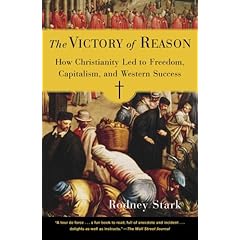
The Victory of Reason: How Christianity Led to Freedom, Capitalism, and Western Success (Random House, 2006). Stark contends that Christianity is a forward-looking religion, evincing faith in progress and in its followers' abilities to understand God over time. Such a future-based rational theology has encouraged the development of technical and organizational advances, such as the monastic estates and universities of the Middle Ages. Stark contends that these developments transformed medieval political philosophy so that democracy developed and thrived in those states, such as northern Italy, that lacked despots and encouraged moral equality. Stark concludes by maintaining that Christianity continues to spread in places like Africa, China and Latin America because of its faith in progress, its rational theology and its emphasis on moral equality. While some historians are likely to question Stark's conclusions, his deftly researched study will force them to imagine a new explanation for the rise of capitalism in Western society (from Publishers Weekly).
The Rise of Christianity: How the Obscure, Marginal, Jesus Movement Became the Dominant Religious Force (Harper Collins, 1997).
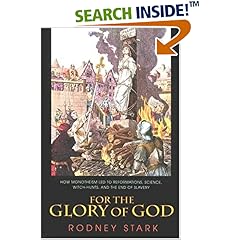
For the Glory of God: How Monotheism Led to Reformations, Science, Witch-Hunts, and the End of Slavery (Princeton University Press, 2004). In One True God: Historical Consequences of Monotheism, sociologist of religion Stark examined the nature of God, the wrath of God, the kingdom of God, the grace of God and the "chosen" of God. In this follow-up volume to his ambitious magnum opus, Stark investigates the role of monotheistic religions in reformations, witch-hunts, slavery and science. Such efforts represent an attempt by monotheistic religions to preserve the idea of the One True God against corrupting influences inside and outside the religions themselves. Stark asserts that, contrary to traditional notions, no single religious reformation can be isolated in any monotheistic religion. Thus, Christianity has experienced not simply the Reformation of Luther but many and various reformations that resulted in a diversity of sectarian movements that practice the worship of the One True God in their own ways. Stark also argues that science could have evolved only out of a monotheistic culture that viewed the world as God's handiwork, and that the witch-hunts of Europe could have taken place only in a culture marred by religious conflict and motivated by the desire to displace heretical religious sects. Despite its purported general focus on monotheistic religions, however, the book devotes very little attention to Islam or Judaism, a serious omission in a study that claims to cover so much ground. In addition, Stark's turgid prose and social-scientific style mar what otherwise could have been an engaging study (from Reed Business Information).
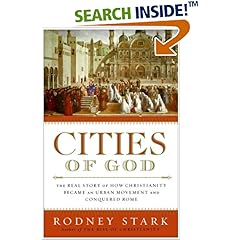
Cities of God: The Real Story of How Christianity Became an Urban Movement and Conquered Rome (Harper Collins, 2006). Contemplating the rapid spread of early Christianity, Lucian the Martyr marveled in the fourth century that "almost the greater part of the world is now committed to this truth, even whole cities." To explain Christianity's remarkable success in capturing the cities of the Roman Empire, Stark deploys an empirical social science that exposes the flaws in previous historical theorizing. By parsing records of church construction, inscriptions on tombs, and names on imperial contract permits, Stark converts plausible conjectures into testable hypotheses about the growth of Christianity in the 31 largest Roman cities. And while some of the statistically validated hypotheses fit within conventional wisdom, others compel fresh thinking. The traditional belief that Christianity spread through mass conversion, for instance, gives way to a numerically substantiated dynamics of person-to-person conversion. And despite recent acclaim for the Gnostics as the true early Christians, the evidence links the Gnostic impulse to dying pockets of stubborn paganism, not the rising new faith. Like Stark's Victory of Reason (2005), this book will spark controversy--the kind that attracts curious readers. (Bryce Christensen).
I am currently reading Cities of God and enjoying it. Stark takes a dig at the "Jesus Seminar", he contends that Paul was a missionary to the Jewish Diaspora, he contends that Gnosticism was a failed attempt to paganize Christianity, paganism was not stamped out by state represssion but gradually faded away, and the cult of Mithraism posed no competing alternative to Christianity.
Wednesday, June 27, 2007
Breeding Books
If you were take I. Howard Marshall's book on New Testament Theology and Alexander Wedderburn's book The First Christians, and you forced them to breed and produce progeny, what would the result be? In other words, how do you combine New Testament Theology and Christian Origins? This is what I intend working on in the near future (commentaries on 1 Esdras and Colossians to be written first). Does Christian Origins have to be untheological and does New Testament Theology have to be less historical? How would such an approach answer the problem of unity and diversity in the New Testament and how does it meet the challenge to New Testament Theology posed by W. Wrede, H. Raisanen, and W. Bauer? What is the pastoral and theological mileage that comes out of this.?
Friday, June 22, 2007
New Book by Martin Hengel
Eisenbrauns reports that Martin Hengel and Anna Maria Schwemer are co-authoring a new book called: Geschichte des fruhen Christentums: Band I: Jesus und das Judentum. Three other books in the series are planned. The blurb reads:
Der erste Band dieser auf vier Bände geplanten Geschichte des frühen Christentums umfaßt den Weg und das Wirken Jesu vor dem Hintergrund des zeitgenössischen Judentums in Palästina. Daß die Darstellung Jesu selbst bereits Teil einer solchen Geschichte sein muß, sollte heute nicht mehr bestritten werden. Jesu Wirken und Leiden muß in engem Zusammenhang mit dem palästinischen Judentum und seinen religiös-politischen Gruppen gesehen werden. Bei der Überfülle der Jesusbilder kommt den Vorfragen nach den Quellen und den Kriterien einer historischen Untersuchung besondere Bedeutung zu. Hier ist wesentlich, daß aufgrund der Quellenlage nur "Annäherungen" möglich sind und die historische Gestalt Jesu von sehr verschiedenen Aspekten aus gesehen werden kann. Martin Hengel und Anna Maria Schwemer untersuchen zunächst die galiläische Herkunft Jesu, und behandeln dann weiter das Verhältnis zu Johannes dem Täufer und den historischen Rahmen seines Wirkens. Es folgen die Form seiner Verkündigung sowie deren Inhalt, der von der anbrechenden Gottesherrschaft, dem göttlichen Willen und der Liebe des Vaters bestimmt ist. Weitere Schwerpunkte bilden Jesus als Wundertäter und das umstrittene Problem seines messianischen Anspruchs, der nicht auf die Titelfrage beschränkt werden darf. Am Ende stehen der letzte Kampf in Jerusalem, seine Passion und die Erscheinungen des Auferstandenen.
This seems to fall in line with a new genre of multi-volume Christian Origins projects as already undertaken by N.T. Wright (Christian Origins and the Question of God) and James D. G. Dunn (Christianity in the Making). I hope SCM picks up this volume and gets a English translation out soon.
HT: Matthijs den Dulk
Saturday, June 02, 2007
Christian Origins without Acts and Eusebius
For some time I have been meaning to respond to remarks made by James Tabor over at his blog The Jesus Dynasty. In particular, I intend to contest his view about early Christianity.
Tabor challenges what is often often assumed about Christianity, namely: (1) That "the essential story line we read about in the New Testament book of Acts is an accurate version of the early years of the Jesus movement following the crucifixion". (2) And he says: "The second grand assumption about early Christianity that I think we should radically questioned is the portrait of its clean break with Judaism and its subsequent harmonious (despite a few evil heretics) and unbroken advance into the second and third centuries." Instead, he advocates we try to reconstruct Christianity by using "Nag Hamaddi texts found in Egypt in 1945, the newly edited and translated Pseudo-Clementine literature, the Didache, and various Syriac and Arabic sources".
At another place Tabor says: "Acts and Eusebius are not 'the story,' as I have recently written, then we have a lot of hard work before us. The good news is that much survives and I can not think of any field of historical investigation that is more exciting than Christian Origins at the beginning of this 3rd. millennium. If I may misquote/misapply the prophet Hosea: After two days he cause us to live, and on the third day he will raise us up. What an amazing time in which to live."
Here's my response:
1. If Acts and Eusebius are historically defunct and not the "real" story, then it is not so much a matter of getting on with the "hard work before us", rather, we should take up a new hobby besides Christian origins (go fishing I guess or watch that prosaic sport called "the Scottish Premier League"). Without the testimony of Eusebius and Luke we have no history of Christian Origins; however biased these reporters are, they constitute our primary and most valuable witnesses to the beginnings of Christiantiy. Without them, plotting the macro-picture of Christian Origins is done with, it is "game over"!
2. Tabor beleives that the Christian bias of these document eliminates them as reliable sources. But the fact of the matter is that there is no such thing as uninterpreted history, whether that is Luke or Thomas or whether it is Eusebius or the Ps-Clementines. What is more, Luke and Eusebius are purporting to give a narrative account of history, something that was not the intention of the NH or the other Christian writings that Tabor alludes to. We should then be more predisposed to trust Eusebius and Luke in their account (or at least in places where we have no evidence to prove the contrary).
3. I for one doubt whether Luke (and Eusebius) are presenting a purely romanticized and fictitious account of Christian origins. Yes, I can give a polite nod to Luke's propensity to down-play conflicts and his Pauline sympathies (but see Martin Hengel before you call Luke a pure Paulinist, since Hengel thinks that Luke is a naughty disciple of Paul). Yet I have a hard time thinking of Luke as a complete revisionist and Acts as as being entirely biased towards ecclesiastical uniformity. George Caird wrote: "In all this Luke is undoubtedly preserving the authentic quality of primitive Christianity. If he had been disposed to read back into the age he was describing the characteristics of the age in which he wrote, we should presumably have had from him a story of a mission planned and directed from Jerusalem by the Twelve. But of such ecclesiastical theory there is not a trace in his narrative" (Caird, Apostolic Age, p. 66; cf. Hengel, Between Jesus and Paul, p. 55). Thus, when Tabor says: "book of Acts is probably the most misleading document in the New Testament canon", I think have due cause to disbelieve him.
4. Is the Nag Hammadi and these unnamed Syriac/Arabic sources (whatever they are: Diatessaron or Epistula Apostolorum) any less biased or ideological than Luke and Eusebius? Of course not! Why are they kosher sources and Luke-Eusebius are not? Tabor might say that we can peel away the biases and ideology and see what really happened. And why not so for Acts and Eusbius too? In fact, his preferentiality treatment of the NH and other "lost" sources shows the prejudical nature of Tabor's inquiry.
5. At last year's SBL conference, I heard Francois Bovon (not exactly a card carrying evangelical) decry certain approaches to Christian Origins (i.e. the Christian Origins Seminar) for moving the periphery of early Christianity to the centre, i.e. Q, Thomas, and the NH. These writings are voices from the margin, and while it is indeed necessary to integrate them into the story of early Christianity, they are cameos or extras in the larger saga.
I am not necessarily subscribing to some "big bang" theory of Christian Origins where there was a period of pristine purity and social harmony until Simon Magus, Marcion, and Hillary Clinton came on the scene (some of my American friends inform me that it is a well established historical fact that Hillary Clinton is the Jezebel of Rev. 2.20 reincarnated). I concur that there was no clean and final split between Christianity and Judaism in the first two centuries. Also, there was a genuine complexity and diversity in the early church. However, some forms of Christianity though diverse were not mutually exclusive, some groups were perhaps competitive but necessarily hostile to each other, some groups with divergent views could quite happily cooperate in a common cause. Figures like Paul, John Mark, John the Elder, Peter, and Barnabas moved across the Mediterreanean and interacted with various Christian groups and had amicable relations with them. I do not think that Christians who read the Fourth Gospel would have been puzzled or offended by what Paul wrote. While Walter Bauer (for second century Christianity) and Dom Crossan and Jimmy Dunn (for first century Christianity) have given us a picture of a highly diverse and fluid movement, many of their contentions and conclusions have been rejected and refuted. Without reading the unity of the later orthodox church into the first century, I think it wise to remember that in the first century Christians did have some sense of being a worldwide movement (if you get a chance read Paul Trebilco's inaugural professorial lecture on this subject - rivetting stuff). I think that early Christianity, despite the complexity of the movement, was a relatively small and homogenous entity, and exhibited many more characteristics of unity and accordandance than is often recognized.
Tabor challenges what is often often assumed about Christianity, namely: (1) That "the essential story line we read about in the New Testament book of Acts is an accurate version of the early years of the Jesus movement following the crucifixion". (2) And he says: "The second grand assumption about early Christianity that I think we should radically questioned is the portrait of its clean break with Judaism and its subsequent harmonious (despite a few evil heretics) and unbroken advance into the second and third centuries." Instead, he advocates we try to reconstruct Christianity by using "Nag Hamaddi texts found in Egypt in 1945, the newly edited and translated Pseudo-Clementine literature, the Didache, and various Syriac and Arabic sources".
At another place Tabor says: "Acts and Eusebius are not 'the story,' as I have recently written, then we have a lot of hard work before us. The good news is that much survives and I can not think of any field of historical investigation that is more exciting than Christian Origins at the beginning of this 3rd. millennium. If I may misquote/misapply the prophet Hosea: After two days he cause us to live, and on the third day he will raise us up. What an amazing time in which to live."
Here's my response:
1. If Acts and Eusebius are historically defunct and not the "real" story, then it is not so much a matter of getting on with the "hard work before us", rather, we should take up a new hobby besides Christian origins (go fishing I guess or watch that prosaic sport called "the Scottish Premier League"). Without the testimony of Eusebius and Luke we have no history of Christian Origins; however biased these reporters are, they constitute our primary and most valuable witnesses to the beginnings of Christiantiy. Without them, plotting the macro-picture of Christian Origins is done with, it is "game over"!
2. Tabor beleives that the Christian bias of these document eliminates them as reliable sources. But the fact of the matter is that there is no such thing as uninterpreted history, whether that is Luke or Thomas or whether it is Eusebius or the Ps-Clementines. What is more, Luke and Eusebius are purporting to give a narrative account of history, something that was not the intention of the NH or the other Christian writings that Tabor alludes to. We should then be more predisposed to trust Eusebius and Luke in their account (or at least in places where we have no evidence to prove the contrary).
3. I for one doubt whether Luke (and Eusebius) are presenting a purely romanticized and fictitious account of Christian origins. Yes, I can give a polite nod to Luke's propensity to down-play conflicts and his Pauline sympathies (but see Martin Hengel before you call Luke a pure Paulinist, since Hengel thinks that Luke is a naughty disciple of Paul). Yet I have a hard time thinking of Luke as a complete revisionist and Acts as as being entirely biased towards ecclesiastical uniformity. George Caird wrote: "In all this Luke is undoubtedly preserving the authentic quality of primitive Christianity. If he had been disposed to read back into the age he was describing the characteristics of the age in which he wrote, we should presumably have had from him a story of a mission planned and directed from Jerusalem by the Twelve. But of such ecclesiastical theory there is not a trace in his narrative" (Caird, Apostolic Age, p. 66; cf. Hengel, Between Jesus and Paul, p. 55). Thus, when Tabor says: "book of Acts is probably the most misleading document in the New Testament canon", I think have due cause to disbelieve him.
4. Is the Nag Hammadi and these unnamed Syriac/Arabic sources (whatever they are: Diatessaron or Epistula Apostolorum) any less biased or ideological than Luke and Eusebius? Of course not! Why are they kosher sources and Luke-Eusebius are not? Tabor might say that we can peel away the biases and ideology and see what really happened. And why not so for Acts and Eusbius too? In fact, his preferentiality treatment of the NH and other "lost" sources shows the prejudical nature of Tabor's inquiry.
5. At last year's SBL conference, I heard Francois Bovon (not exactly a card carrying evangelical) decry certain approaches to Christian Origins (i.e. the Christian Origins Seminar) for moving the periphery of early Christianity to the centre, i.e. Q, Thomas, and the NH. These writings are voices from the margin, and while it is indeed necessary to integrate them into the story of early Christianity, they are cameos or extras in the larger saga.
I am not necessarily subscribing to some "big bang" theory of Christian Origins where there was a period of pristine purity and social harmony until Simon Magus, Marcion, and Hillary Clinton came on the scene (some of my American friends inform me that it is a well established historical fact that Hillary Clinton is the Jezebel of Rev. 2.20 reincarnated). I concur that there was no clean and final split between Christianity and Judaism in the first two centuries. Also, there was a genuine complexity and diversity in the early church. However, some forms of Christianity though diverse were not mutually exclusive, some groups were perhaps competitive but necessarily hostile to each other, some groups with divergent views could quite happily cooperate in a common cause. Figures like Paul, John Mark, John the Elder, Peter, and Barnabas moved across the Mediterreanean and interacted with various Christian groups and had amicable relations with them. I do not think that Christians who read the Fourth Gospel would have been puzzled or offended by what Paul wrote. While Walter Bauer (for second century Christianity) and Dom Crossan and Jimmy Dunn (for first century Christianity) have given us a picture of a highly diverse and fluid movement, many of their contentions and conclusions have been rejected and refuted. Without reading the unity of the later orthodox church into the first century, I think it wise to remember that in the first century Christians did have some sense of being a worldwide movement (if you get a chance read Paul Trebilco's inaugural professorial lecture on this subject - rivetting stuff). I think that early Christianity, despite the complexity of the movement, was a relatively small and homogenous entity, and exhibited many more characteristics of unity and accordandance than is often recognized.
Thursday, May 31, 2007
The Pastoral Significance of Christian Origins and New Testament Theology
I want to argue that Christian Origins and New Testament Theology have important pastoral implications. Studying Christian Origins allows us to see the big picture of the diversity and growth of the early church, and New Testament Theology enables us to grasp the complexity and accordance of theological ideas within the canon itself. Together they indicate the sociological and theological unity and diversity of early Christianity.
Why is this important? Well, I find that many Christians operate with a default "myth of Christians origins" and skewed view of New Testament Theology. What is that myth and what is skewed?
1. Well, the myth goes something like this: In the beginning was "us" (i.e. me, since all the first Christians held the same beliefs that I did, they hated the same false teachings that I hate, my distinctives were their distincitives). Things went well for us until about 100 AD when it all turned to a schmozzle and we disappeared. But the good news is that "us" is back and we have brought with us a return to the pristine era of doctrinal purity. We are the gatekeepers of truth and righteousness and the boundary of the kingdom includes us and our friends. In the immediate sense, all before us and all apart from us are dogs and devils. (Note, this is a caricature and an exageration and I do not have any body or any group in mind).
2. On another level, when students (esp. evangelical students) talk about the message of the New Testament, they usually mean Paul. And when they mean Paul, what they mean is Romans and Galatians. Their understanding (or sometimes lack of undestanding) of these two epistles often becomes the centre of not only Paul, but of the entire New Testament. Hebrews, Matthew, Revelation, and Luke-Acts are all forced into a Pauline framework.
How is this corrected? First, Christian Origins shows us the real diversity of the early church. You only have to compare the Johannine literature, Luke-Acts, and Paul to see that the saving significance of Jesus was expressed in different (I did not say contradictory) concepts, categories, and terms. Approaches to the law were diverse and pluriform as Christians struggled (in every sense of the word) to understand how the law-covenant was to be understood and followed in light of the coming Jesus/faith (cf. Gal. 3.23). A study of Christian Origins opens our eyes to the reality and goodness of diversity, so that Christians can learn to differentiate between convictions and commands, and discern between the major and the minor doctrines of Christian belief. I would also add that, despite this theological breadth to the early church, there was still unity within diversity, a unity apparent in the common kerygma of the early church. While there was diversity and complexity in the early church, it was never a free for all, and the desire to discern between true and false expressions of belief were part of the Christian movement from the very beginning. That leads us to New Testament Theology and rather than priviledging Paul to supra-canonical status (and Romans and Galatians and hyper-canonical), we should listen to each corpra on its own terms and to the issues to which they speak. A study of this kind will indicate where the theological (and dare I say) spiritual centre of gravity lies in the New Testament.
Subscribe to:
Posts (Atom)