Showing posts with label Philippians. Show all posts

Monday, January 10, 2011

Martin Hengel on on the Christ Hymn

Just reading the conclusion to Martin Hengel's The Son of God and this is what he says about the Christ Hymn of Philippians 2 (p. 76):

"Now if Christ is identical with the heavenly, pre-temporal 'image of God', that also means that he was ' of divine nature', as we hear at the beginning of the Philippians hymn. Thus, although he is clearly subordinate, the Son no longer stood on the side of creation alone, but also on the side of God. Only through the incarnation, which is 'consummated' in his death on the cross, does he receive a share in human destiny and can he be regarded as reconciler and intercessor for men. Jesus was now no longer just the perfect righteous man, chosen by God, who was in complete accord with God's will, a model for discipleship, but in addition the divine mediator who out of the Father's love for lost men obediently gave up his heavenly communion with the Father and took on human form and human destiny, a destiny which led to a shameful death on the cross. Thus incarnation and death became an unsurpassable expression of the divine love."

Friday, July 16, 2010

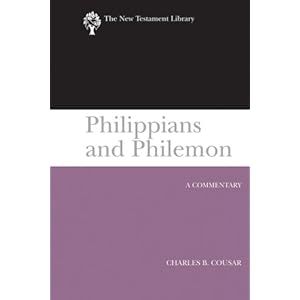
Book Notice: Philippians & Philemon by Charles Cousar

Charles B. Cousar
Philippians and Philemon: A Commentary
NTL; Louisville, KY: Westminster John Knox, 2009.
Available from Amazon.com in the USA and Alban Books in the UK.

Charles Cousar has done several works on Paul including an introduction to Paul's letters, Paul's theology of the cross, and a commentary on Galatians. This volume is a very brief but readable commentary on Philippians and Philemon that situates them both in the context of Paul's Ephesian ministry in the mid-50s.

In the introduction, Cousar is uneasy about the purported compilation theories where Philippians is made up of several letters that have been synthetically compiled into one. He thinks, with M.D. Hooker, that it easier to attribute the sudden changes in the letter to Paul himself than to an editor. On the place and date of writing, I was pleasantly surprised and glad to see that Cousar assigns it an Ephesian provenance. He is correct in that it is hard to reconcile Paul's view in Romans that he has no further work left to do in the eastern regions (Rom. 15.22-29) and hold to Paul's intent to visit Philippi after his release from imprisonment Rome (Phil. 2.24). That would mean dating Philippians 52-55 AD. Cousar believes that the primary purposes of Philippians are (1) to report on his situation in captivity to relieve the anxiety of the Philippians; (2) express gratitude for their recent gift through Epaphroditus; (3) to commend Epaphroditus to them; and (4) to encourage them to remain united in the face of opposition. On the Christ Hymn, Cousar rightly regards its purpose as an ethical exhortation to humility. He rejects a strictly Adamic reading of the hymn where Christ is another Adam who does not seek equality with God, but humbles himself as the true bearer of God's image. Cousar notes that morphe is not strictly synonymous for eikon and what Jesus grasped after seems to be something that he already had, but did not exploit, rather than something that he grasped after. He regards the passage as allowing for a "traditional reading of the preexistence of Christ". Cousar also regards Paul's boast in Phil. 3.4-6 as including his inherited credentials and achieved credentials. The soteric imagery indicates that "Being incorporated into Christ" is the vantage point from which he now sees himself. I also agree with Cousar that dia pisteos Christou can serve as a shorthand for the obedient self-surrender of Jesus. On Philemon, Cousar also assigns it to Ephesus in the mid-50s. I concur with Cousar's reconstruction of the situation that Philemon is not a runaway slave, but is an estranged slave seeking the help of his master's friend to be reconciled.

I have to say that this volume is rather terse compared to other volumes in the NTL series. It is only 106 pages long and the Philemon commentary is only five and a half pages! Though I have to say that it is an easy read, gives opinions on all the disputed matters in a concise way, and I agree with nearly all of Cousar's opinions on the critical issues. So despite its brevity, it does have some value. But there is no escaping the fact that it looks like this volume is out of place in the NTL series esp. when compared to the far more thorough volume on Colossians by Jerry Sumney. I still prefer the Philippians commentaries by Bockmuehl, O'Brien, Fee, and Hooker, but this one will sit nicely on the shelf.

Saturday, November 29, 2008

Provenance of Philippians

When and where was Philippians written? Philippians is attributed to a Roman provenance ca. 62 CE by most english commentators (see Bockmuehl; Witherington; O'Brien; Fee; Silva etc.) yet many continental commentators are open to an Ephesian setting ca. 55-57 (e.g. Gnilka; Muller, etc.). Mark Goodacre in his 2008 SBL paper on Dating the Crucial Sources in Early Christianity gave Philippians and Philemon a question mark in regards to their place in a Pauline chronology which reflects the indeterminate nature of the evidence. More recently, though, I've become convinced of the probability of an Ephesian provenance ca. 55-58 CE during an imprisonment in Ephesus for Paul's letter to the Philippians. In a nutshell, here are the best arguments:

(1) Most Pauline chronologists (e.g. Knox, Ludemann, Jewett, and Riesner) either posit or allow for the possibility of an Ephesian imprisonment (see 2 Cor. 1.8-11).

(2) Assuming the unity of the epistle to the Philippians (see John Reumann in AB for the alternative view), Philippians 3 stands out as including some polemical remarks against proselytizing opponents (3.2-9) and some anti-nominan behaviours (3.11-12, 18-19) which may reflect very recent debates in Galatia and Corinth and Paul is doing some preventative house keeping to make sure that another 'church' does not go the same route.

(3) The reference to the praetorium in Phil. 1.13 does not necessarily correspond to the imperial residence in Rome because (a) would the emperor really house accused criminals from the east in his own residence?; and (b) praetorium can mean simply 'head quarters' in places outside of Rome.

(4) There are a number of similarities in language and ethos between Philippians and Philemon. Francis Watson has shown the similarities in language between both epistles and we can note that these two epistles also look forwad to Paul's imminent release from detention. There are too many journeys implied by the movement of Paul's co-workers (Ephaphras, Onesimus, Tychicus, John Mark) back and forth between Paul's locale and the Lycus Valley for Philemon to have been written from Rome which is over 1000 miles away, hence, Ephesus is a more likely setting for Philemon. Thus, if Philemon and Philippians are co-temporous, they were probably written from Ephesus.

(5) Paul's intent to send Timothy to the Philippians in Phil. 2.19 probably corresponds to the sending of Timothy to Macedonia in Acts 19.22. There is no evidence, internal or external, that Timothy ever accompanied Paul to Rome (if the Pastorals are authentic or early post-Pauline then Timothy was definitely outside of Rome during Paul's Roman imprisonment).

(6) How does this pan out for Pauline chronology? If Philippians was written from Ephesus after Galatians and 1 Corinthians, then Paul probably composed it during ca. 55-56 not long after Timothy had returned from the visit to Corinth that Paul describes in 1 Cor. 4.17, 16.10-11 and after the tearful letter of 2 Cor. 2.1-4. Paul intends to send Timothy to Philippi (Phil. 2.19 = Acts 19.22) and to eventually visit himself (Phil. 2.24; 2 Cor. 2.12-13; = Acts 20.1).

See further:

Francis Watson, Paul, Judaism, and the Gentiles: Beyond the New Perspective (Grand Rapids, MI: Eerdmans, 2007).

Frank S. Thielman, 'Ephesus and the Literary Setting of Philippians,' in New Testament Greek and Exegesis: Essays in Honor of Gerald F. Hawthorne, eds. A. M. donaldson and T. B. Sailors (Grand Rapids, MI: Eerdmans, 2003), 205-25.