I'm currently finishing up the editing and indexing for another Bird-Book that I hope to be out in time for ETS/SBL 2009, which is Crossing over Sea and Land: Jewish Missionary Activity in the Second Temple Period (Hendrickson). Here's the cover: gucci job by the designer me thinks!
COSL Cover
Saturday, July 25, 2009


Off to Chicago/Wheaton
 I leave on Monday for a week of meetings in Chicago, Grand Rapids, and Wheaton. I'm looking esp. forward to going to Wheaton since I've never there been before. I've heard it's like the Christian "Mecca" with many churches but very few liquor stores. I can't wait to see the Billy Graham Center and bask in the glory of a colossal edifice dedicated to good ol' St. Billy the Evangelist himself. On the way there and back I'm hoping to "finally" read through Mike Gorman's book on Inhabiting the Cruciform God and Markus Barth on Justification. I hope to see you around the traps if you're there (I'll be the read head guy kneeling in front of the BGC crying out, "I'm not worthy, I'm not worthy to gaze upon thee"). Otherwise, I just hope that I don't get kidnapped by any of those right wing rocky mountain militas while I'm in Grand Rapids. Just to be safe, I've got a bumper sticker on my luggage that says, "The UN wants to take your guns away," which means they should let me off if I'm captured.
Calvin and Theosis
Sadly, I could not make the Calvin 500 Conference in Geneva this month gone by. But in looking at the photos of the event it looks as if a great time were had by all, and it was great to see PCA and PCUSA guys there in such intimate fellowship drawn together by their common love for John Calvin (who knows were such friendship could lead too). One of the papers I would have like to have heard was that given by Bruce McCormack on, "Union with Christ in Calvin's Theology: Grounds for a Divinisation Theory?" In sum, McCormack rejects the notion that Calvin's idea of union with Christ can be seriously integrated with the Eastern Orthodox notion of theosis. McCormack recognizes that there is one passage in Calvin that might support this perspective: "the flesh of Christ is like a rich and inexhaustible fountain that pours into us the life springing forth from the Godhead into itself. Now who does not see that communion with Christ’s flesh and blood is necessary for all who aspire to heavenly life?" (ICR 4.17.9). The problem that McCormack notes is that Calvin's christology will not actually allow God's essential life to be communicated to believers. McCormack states that Calvin "has dispensed completely with that which made divinisation theories possible, viz., the idea of an inter-penetration of the natures. This move only serves to underscore what we saw earlier: the believer participates only in the human nature of Christ. And since there can be no inter-penetration of the natures in Christ, participation in the human nature of Christ cannot result in a participation in the divine nature. The end result is that one simply cannot find the ontological ground needed for a divinisation theory in Calvin’s Christology. If there is no inter-penetration of the natures, there can be no divinisation".
Under the heading Residual Questions, McCormack also deals with Calvin's alleged link of justification and sanctification through "communion". He writes:
"Dennis Tamburello thinks himself to find evidence of a “twofold communion” with Christ in Calvin’s writings—one of which corresponds to justification and one to sanctification. His primary sources for this claim are Calvin’s commentary on Gal.2:20 (published in 1548) and a letter written to Peter Martyr Vermigli (in 1555). In the first, he says, “Christ lives in us in two ways. The One consists in his governing us by his Spirit and directing all our actions. The other is what he grants to us by participation in his righteousness, that, since we can do nothing of ourselves, we are accepted in him by God. The first relates to regeneration, the second to the free acceptance of righteousness.” It is surely not without significance that this work was published before the onset of the Osiandrian controversy and, therefore, before Calvin had given his doctrine of justification its final form. Be that as it may, it is conceptually odd to treat justification as a form of communion if one understands justification along the lines of the imputation of an alien righteousness. One could say that it is still necessary for faith to be awakened in the individual who would receive the promise of imputed righteousness—and that, therefore, union with Christ must logically precede justification. All of that would make sense, though it would be strange to describe it in terms of a twofold communion."
I think that pretty much makes sense, though I think Calvin's duplex gratia provides a better explanation for the link of justification and sanctification through union with Christ than what Tamburello's notion of "communion" does.
I should note that the essay will published in Tributes to John Calvin, ed. David W. Hall (Phillipsburg, NJ: Presbyterian and Reformed Publishing, 2009).
The Return of the Messiah
No, I'm not talking about the parousia here. Rather, I'm talking about what I perceive to be a "surge" of sorts in ascribing a messianic paradigm, intent, self-consciousness to the historical Jesus in recent scholarship. In the Wrede to Bultmann era, the messiahship of Jesus was a theological construct, a profession of the christology of the believing community, read back into the earthly life of Jesus in the Gospels. N.A. Dahl provided a glimmer of continuity between the pre-Easter Jesus and the post-Easter christology by arguing for the authenticity of the titulus on the cross. So Jesus did not claim to be the messiah, but he never denied the allegation of being a messianic claimant at his trial either, which is why the titulus was put up. Others (e.g. Fredriksen, Dunn) argued that while Jesus' followers and some of the crowds thought him the messiah, Jesus himself shied away from this leadership role. Some like Sanders say that Jesus saw himelf as the royal arbiter of God's kingdom, but not in fact as a messiah.
But times they are a changing. Obviously, you have guys like N.T. Wright and Craig A. Evans asserting the case for a messianic Jesus. I have my own contribution to the subject as well in the now released book, Are You the One Who is to Come? The Historical Jesus and the Messianic Question. Then there is also Dale C. Allison's work on Jesus of Nazareth: Millennarian Prophet and his more recent book The Historical Christ and the Jesus of Faith. What is more, in the latest issue of JSHJ there is a cracking good essay by Suzanne Watts Henderson titled, "Jesus' Messianic Self-Consciousness Revisited: Christology and Community in Context." Henderson's article concludes:
"In embodying God's dominion unleashed on earth, both Jesus and those who followed him apparently thought they were ushering in the messianic age of God's rule. As messiah, Jesus functioned authoritatively to bridge the chasm between divine and human power, making God's kingdom authority available to those who would trust in God's coming rule. Understood in this light, Jesus' messianic demurral, his messianic death, and his designation as 'messiah' in the post-resurrection age make more coherent and contextual sense than is often recognized"
I've said elsewhere, that this would make a great Ph.D topic for some brave soul.
Friday, July 24, 2009
Leap of Faith - My former job!
Before I got into NT scholarship, this is what I used to do for a living! So don't mess with me folks!! BTW, those landings hurt!!!
Rikki Watts: The Psalms in Mark's Gospel
I have an unpublished paper by Rikki Watts of Regent College entitled: "The Lord's House and David's Lord: the Psalms and Mark's Perspective on Jesus and the Temple." The abstract states:
"Four Davidic Psalms (2, 118, 110, and 22), each cited or alluded to at least twice, in this order, and at critical junctures in Mark's narrative, play a key role in his Gospel. In contemporary understanding Psalm 2 was associated with teh future messianic urging of Jersusalem and especially the Temple (e.g. 4QFlor, Pss Sol 17). Psalm 118, concluding the Egyptian Hallel, spoke of Israel's future deliverance under a Davidic king with the restored temple as the goal of Israel's return from exile. Psalm 110's surprisingly elevated royal desgination, uniquely expressed in Melchizedekian preist-king terms, contributed to several portraits of exalted heavenly deliverers, some messianic, who would preside over Israel's restoration (e.g. 11QMelch, 1 Enoch) while Psalm 22's Davidic suffering and vindication described teh deliverance of righteous Zion (e.g. 4QPs). Drawing from the dual perspective of their original contexts and contemporary interpretations, this paper proposes taht Mark's careful arrangement of his psalm citations presents Jesus as both Israel's Davidic Messiah (Pss 2, 118) and the temple's Lord (Ps 110) who, coming to purge Jerusalem but rejected by the temple authorities, announces the present structure's destruction and, through his death and vindication (Ps 22), its replacement with a new people-temple centred on himself."
What do the rest think on this? I concur with the use of Psalm 2 in Judaism and its relevance for the Gospel of Mark. The issue of replacing the temple with a people-temple is perhaps more controversial, although I am willing to give it some air time (the problem is that the early Jerusalem church seems fairly temple-centred in their worship and that requires explanation: two temples in parrallel or one temple inside another). Certain Ps 110 is also a big part of Mark's Christology too.
A Tale of Two Gospels in Two Provinces
Read Archbishop Duncan's open letter to the world Anglican communion entitled, "Two Cities: One Choice". I liked this part in particular:
The Anglican Church in North America, whose leaders met at Bedford, Texas, from June 20th to June 25th, embraced the values and behaviors familiar to Christians in every age: daily repenting of human sin in disobeying the one Lord, embracing the need (both personal and corporate) of a divine Savior, and recommitting to the proclamation in word and deed of the gospel of transforming love. The unity at Bedford, despite very real differences, was palpable.
The Episcopal Church, whose leaders met at Anaheim, California, from July 8th to 17th, blessed the values and behaviors of a re-defined Christianity: enabling a revisionist anthropology, budgeting litigation rather than evangelism, and confusing received understandings of Scriptural truth, not least concerning the necessity of individual salvation in Christ Jesus. At Anaheim, there were those who valiantly stood against the revolutionary majority, and their pain and grief at what was happening was heartbreaking for all who saw it, not least for their brothers and sisters in the Anglican Church in North America.
The Episcopal Church, whose leaders met at Anaheim, California, from July 8th to 17th, blessed the values and behaviors of a re-defined Christianity: enabling a revisionist anthropology, budgeting litigation rather than evangelism, and confusing received understandings of Scriptural truth, not least concerning the necessity of individual salvation in Christ Jesus. At Anaheim, there were those who valiantly stood against the revolutionary majority, and their pain and grief at what was happening was heartbreaking for all who saw it, not least for their brothers and sisters in the Anglican Church in North America.
Thursday, July 23, 2009
How Divine Were ANE Kings?
I'm reading through J.J. Collins and A.Y. Collins King and Messiah as Son of God and am enjoying it very much (I wish I had this book a year or two ago!). I've always enjoyed John Collins' work on Daniel and the rise of messianism. This book looks more explicity at the links between divinity and messianism.
In the opening chapter, John Collins discusses notions of divine kingship in the ANE. He notes that scholars have shrunk back from earlier claims that these monarchies (Egypt, Hittite, Mesopotamia, etc.) regarded their kings as incarnations of gods. Collins cites two scholars to counter this view: (1) Silverman: "A pharaoh might be: named as a god in a monumental historical text, called the son of a deity in an epithet on a statue in a temple, hailed as the living image of god in a secular inscriptions, described as a fallible mortal in a historical or literary text, or referred to simply his personal name in a letter"; and (2) Leprohon: "The evidence shows that the living pharaoh was not, as was once thought, divine in nature or a god incarnate on earth. Rather, we should think of him as a human recpient of a divine office. Any individual king was a transitory figure, while kingship was eternal".
I think two implications flow from this: (1) The divine-language used to describe kings in the OT (e.g. Psalm 45 "elohim"; Isaiah 9 "immanuel") are part of the ANE culture that is being tapped into and the king is praised in exalted terms, though still human and still evidently subject to God (see esp. the wider context of Ps 45). The Israelite/Judahite king was never an object of veneration in the cultus, but rather functioned as its chief custodian. (2) In Genesis 1.26-27, when humans are said to be in the "image of God", theologians argue over what the "image" precisely is: moral, psychological, relational, etc. But since "image of god" was used quite often to describe ANE kings, it means perhaps no more than humanity is royal in God's eyes and is charged with the delegated divine function of ruling over creation.
Book Notice: Approaches to Paul
My friend Mark Nanos just informed me about Magnus Zetterholm's new book Approaches to Paul: A Student's Guide to Recent Scholarship. At first glance it looks to be a very useful book for a course on Paul and once I have received it, I'll write a review on the blog.
Wednesday, July 22, 2009
Undergradese
 Thanks to Steve Walton for alerting me to this little gem from the Times about dealing with undergrads. It's funny, because it's partly/mostly/completely true!
Tuesday, July 21, 2009
Update on Textbooks for Teaching Paul to Undergraduates
A couple of years ago I wrote a dialogical post on preparing a Paul course. A major concern at that point was the determination of the best textbooks to use in the course. The choice of textbooks is all the more challenging in my context as I teach within a General Education curriculum which requires students to take Bible classes that have no vocational interest in the subject. These are late teenagers--sometimes early twenty-year olds (but its getting harder to tell the difference anymore) who are taking Paul because they "have to".
Over the course of the last two years, teaching Paul now four times, I have, through trial and error, found what I think are the best two Paul books for my context. I don't claim to think however that these are the most suitable for every context. What's more, while I would like to use Michael's book Introducing Paul--and do recommended it often to students, it overlaps with my own lectures (great minds think alike).
The IVP book by Capes, Reeves and Richards, Rediscovering Paul: An Introduction to His World, Letters and Theology (2007) and Horrell's An Introduction to the Study of Paul (T&T Clark Approaches to Biblical Studies)
 (T&T Clark, 2006). The former overviews topics like letter writing in the first century (Richard's expertise) and short chapters over all of Paul's letters. The latter is introduces students to the academic study of Paul and shows them the various approaches to his interpretation.
There is really only one other book I still have yet to find that I think would be useful as a third leg of the stool. That is a short book that provides a narrative history of Paul's life. Richard Longenecker's short book The Ministry and Message of Paul would be just the book if it were not now over 30 years old.
Over the course of the last two years, teaching Paul now four times, I have, through trial and error, found what I think are the best two Paul books for my context. I don't claim to think however that these are the most suitable for every context. What's more, while I would like to use Michael's book Introducing Paul--and do recommended it often to students, it overlaps with my own lectures (great minds think alike).
The IVP book by Capes, Reeves and Richards, Rediscovering Paul: An Introduction to His World, Letters and Theology
(2007) and Horrell's An Introduction to the Study of Paul (T&T Clark Approaches to Biblical Studies) (T&T Clark, 2006). The former overviews topics like letter writing in the first century (Richard's expertise) and short chapters over all of Paul's letters. The latter is introduces students to the academic study of Paul and shows them the various approaches to his interpretation.There is really only one other book I still have yet to find that I think would be useful as a third leg of the stool. That is a short book that provides a narrative history of Paul's life. Richard Longenecker's short book The Ministry and Message of Paul would be just the book if it were not now over 30 years old.
Monday, July 20, 2009
Articles by Paul Foster from Edinburgh Diocese
My good friend, Paul Foster of Edinburgh Uni, has some good articles the Scottish Episcopal e-zine "Edge" including the topics of the Trinity (pp 12-13), the Apocryphal Gospels (p 6), and taking Paul seriously (p 6).
Lane Tipton and Calvin, Union with Christ, & Justification
There is a great little clip by Lane Tipton of WTS-Philly on Calvin and Justification. Tipton asserts that some modern exponents have over emphasized the forensic aspect of justification at the expense of the rest of the benefits of Christ. In fact, Tipton seems to make the scandalous inference that justification is based on union (gasp!). Do watch it!
Sunday, July 19, 2009
CT on Martin Hengel
Christianity Today has a piece on Martin Hengel entitled: "The Champion who Debunked Bultmann". It also links to an essay written by Martin Hengel entitled, "Raising the Bar: A daring proposal for the future of evangelical New Testament scholarship," (2001) that includes these quotes:
"Only by mastering these languages can we read and understand the necessary Jewish, Greco-Roman, and early Christian sources, especially the church fathers, who are the earliest exegetes of the whole Bible. To present the faith to the 21st-century world, we need to support young, gifted scholars who have excellent philological-historical training and possess a broad learning base as well as specialized expertise. The evangelical community needs to free up resources for our scholars."
Listen to this proposal:
"Allow me to make a daring proposal: Why not found an IBR-run institute of advanced studies at a traditional, renowned university center in the United States? The university would grant room to IBR on its campus, thus allowing IBR to develop a respectable evangelical presence at the university. Another plus of a renowned university location would be the scholars' access to a world-class library collection. Such a center would house evangelical doctoral students and postdoctoral students who could study alongside more seasoned professors during their sabbatical years. The institute would also attract the best scholars from overseas who are indebted to the truth of the gospel and love the Bible. The center would operate within a free atmosphere of scholarly discussion but with the confident assurance that Christ, "the truth and the way and the life" (John 14:6), will overcome all human misunderstandings and wrong ways."
Hengel concludes in the end:
"John 8:32 promises that "the truth will make you free." This is the ultimate aim of all true biblical scholarship. The search for truth unites us, and it is a task for which we remain always responsible. In a time of astonishing discoveries about the Bible, but also of deep errors and seducing deception, this task is more necessary than ever."
Saturday, July 18, 2009
Graham Stanton Passes Away
I've just heard (via Mark Goodacre) that Graham Stanton has passed away after a long struggle with cancer. At TF Richard Burridge reported to us that Graham was seriously ill and not long for this world. In the past, I have benefitted immensely from many of Stanton's works including his Jesus of Nazareth in New Testament Preaching and Jesus and the Gospels. He will be dearly missed. May he rest in peace.
Addition by Joel Willitts.
Graham Stanton was a wonderful person and an excellent scholar. During my four yeas at Cambridge, I have ample opportunity to see him up close. He had a irenic personality and a commonsense perspective when approaching any subject. He was a man of faith as well as a scholar.
His scholarship will be missed and his person even more.
Gospel of Thomas: Three Recent Books
Some recent and decent books on the Gospel of Thomas that have come out in recent days include the following:
Uwe-Karsten Plisch
The Gospel of Thomas: Original Text with Commentary
Stuttgart: Bibelgesellschaft, 2007.
Available in the UK and Europe at Alban Books.
This is a fine introduction and commentary on the Gos. Thom. and its associated literature. Plisch is very circumspect about dating and though he recognizes that logia 68 is post-Bar Kochba revolt, it does not mean that the whole document is. He regards the transmission of Gos. Thom. as preserving a mixture of traditions that are earlier and later than the Synoptic Gospels and some independent traditions too, though he provides no argument for this in actuality. But he does raise a good point that the case for Thomasine dependence on the Synoptics only applies to about half of Gos. Thom. which parallels the Synoptic accounts. What I did find interesting was Plisch's suggestion for how the Gos. Thom. emerged and he uses the analogy of a box filled with ostraca. He writes: "In studying the Gospel of Thomas, I was thinking about a box filled with ostraca. Without making too much of it, this image can still be applied to the aporias in the Gospel of Thomas. One the one hand, the size of an ostrakon is limited; on the other hand, it is big enough to allow recording of several excerpted proverbs that can even come from different sources. Yet it can also happen that there is not eough room on the ostrakon (or other writing surfaces) for the entire text of the last excerpted logion, so that the rest of the text has to be recorded on the next writing surface." It is this variety of sources that best explains the disparity of the Gos. Thom. in his thinking. That means that the tradition-history of each logion should be evaluated on case-by-case merits. Plisch follows mainstream commentators by identifying the roots of the Thomasine tradition in Syria. He thinks the use of doublets might indicate the influence of lectionaries on the collection of logia as well. Plisch also provides one of the best short introductions to the theology of Gos. Thom. that I've read where he notes its distictive perspective on Jesus, the kingdom, salvation, ethics, and ecclesiology. The presentation of the text in the commentary contains the Coptic text of each logion, followed by a Greek retroversion of the logion whenever it has a parallel in the NT or in the P.Oxy materials. An English translation is also included and in the commentary Coptic and Greek words are helpfully transliterated.
Enno Edzard Popkes
Das Menschenbild des Thomasevangeliums: Untersuchungen zu seiner religionsgeschichtlichen und chronologischen Einordung
WUNT 206; Tuebingen: Mohr/Siebeck, 2007.This is Popkes' published version of his Habiltationsschrift which is distinguished from some approaches to Gos. Thom. by its refusal to try to excavate layers of redaction and tradition underneath the text. Popkes provides a study of the anthropology in Gos. Thom. and especially the concept of "image". Popkes will also be contributing an essay on "Paul and the Gospel of Thomas" to a collection edited by myself and Joel Willitts in the future so keep an eye out for his essay there.
Christopher W. Skinner
John and Thomas - Gospels in Conflict? Johannine Characterization and the Thomas Question
PTM; Eugene, OR: Pickwick, 2009.
Available through Wipf & Stock in the USA.
In this volume Christopher Skinner contests the notion that the Fourth Gospel was composed as a polemic against Thomasine Christians or the Gospel of Thomas due to certain readings of John 20.24-28 which are said to reflect and inter-community conflict. Skinner points out that Thomas is a fairly insignificant character in the Fourth Gospel, Thomas is simply one of many unbelieving and uncomprehending characters which provide a narrative foil for the literary and the theological designs of the Fourth Gospel, and interactions between Jesus and Thomas do not reflect interneccine strife anymore than the interactions between Jesus and Phillip.
He writes: "In their publications on the John-Thomas relationship, Riley, DeConick, and Pagels are concerned with the history of early Christianity and what they regard as its multiform development. All three scholars rely heavily upon source-, form-, and redaction-critical criteria to explain the conflict they envision. Elements of historical inquiry also factor into their discussions. Then, after developing a picture of the John-Thomas conflict using a complex set of different historical-critical elements, each scholar introduces a one narrative critical insight to vaidate their view - the characterization of Thomas. This leads to a truncated reading of the Johannine narrative that drastically overemphasizes the significance of one minor character. The hermeneutic that emerges is an amalgam of loosely connected methodological assumptions forced together to pain a picture that is unsupported by the available information. Through this approach they reveal that their greater concern is to mine the text for insights that will assist their revaluation of early Christianity and gospel origins. Or, to say it more succinctly, in the character of Thomas they simply find what they are looking for. Because of this they generate incomplete, superficial readings of the Fourth Gospel that subjugate the interests of careful reading to those of historical speculation and reconstruction" (pp. 231-32).
Skinner's arguments should be read beside those found in Ismo Dunderberg's volume, The Beloved Disciple in Conflict? since Dunderberg argues similarly against a John/Thomas community conflict. Overall, Skinner's monograph makes for a sound read and gives a good update on recent research on the Gospel of Thomas.
Is Baptism a Gospel Issue - John Davies
Over at the PTC Blog, John Davies has a good post on Is Baptism a Gospel Issue? He concludes at the end: "When we abandon baptism, we substitute other more individualistic and subjective forms of recognition and exclusion. We undermine the unity on which the NT places such a high value. We subvert the gospel."
N.T. Wright Project
A trio of students at Princeton Theological Seminary have started the "N.T. Wright Project," which is their attempt at reflecting on several of Wright's works. Their blog can be found here, and the posts contain son the Wright vs. Piper debate, Jesus and the Victory of God, and The Last Word.
Friday, July 17, 2009
Is Michael Bird Scottish?
Is Michael Bird Scottish? Well, according to "World Magazine" I am! Over at WM, Marvin Olasky reviews Introducing Paul, and he sounds pretty excited by it, but I have to tell Marvin: ochai laddy, ya a wee bit off da mark on dat un. But an easy mistake to make since I do have red hair and I am in Scotland! If anyone has an on-line subscription to WM, I'd love to read the whole review.
Paul and Pagan Sexual Ethics
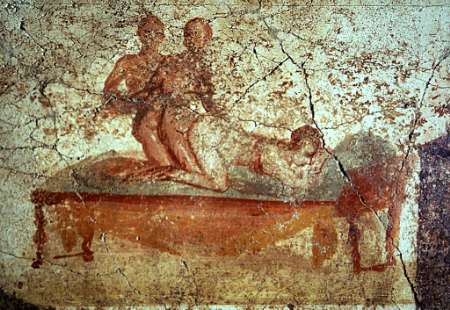
If you think Paul is a bit too harsh in Rom. 1:26-28, consider this image from ancient Rome (sadly, I could not bring myself to post it on the blog, be warned, it is pretty explicit).
Thursday, July 16, 2009
Phoebe as "Deacon" and "Leader"
At the recent PCA assembly in Florida, I an informed that there was a spirited debate between two big-hitters in the American Pressbie scene, Tim Keller and Ligon Duncan, about women Deacons. Well, over at SBL Forum, there is an interesting article by Elizabeth McCabe on "A Reexamination of Phoebe as a “Diakonos” and “Prostatis”: Exposing the Inaccuracies of English Translations".
Roland Deines' Tribute to Martin Hengel
Over at SBL there is a very moving tribute to Martin Hengel by his former student and colleague Roland Deines.
I should also mention that the New Testament Group of the Tyndale Fellowship is dedicating its 2010 meeting to interacting with the work of Martin Hengel. This will involve mostly invited speakers and we hope it is a fitting tribute to the importance of Hengel's work from a broadly evangelical perspective.
Gospel of Peter Images On-line
Thanks to Gospels.Net, but now you can view all of the pieces of the Gospel of Peter online including the The Akhmim Fragment, Oxyrhynchus Papyrus 2949, 4009, and The Faiyum Fragment (although the P.Oxy and Faiyum materials may not actually derive from the Gospel of Peter - see Paul Foster's work on this for the arguments).
David deSilva on 2 Thess 2.1-12
In his NT Intro, David deSilva has come good comments about the exhortation in 2 Thess 2.1-12:
"Second Thessalonians 2:1-12 is not merely about eschatological information, however. It plays a strategic part in shaping the outlook of the converts who heard it. It has a rhetorical function and social effect that we could easily overlook. Apocalypses and the invocation of apocalyptic topics often have as their goal the clarification of the cosmic significance of the choices and alliances people make in the here and now. While speaking of future and other worldly realities, these apocalypses also shape the hearer’s perception of the present, this worldly realities" (p. 547).
Wednesday, July 15, 2009
Tom Wright on recent TECs schismatic actions
Over at the Times Online, Bishop Tom Wright of Durham pull no punches in his piece The Americans know this will end in schism. The last paragraph was a bit of a double-edged sword, "Contrary to some who have recently adopted the phrase, there is already a “fellowship of confessing Anglicans”. It is called the Anglican Communion. The Episcopal Church is now distancing itself from that fellowship. Ways must be found for all in America who want to be loyal to it, and to scripture, tradition and Jesus, to have that loyalty recognised and affirmed at the highest level." I hope that many of my American Anglican friends in the USA get the recognition that they deserve for keeping the faith.
Monday, July 13, 2009
Tom Schreiner on Revelation 20
In a recent sermon, Tom Schreiner preaches on Revelation 20 and narrates his change from amillennialism to pre-millennialism. It is a very good sermon in terms of both theology and exhortation.
HT: Andy Naselli.
Tyndale Fellowship - Part 3
The Wednesday of TF started with myself leading devotions on 1 Tim 4:16, "Watch your life and doctrine closely". But the main event of the day was the panel session on Richard Burridge's new book, Imitating Jesus: An Inclusive Approach to New Testament Ethics with reviews from John Nolland and Michael Thompson and with responses from Richard Burridge. It was a humdinger!
Nolland and Thompson gave a good critical appraisal of Burridge's work. In a nutshell, Nolland complained that Burridge neglects the words of Jesus too much on ethics (e.g. Matthew 18) and Thompson suggested that Burridge potentially sets up a false dichotomy of imitate Jesus or exclude homosexuals. I felt sorry for Burridge since the book isn't about homosexuality and the Anglican communion, he didn't want to discuss this for two hours, but we all knew that it was (as he said in his book) the "white elephant in the room". Burridge gave his own biographical description of his journey in the Gospels and in NT ethics. He said that he's spent "15 years trying to prove that the Gospels are really about Jesus" and he has also been effected by his experiences in South Africa in relation to apartheid. He believes that the historical Jesus matters for NT ethics and NT ethics should start with Jesus (in contrast to Richard Hays' approach). Burridge also rejects "biblical" versus "inclusive" and he rejects the false choices of "rigorous exclusion" and "anything goes ethics" when it comes to applied ethics. He also pointed out that one of the major motivations in the Clapham sect was their reading Scripture in light of the experiences of a slave and ex-slave and for him the "gay issue" should be approached in much the same way. I got hints that, if pushed far enough, Burridge would treat same-sex relations much in the same way as the COE currently treats remarriage after divorce: they are not ideal, people who participate in them need to repent, but they are part of life in a fallen world and need to affirmed and treated graciously.
My thoughts on Burridge's paper are: (1) I think it is important to note that the "historical Jesus" is the "historically reconstructed Jesus" and while this exercise has a valid place in Christian Theology, I don't want to use it/him to displace the "canonical Jesus". (2) I appreciate Burridge's attempt to swing the pendulum away from the words of Jesus and towards the actions of Jesus (e.g. his inclusive table-fellowship with sinners) for informing Christian ethics. But swinging the pendulum from one extreme to the other is simply not the solution, rather, a balanced approach is needed. In the end, I think Burridge would concur. (3) I genuinely appreciate the logic of relating marriage after divorce to same-sex relationships (not ideal, must repentant, but in a fallen world we have to live with it), the only problem is that nowhere in the NT do we find marriage after divorce in the vice-lists and nowhere in the NT do we find exception clauses for same-sex relationships. So I'm not too sure if you can put the two in the same boat. (4) As Burridge concedes, his inclusive approach may well run aground on Paul, esp. his vice-lists and practice of church discipline. (5) Although Burridge never defines what it means to be "inclusive," I get the vibe that he means it hermeneutically, that is, you are willing to sit down with gays, lesbians, LGBT, and read the Bible together and everyone has a place at the table. Sadly though, that is one Bible study that can just go on forever, and you're still left with the problem of what do you do in the end in the church. Does being hermeneutically inclusive have to result in being ecclesially inclusive in membership and ministry? I'm all for Bible studies, but what do you do at the end of the day if everyone does not agree? (6) I hear from some of my Anglican friends in the USA that the only heresy is "exclusion". I cannot help but think that Burridge's book is going to be used to provide a theological justification for that perspective and it will widen the chasm between the orthodox and the revisionists in TEC.
I think Burridge spoke very well, he gave some good responses to what Nolland and Thompson presed him on, the whole panel discussion was cordial and gracious, and it was a very exciting and often animated exchange of views. In sum, I think "inclusive" is a good word like "liberal" (who wants to be called "illberal" in their giving!). But the challenge is to be, as Burridge himself notes, biblically inclusive. For me, it means that everybody is invited to my church - gays, prostitutes, druggies, even people who vote republican - and come as you are, but no-one is allowed to stay as they are, because all have sinned and fallen short of the glory of God and need the atoning work of Christ, the loving care of the Father, and the renewing power of the Holy Spirit.
That evening the John Wenham Lecture was given by Wayne Grudem on the "Perpescuity of Scripture" (I was pleased that he affirmed much of Mark Thompson's little IVP book on the subject in the NSBT series which is a little gem). Grudem spoke well, I think his points were very valid and sound, it was a great presentation that was ideal for a mixed audience of scholars and lay people. In the end, he expressed his probable rejection of the WCF which limits perpescuity to the things necessary for salvation (i.e. the gospel presentation). In my mind, the only problem with perpescuity is that it seems to die a death of a thousand qualifications when you apply it. Even so, Grudem did a good job of showing how it relates to the nature of God and to the nature of revelation. The biggest question I had was related to extra-biblical sources. Grudem said that extra-biblical sources cannot be used to falsify the Bible. Fine, but they can falsify people's interpretation of the Bible and their understanding of how the Bible relates to its environment. I asked Grudem about this. I noted that the Bible was written "for us" but not "to us" and we don't have all the shared historical and cultural knowledge between authors and readers. Ultimately discovering more of this shared knowledge can improve and even correct our understanding of the Bible. Thus, knowing that Jude cites 1 Enoch seems a necessary condition of understanding the Epistle of Jude in my mind. Grudem replied that it doesn't change anything we know and the 1 Enoch citation might even be an authentic prophesy handed on orally (all I can say is that in seminary I did change my mind from regarding this passage from 1 Enoch as an authentic prophesy to seeing it as a pseudepigraphon that was rhetorically useful for Jude's purpose in talking about the final judgment). Interestingly enough, the next day at breakfast I pressed Grudem on this and he gave a good example of how the ESV has been influenced by further findings in extra-biblical sources. Grudem said that Bruce Winter's work on women in Corinth convinced the ESV committee that gyne in 1 Cor. 11.2-16 should be translated as "wives" rather than "women" since evidence (literary and archaeological) shows that only wives had to wear head coverings. I pointed out to him that many churches in Scotland practice mandatory head coverings for all women in worship. Have we discovered, then, new evidence to show that they have been wrong all along? If you say, "yes", I think you've conceded the argument about the value of extra-biblical sources, viz., that they can correct our understanding of the Bible.
Saturday, July 11, 2009
Tyndale Fellowship - Part 2
Day two of the TF was great. Mariam Kamell (a Ph.D student at St. Andrews) kicked off the NT group meetings with a cracking good paper on the ethics of James where she noted that James does have an indicative element (implanted word, new birth) prior to its indicative ethics (keeping self pure, visiting orphans and widows, etc). This was followed up with some other good papers on Paul and imitation (Rick Weymouth with pictures of Christian relics in Jordan), Paul's ethics based on 2 Cor 5.17 (Timothy Keene - Timothy with Chris Tilling are the only two people I know who accepts N.T. Wright's reading of 2 Cor 5.21) and ethical points in the Acts 15 Jerusalem council (Hyung Dae Park).
The annual TF NT lecture was delivered by Roland Deines of Nottingham University, who was soon to leave for Martin Hengel's funeral in Germany. His topic was ‘God’s Role in History as a Methodological Problem for Exegesis: Towards a Historical-Critical Assessment of the Conviction that God is Acting in History’ and he started by noting what Josephus says about miraculous events: "let each one decide on this as he fancies". Ancient historians, such as Lucian of Samosata, aimed for a reserved objectivity on the "miraculous" and this is preferable to modernist approaches. Deines presented a survey of the approaches of Troeltsch, Hengel, and Ratzinger. What Deines was heading for was a way to integrate God's existence into the study of historical effects. His own view was that revelation is real, but mysterious and unfixable, and we should be prepared to integrate a degree of transcendence into our view of historiography. The two big issues here are: (1) If we accept the historical possibility of miracles, then don't we have to accept all "miracles" in all religions as well, be they Christian, Hindu, Muslim, etc.? Why or why not? (2) If you reject miracles and God/transcendence as part of an explanation of history, then you're buying into a perspective that is only 200 years old and limited to Western civilization. To say that they only reason why Muslims in the Middle East still believe in religious miracles is because they haven't had their enlightenment yet is a tad bit imperialistic. Deines' paper was very philosophical for a NT paper, but otherwise, very stimulating.
New Baptist Logo
 The Anglican Church League contains some of the more conservative members of the Sydney Anglicans and they are not afraid to dish out what they think about liberals and pentecostals and sometimes on other evangelicals in Australia (of course whether there actually are "other" evangelicals in Australia or even intelligent life north of Hornsby might be the root of the problem). While I'm a pro-GAFCON anglophile, the ACL's jibe at those who should be thought of as brothers is not always my cup of tea. But I have to say that I do agree with the implied jibe behind their recent report on the Australian Baptist's new logo. Australian Baptist Ministries (formerly Baptist Union of Australia) has taken out the cross and Bible from their old logo and replaced it with three concentric circles. Read the article and find out why. All I have to say to my Aussie Baptist friends is: (1) This is what happens when you let Victorian Baptists run anything of national importance; (2) Your new logo looks like an advertisement for treating ringworm; and (3) What a load of ... [fill in as preferred].
Friday, July 10, 2009
Tyndale Fellowship - Part 1
I'm back from the Tyndale Fellowship and had a brilliant time. It was a matter of automobiles (Inverness to Edinburgh), planes (Edinburgh to Stanstead), and trains (Stanstead to Cambridge) to get there, but well worth it. I was most pleased to see folks making the effort to arrive there after International SBL in Rome and after the Sinaiticus Conference in Birmingham too.
The first plenary session featured John Drane, David Wenham, myself on the "Nature & Purpose of the Tyndale Fellowship". John Drane raised questions about the publicity of the fellowship (since some Bible College principals in the UK have not even heard of it), the distinctivness of the fellowship (since many of us belong to other learned societies already), the value of the fellowship (what do we do for the church), and what kind of "fellowship" is the fellowship? In my response I reviewed the goals for the Tyndale Fellowship espoused in F.F. Bruce's charter for the organization published in EQ in 1947 and said that we are more or less meeting them and remaining true to the vision of the founders. I also pointed out that while publicity can be handled better, we already have an international reputation which is great. On distinctiveness, the Tyndale Fellowship is one of the few places where scholars can be nakedly and unapologetically evangelical and not be called a neanderthal. As for value-added, we can make a significant impact to the church by encouraging study of the biblical languages when some colleges are dropping them from the programme - this roused hearty "amens" from the audience. We should make our scholarship more accessible for others, but that is not to say that good cutting edge scholarship by evangelicals simply is valuable in its own right (Peter Williams cogently stated this during the Q&A). On being a fellowship, I don't see the need to reproduce what the local church should do, Tyndale Fellowship is a fellowship in so far as it fosters cooperation, encouragement, learning, and friendship in a Christian environment. See more thoughts on this by Nijay Gupta who was there.
The Christian Doctrine lecture was given by John Webster on "Creatio ex nihilo" which was brilliant (as JW always is). Ironically, the lecture was given during a thunder storm which added further excitement to the lecture. Webster basically showed how CEN gives us a particular Christian understanding of Creator, Creation, and Creatures. He raises a good question, one that many biblical scholars and scientists ask: how can an ANE text provide a rationale for a metaphysical reality? Although Webster believes that theology is "biblical reasoning", he also believes in the value of theological reasoning. That is becasue God's actions in salvation-history cannot be divorced from the inner-life of God in himself which is the condition of God being for us. To contemplate the work of creation is to conteplate the Worker in his work. One quote for one of my M.Th students I have to mention: "Immutability is not the absence of love, but the grounds for the constancy of his love."
The Old Testament lecture was delivered by Lena-Sophia Tiemeyer on "To read - or not to read - Ezekiel as Christian Scripture" and this was probably the most provocative and interesting of all the papers at TF this year. Basically, Tiemeyer wants to read Ezekiel for authorial intent and with the "grain" of the text, as part of Sola Scriptura, in canonical perspective, but she recognizes elements of Ezekiel which she finds morally abhorent such as that which happens to the populace of Jerusalem and Judea. She believes that a "Christian" reading requires honesty as some parts are morally offensive and sound to us as unworthy of God, yet we cannot be selective and we cannot explain it away. Instead she chooses to look Ezekiel's "violent and misogynist God" in the face and plea before him. We should read Ezekiel with Lamentations and be willing to lament before God, appeal to his mercy, honour, and grace, and accept God's acts but also call him to account. I thought Tiemeyer was giving a no holds barred wrestling with God (esp. her reflections as a woman on Ezekiel 16). My question to her was whether her approach was distinctively "Christian". Granted it was canonical, but a Jewish readership could come to the same conclusion. What I wanted to know (and Chris Wright pressed her on this too) what would happen if we read those hard parts of Ezekiel not just canonically with Lamentations, but in dialogue with the story of the cross too? How does that impact our reading of suffering, judgment, and God in Ezekiel?
Craig Blomberg Reviews "Introducing Paul"
Over at the Denver Journal, Craig Blomberg reviews my book Introducing Paul. I was quite happy that it was a very positive review, though I might have to go back and re-think a few things on the Pastoral Epistles that Blomberg rightly brought up. To have an American both understand and affirm my sense of humour was also quite an achievement for me. But the highlight of the review was Blomberg's statement at the very end, "may the American IVP in the future retain the wonderful British IVP title!". Are my friends in Downers Grove listening?
Edinburgh Dogmatics Conference in August 2009
One of the best theology conferences in Scotland (held every second year) is the Edinburgh Dogmatics Conference which is to be held at the Free Church College on 24-27 August 2009. This year's topic is "The Doctrine of Church" and it features Bruce McCormack, Henri Blocher, Andrew Clarke, Michael Horton, John Franke, Jason Curtis, Andrew McGowan, and Paul Nimmo. Do get along if you can!
Tuesday, July 07, 2009
Interview with Martin Hengel
Thanks to John Dickson and the Centre for Public Christianity is this interview with Martin Hengel on video. Enjoy!
Saturday, July 04, 2009
Happy Fourth of July
To my American readers I say, "Happy Independence Day!" and I would like all of you to now go back and read Romans 13 about submitting to divinely instituted government (it's never too late to repent you know and the English are much nicer these days). And while you're at it, please remove those idolatrous icons of nationalism, i.e., your American flags, from places of worship as our citizen is in heaven and God does not look and sound like Colonel Sanders (I know that sounds shocking but trust me on it!). Finally, let me leave you all with a joke:
Q: What is the difference between America and a tub of yoghurt?
A: If you leave a tub of yoghurt for 200 years it will develop a culture!
Blessings to my yanky mates!
Friday, July 03, 2009
Martin Hengel Passes Away
When I got to work today, I sat down to drink my tea and read my googlereader feed, and I was saddened to hear of the passing away of Martin Hengel.
Hengel was a luminary among the German academy, his command of primary sources was brilliant, he exposed how many of the suppositions of critical scholarship weresimply not critical enough. He destroyed the Bultmannian taxonomy of Hellenistic vs. Palestinian Judaism, he was viscious as he was right when attacked form criticism (note his words: "Therefore nothing has led research into the Gospels so astray as the romantic superstition involving anonymous theologially creative community collectives, which are supposed to have drafted whole writings"), he boldly asserted that Acts might actually have more historical value than what most of his contemporaries would allow, and despite his historical-critical endeavours he sincerely believed that Theology really was a good thing (see my summary here of Hengel). Of course, Hengel was not an "inerrantist" either, not this remark:
"This may seem to us to be quite an extreme case [Osiander on harmonizing the Gospels], but a similar sort of unbiblical, and ultimately rationalistic, apologetics remains the rule in Protestant orthodoxy until the beginning of historical criticism in the eighteenth century, and indeed in some evangelical fundamentalist circles to the present day. Such a “fundamentalistic rationalistic” exegesis which makes the New Testament a law book does little service to the real historical and theological understanding of the Gospels (the two cannot be separated) as the radical ahistorical scepticism which seeks to investigate the text only by a literary approach in terms of its aesthetic value or by a dogmatic approach in terms of its unalterable fixed “truth content” and prohibits any authentic historical investigation, or at least is not interested in it."
I shall remember him for his work on the Gospels (esp. the origins of the superscriptions and his work on the Fourth Gospel), his writings on Paul's early years, and his SNTS lecture on the tasks of New Testament studies. My recent book, Are You the One Who is to Come? was partly inspired by his own essay "Jesus, the Messiah of Israel" and I was sincerely hoping to send him a personal copy thanking him for his own work.
Note also my post about Larry Hurtado's tribute to Hengel in ExpTim a while ago. Roland Deines will be providing the Tyndale Fellowship NT lecturer next week on God and History and it includes a section on Martin Hengel. I look forward to hearing that from one of Hengel's former students.
Several people have blogged on this too and I sharen't add much more other than concur with Sea Winter: "Tübingen has lost a great Neutestamentler. If God writes footnotes, then at least Hengel will be on hand to add a judicious classical reference or two, probably from memory. Requiescat in pacem".
Around the Blogs
Around the blosophere:
On the travails in the Church of Scotland, note the sober and gracious thoughts of David Robertson (from a Free Church perspective). He particularly warns his FC friends against "schadenfreude, delighting in another’s misery in order to indulge in an ‘I told you so’ kind of self-justification".
Chris Tilling has the new COE logo, absolutely hillarious!
See Ben Myers on Blogging as Theological Discourse.
Wednesday, July 01, 2009
Latest Issue of EQ
The latest issue of Evangelical Quarterly 81.2 (2009) includes:
Benjamin Sargent
The dead letter? Psalm 119 and the spirituality of the Bible in the local church
Jason B. Hood
Evangelicals and the imitation of the cross: Peter Bolt on Mark 13 as a test case
Keith Innes
Towards an ecological eschatology: continuity and discontinuity
Derek Tidball
Post-war evangelical theology: a generational perspective
Paul Helm on N.T. Wright
Paul Helm is starting a four part review of N.T. Wrights' new book on justification. This quote was interesting:
"I gained three general impressions of theological nature. One is that the gap between Wright and the classic Reformation view of justification (as expressed by John Piper, for example) seems to be not as great as before. If one presses the logic of Wright’s present position, then the gap is even less. Where the gap has already narrowed is over the question, Are believers justified now? Or are they only justified at the last, on the basis of a whole life? In the new book he writes that the future judgment responds to the present verdict which is issued simply and solely on the basis of faith’ (165) See also 179, 207-12, 223. But it has to be admitted that Wright wobbles on this, as in 166-7 ‘the verdict on the last day will truly reflect what people have actually done’. The vagueness of the language irritates: 'corresponds to', 'anticpate', 'reflect'. How corresponds to, anticipates, reflects?, one vainly asks."
Monday, June 29, 2009
Send Up of Youth Ministry
Thanks to my good friend Denny Burk, I have discoverd a hillarious clip on You.Tube about Youth Ministers. It is called "Ignatius the Ultimate Youth Pastor".
A Theology of the Apostolos?
We are very accustomed to reading theologies of Paul and sometimes even theologies of the "Gospels". But I don't recollect ever seeing a serious theology of the Catholic Epistles as a unified corpus. What is more, the Catholic Epistles and Acts comprised a literary unit in the Ancient Church called the "Apostolos" and you can find manuscripts that contains these writings and lectionary readings based around them. Part of the problem is, as David Horrell states, a perception that the contents of the Apostolos, "do not constitute a collection of texts with a distinctive and closely shared theological perspective". But is this really the case? Is the theological complexity (read "diversity" if ya like) of the Apostolos no different from the complexity within the canonical Gospels, within the Pauline corpus, or within the Book of the 12 Minor Prophets. The Book of the 12 is probably a good example. If it constituted the one literary "corpus" then it was probably meant to be read synchronically. Should we read the Apostolos (or even just the Catholic Letters if ya want to leave Acts with Luke) the same way as a distinct literary unit that comprises a mutually interpetive collection of texts? Some unity of the collection might well be inherent like elements of christology and praxis, but some elements of unity would be constructed when these writings are read as a literary whole. I think this is a good Ph.D thesis in the wings waiting to be done by some brave soul. A canonical reading of the Apostolos as a single corpus with its own theological texture!
Saturday, June 27, 2009
Tagged - Five Influences
Michael Barber has tagged me on five books or scholars that have influenced me the most. I don't usually play these "tag" games, but I'll indulge my good friend Michael and play this one. To begin with, I have to protest, this question is kinda like, "Who are your five favourite relatives?" It's so hard to pick, so I'll go for categories:
1. Ancient Author: My favourite ancient author is a hard one. I love the Epistle of Diognetus whoever its author may be. I'm partial to Irenaeus and Justin Martyr too. But I would have to say that John Chrysostom is my favourite ancient author as I find his homilies theologically captivating and spiritually nourishing.
2. Reformed Author: I really love Richard Baxter's The Reformed Pastor, but obviously you cannot go past John Calvin as the greatest theologian of the Reformation. His Institutes of the Christian Religion continues to amaze me as to its biblical rigor and theological brilliance. In more recent times, I've also benefitted immensely from his commentaries on Romans, Galatians, and Colossians.
3. Modern Authors: Several modern authors have contributed to my intellectual and theological development and represent role models of evangelical biblical scholarship that I've tried to emulate. They include Scot McKnight, Craig Keener, and Stan Porter and I include them because they write well, they write often, and they actually teach me stuff. I'm also very privileged to say that I consider all three guys to be my friends too. Further mention in despatches for I. Howard Marshall, James Dunn, and Richard Bauckham as top British scholars that I learn much from too! Now as for the authors who have influenced me the most, there are two in particular that I have to mention. At the risk of sounding schizophrenic, I'm gonna say that the two modern authors who have influenced me the most are N.T. Wright and D.A. Carson. Both inspired me, in different ways, to become a New Testament lecturer.
On Wright, I first remember seeing a few references to Jesus and the Victory of God (JVG) in the footnotes of journal articles in the late 1990s. I finally saw a copy of JVG in a bookshop in Griffin just outside of Atlanta in December 1999 and I thought it looked pretty cool. I then read it in February of 2000 and was blown away. In the early pages Wright speaks of how for most Christians as long as Jesus had a sinless birth and a sin bearing death, the actual content of his life matters very little. Protestant theology has focused on the work of Christ rather than on the teachings Christ. That comment struck at the very jugular of the way that I read the Gospels, formerly believing that (1) they were just there to introduce Jesus as the glorious subject of Paul's soteriology; and (2) Jesus taught mostly about how to get to heaven and how to be a good Christian. Reading JVG constituted the moment when I swallowed the red pill and left the "matrix" of "hyer-individualized vertical piety" and entered the real world of the New Testament. JVG enabled me to put aside the pious platitudes of the Sunday School Jesus and meet a Jesus who fitted into the first-century context, who shaped his followers to lead the church, and stood as part of the storyline of Israel's Scriptures. Wright's various works on Resurrection, Paul, and Discipleship continued to capture my imagination, even if I have not been convinced by all of his conclusions (e.g. still-in-exile, works of law, justification, etc.). As far as New Testament Theologians go, my belief is that Wright is for evangelicals what Bultmann was for the liberals.
On Carson, his commentary on the Gospel of John (PNTC) is one of the best biblical commentaries I've ever read. Carson elegantly combines exegetical acumen, theological reflection, and pastoral application in the one package. He's also uniquely gifted in the sense of being just as good in person and he is in print. I remember attending his lectures on Justification and the NPP at the Sydney Presbyterian Theological Centre in 2001 which was a good counter-point to my recent readings of Wright. In fact, those lectures innoculated me from ever getting into the NPP in a complete way (though apparently some vociferous critics of mine would disagree on that point!). Carson's devotional work For the Love of God also continues to feed my mind and soul in the mornings when I get to my office and I also really like the songs he's co-written on his two CDs. Carson can be fairly harsh in his criticisms at time, but for the most part I've found him fairly nuanced and irenic. Whereas I've been known to defend N.T. Wright on various points, I like to point out that I also defended Carson's much-criticized conclusion to JVG I in footnote of SROG. Carson remains for me one of the foremost examples of scholarship that is both academic, evangelical, and pastoral.
4. Wild Card Author: If there was one author that I would like to be stranded on a desert island with for a week or so, it would have to be Markus Barth. AI don't know whether I would say that Markus Barth has influenced me that much, but I find him to be such an interesting author. Although he died in 1999, I continue to discover just how much his work was way ahead of its time. By that I mean that Markus Barth was into several things that at the time were considered marginal in scholarship, but now have gained widespread currency. He was into the "faithfulness of Christ" long before Richard Hays revived it. He linked resurrection and justification long before Richard Gaffin (or Michael Bird) ever did. Forget Krister Stendahl as the precursor to the NPP, Markus Barth was highlighting the social dimensions of justification long ago. He wrote an excellent little book on the Lord's Supper which purportedly influenced his Father Karl Barth. And a continental scholar who believes that Paul actually wrote Colossians and Ephesians is about as rare as a reggae band at a Klu Klux Klan convention. Some of his stuff on Jews and Judaism doesn't work for me (since it is too post-holocaust reactive), but I look forward to meeting Markus Barth in the heavenly kingdom and discussing with him the link between justification and glorification with the subject of our study readily before us!
That's my spiel. I now tag Daniel Kirk and Joel Willitts.
More on Gospel from John Davies
Over at the PTC blog, John Davies has some follow-up thoughts (from the last post) on defining the gospel.
Friday, June 26, 2009
OCA Metropolitan Bishop at ACNA
According to Virtueonline, Metropolitan Jonah, Head of the Orthodox Church of America, called for full intercommunion with the Anglican Church in North America. He stated his desire to resume Orthodox/Anglican dialogue with ACNA rather than with TEC (which is a big slap in the face for TEC any way ya look at it). Of course, before anyone gets too excited about Anglicans and Orthodox shacking up together in an ecumenical big tent, Jonah said the basis of intercommunion would have to be: Full affirmation of the orthodox Faith of the Apostles and Church Fathers, the seven Ecumenical Councils, the Nicene Creed in its original form (without the filioque clause inserted at the Council of Toledo, 589 A.D.), all seven Sacraments and a rejection of the heresies of the Reformation. To that he added several "isms" that would have to go including: Calvinism, anti-sacramentalism, iconoclasm, and Gnosticism. Also, the ordination of women to the Presbyterate and their consecration as Bishops would have to end if full intercommunion was to occur. Good to see Orthodox and Anglicans talking together again, but don't hold ya breath waiting for intercommunion!
In Defence of John Piper and N.T. Wright
R. Scott Clark offers some criticisms of John Piper relating to his status as "Reformed" and his apparent softness on the New Perspective on Paul (NPP) and Federal Vision (FV). Clark makes every effort to be gracious in his criticisms, but I felt that many of his points seemed somewhat unfair or grounded on dubious assumptions. In defence of John Piper then:
1. On "Reformed", Clark objects to this description being applied to those outside the Presbyterian and Confessional churches. This is why Clark writes: "Are there as many definitions of 'Reformed' as there are definers or is there is fixed, stable, public, ecclesiastical definition of the adjective? I say the latter is the case." Now every time Clark writes the word "Reformed" I feel like quoting the movie the Princess Bride - "You keep using that word, but I do not think it means what you think it means!" Now far be it for me to lecture a historical theologian on adjectives of the Reformation, but surely, just from usage alone, we can observe that "Reformed" is a polysemous term. From my fallible experience and limited readings, I think that "Reformed" has three primary usages: (1) it can be used historically to signify those Christian groups that emerged during or from the Reformation (Lutheran, Anabaptist, Presbyterian, Anglican, etc.), (2) it can be used theologically to describe those who hold to a Calvinistic and Covenantal theology (though we could ask which part of Calvin is essential and whose covenant theology - e.g. Kline or Murray - is pristine?); and (3) it can be used ecclesiologically to describe those churches that stand in the Continental/Scottish Presbyterian tradition. To say that Piper is "Reformed" it is to mean it in the sense of (2) not (3). I suspect that many do not like applying the term "Reformed" to Calvinistic and Confessional Baptists because it lowers the currency of the term "Reformed," which they feel should be reserved exclusively for themselves (I have to confess that this entire discussion reminds me of Paul's debate in Romans 2 about who is a true "Jew" and Philippians 3 about who is the true "circumcision"). I can resonate against making the term nebulous, but I doubt that Clark's own idea of "Reformed" matches the historical and public reality of how the adjective is used.
On an adjacent point, and maybe Baptist historians can help me with this one, traditionally Calvinistic and Confessional Baptists have been called (or called themselves) "Particular Baptists" and I do wonder when and why the label "Reformed Baptists" can into widespread currency. I don't hear about Particular Baptists anymore. Has the title "Reformed Baptist" come into common usage in order to differentiate themselves from "General Baptists" (i.e. Arminians) and to demonstrate a close affinity with Presbyterian/Anglican/Lutheran churches who they feel that they have more in common with? Interesting question, and I don't know the answer.
People might also be interested to know that the World Reformed Fellowship includes Presbyterians, Anglicans, and Reformed Baptists! Look at the doctrinal basis of the WRF:
- We affirm the Scriptures of the Old and New Testaments to be the God-breathed Word of God, without error in all that it affirms.
- We stand in the mainstream of the historic Christian Faith in affirming the following catholic creeds of the Early Church: The Apostles Creed, the Nicene Creed, and the Chalcedonian Definition.
- More specifically, every voting member of the WRF affirms one of the following historic expressions of the Reformed Faith: The Gallican Confession, The Belgic Confession, The Heidelberg Catechism, The Thirty-Nine Articles, The Second Helvetic Confession, The Canons of Dort, The Westminster Confession of Faith, the London Confession of 1689, or the Savoy Declaration.
It is with great pleasure that I point out that in the WRF, Baptist and Anglican confession are right there beside the WCF and Heidelberg Catechism! Isn't that just wonderful. Evidently Clark does not represent the views of Presbyterians across the world, but only one narrow portion of it.
2. Clark takes exception to John Piper refusing to call N.T. Wright's and Douglas Wilson's gospel the "another gospel" indicted in Galatians 1. Clark writes: "I was troubled by the question and the implication of his answer that we all know what 'another gospel' is and it isn’t that which is taught by N. T. Wright or by Doug Wilson." However, we do know what the other gospel was, it was teaching the Galatians that they had to be circumcised, and to become Jews, in order to become children of Abraham. N.T. Wright and Doug Wilson, as far as I'm aware, do not teach this. Wright's definition of gospel works well in Rom. 1.3-4, 2 Tim. 2.8 (and I have a juicy Luther quote which sounds just like Wright), but I side with Piper in that I don't think it works in 1 Cor. 15.3-8. The gospel has to include both the person and work of Jesus Christ. Sadly, Reformed preachers tend to focus on the work of Christ (i.e. atonement theology) and Wright has rightly brought the person (Messiah, Lord, plus the underlying narrative) back into the picture, which is great, but he still needs to integrate it more closely to the cross and resurrection in his definition of gospel.
3. Clark writes: "Paul identifies one quality of their message as 'craftiness' (πανουργια) that corrupts the mind. Arguably both the FV and NPP are 'crafty' and 'corrupting'." Now I simply don't know enough about the FV so I won't comment there. But to call Wright "crafty" and "corrupting" seems a bit on the unfair side. There have been several good criticisms of N.T. Wright (as opposed to vitriolic ones), I think esp. of Doug Moo and Tom Schreiner, but nowhere do these acidic phrases come up. Wright claims he's getting back to Scripture and not relying on tradition - something most exegetes like to think of themselves as doing - so Wright is hardly unique in claiming to be going back to the sources. Did not Calvin and Luther think of themselves in a similar fashion? The other problem is that Clark simply regards NPP, FV, and Norman Shepherd has some kind of homogenous entity or simply variations on a theme, which strikes me as entirely inaccurate and careless. What is more, is everything in the NPP or FV wrong or equally as bad? Augustine saw Romans as being dominated by the Jew-Gentile question and Calvin was relatively aware of the ethnic dimension to Paul's debates in his Galatians commentary. So Augustine and Calvin would affirm constituent concerns of the NPP, even if not everything! I can't help but think that the old addage of baby and bathwater should cause Clark to seriously qualify his statements about NPP and FV.
On top of that, Clark states that the FVs "advocacy of paedocommunion is certainly corrupting of the Reformed faith as confessed by the churches," yet I would point out that it is possible to advocate Paedocommunion without buying into any of the FV arguments. For case in point, Bishop Glen Davies (Anglican Bishop of North Sydney) has written some excellent pieces on that back in the early 1990s in Reformed Theological Review. Clark also states, "It is beyond question that the NPP is an all-out assault upon and rejection of Paul’s doctrine of justification sola fide," yet consider Jimmy Dunn's remarks (and don't take this as an endorsement of everything Jimmy says): "I have no particular problem in affirming that the doctrine of justification (in its fully orbed expression) is articulus stantis et cadentis ecclesiae; I am astonished by and repudiate entirely the charge that the ‘new perspective on Paul’ constitutes an attack on and denial of that Lutheran fundamental … The point I am trying to make is simply that there is another dimension (or other dimensions) of the biblical doctrine of God’s justice and of Paul’s teaching on justification which have been overlooked and neglected, and that it is important to recover these aspects and to think them through afresh in the changing circumstances of today’s world. In a word, I seek not to diminish let alone repudiate the doctrine of justification (mē genoito), but to bring more fully to light its still greater riches." I'd hardly call that a siege tower against Geneva or Wittenberg.
In sum, I think Clark is unfair to Piper because he thinks that Piper does not put the goal posts of orthodoxy in the right place and so allows too many people onto the playing field. Whereas I think that Piper has a good grasp of what the disqualifying issues are and renders judgment appropriately. I think Clark is unfair to Wright because his criticisms are anchored in harsh rhetoric and vague generalisations. To be fair to Clark, this was a blog post and not monograph, but in whatever format criticisms need to be objective and accurate. I hope I have been objective and accurate in my criticism of Clark and I'm sure he'll correct me where I'm not!
Update: Whereas I've criticized Wright's definition of gospel as too reliant on Rom. 1.3-4 and not taking into account 1 Cor. 15.3-5, in the comments section Trevin Wax alludes to a CT interview with N.T. Wright where Wright defines the gospel as: "The gospel is the royal announcement that the crucified and risen Jesus, who died for our sins and rose again according to the Scriptures, has been enthroned as the true Lord of the world. When the gospel is preached, God calls people to salvation, out of sheer grace, leading them to repentance and faith in Jesus Christ as the risen Lord." Incidentally, Piper's definition is as follows: "The heart of the gospel is the good news that Christ died for our sins and was raised from the dead. What makes this good news is that Christ’s death accomplished a perfect righteousness before God and suffered a perfect condemnation from God, both of which are counted as ours through faith alone, so that we have eternal life with God in the new heavens and the new earth."
Wednesday, June 24, 2009
New Bird Book
My newest book Are You the One Who is To Come? The Historical Jesus and the Messianic Question (Baker Academic) arrived in the post yesterday and it looks nice and schmicko. I love the smell of newly printed books! For bibliophiles, I think it'll be ready for shipping by September if not earlier. I should give due thanks to David deSilva, Craig Evans, and James Crossley for their generous endorsements and to Stan Porter who wrote a very nice foreword. And I can't forget to mention the good folks at Baker for bringing it through. But now comes the hard bit, praying that my new baby doesn't get bullied in the book reviews!
For those interested, other "Bird" books that should hopefully be out in time for SBL in Nawleans are:
- Colossians and Philemon: A New Covenant Commentary (Wipf & Stock)
- (ed. with Preston Sprinkle) The Faith of Jesus Christ: Exegetical, Biblical, and Theological Studies (Paternoster/Hendrickson)
- Crossing Over Sea and Land: Jewish Proselytizing Activity in the Second Temple Period (Hendrickson)
- (ed. with Michael Pahl) The Sacred Text: Artefact, Interpretation, and Doctrinal Formulation (Gorgias Press)
The only problem is that these are the books that I'll be editing, proofing, or indexing over the summer (to be fair, my wife is the one indexing Col/Philm at the moment and enjoying it like root canal). But then again, it beats getting a summer job.
Tuesday, June 23, 2009
Christian Classics Etheral Library
Have you discovered the Christian Classics Ethereal Library yet? I recently have and it is an amazing source for early Christian texts. This website sponsored by Calvin College allows free access to all of the most important early Christian texts in a searchable format. For example it contains all the volumes in the Early Church Fathers series: Ante-Nicene Fathers and both series of Nicene and Post-Nicene Fathers. What is really great about this site is that the browsing capabilities. In addition, when you are browsing by author (ancient and mordern) there are links that provide a concise summary of each person to give you the essential biographical details of the author.
Burkhas and Religious Freedom
CNN reports that the French Parliament is debating a ban on Burkas. I'm ambivalent about this one. The main argument appears to be that Burkas function to demean women and restrict their freedom. On the one hand, if a woman is forced to wear a Burka and barred from all contact with the outside world, that is obviously not good for women. My (admittedly limited) understanding is that Burkas are not in fact a prescribed piece of religious apparel, but are a cultural expression of a woman's modesty in Arab culture that was origianlly inherited from Byzantine culture! So there should be no offence to Muslims if Burkas are banned. Even so, should the state be allowed to prescribe dress and clothing for people? If a woman consents to wear a Burka, for cultural or religious reasons, who has the right to stop her? Isn't this a matter of religious and personal freedom? Moreover, what about those churches that mandate that women must wear hats in public worship (Closed Brethren, Free Presbyterian, Free Church Continuing, and some Free Church) as a symbol of their submission to their family head? Could they end up being banned too?
Monday, June 22, 2009
Alban offer to Euangelion Followers
The generous folks at Alban Books have an excellent offer available exclusive to "followers" and readers of Euangelion. Alban Books is giving a 20% discount to all Euangelion followers/readers who purchase items from them before 31 August 2009. But wait, there's more. Order immediately and you'll also get free postage. Sadly, this offer applies only to UK and European customers. To my American friends I say, get the books you want sent to a friend in the UK and have them to send it to you in the US (I don't know if it's legal, but it's practical). Alban Books distributes volumes for Abingdon, Augsburg Fortress, Ave Maria, Baylor Uni Press, Templeton Press, Westminster John Knox, Eerdmans, Hendrickson, and Orbis. I think I'll even order Leader Keck on Romans myself! To order, print out this form and send it to Alban Books.
Friday, June 19, 2009
Peter Oakes on F.F. Bruce and Evangelical Scholarship
For those who don't know, 2010 is F.F. Bruce's centenary and a few things are tenatively being planned to celebrate it. Otherwise, thanks to Peter Oakes for sending me his article, "F.F. Bruce and the Development of Evangelical Biblical Scholarship," BJRL 86.3 (2004): 99-123. This is an excellent piece that puts FFB in the context of post-war British evangelicalism and shows FFB as a churchman who could engage academic questions and maintain true to his faith. In the conclusion, two paragraphs really do sum up FFB:
"F.F. Bruce was, it seems to me, set up in the 1940s as something of a historian knight-in-shinning-armour, called in to do battle with the sceptical dragons. He did this job pretty well. He assumed that relatively dispassionate historical study would provide a reasonable defence, in the scholarly arena, of traditional Christian readings of key aspects of the Bible. He was proved substantially right. His work, and that of those who followed him, made a very important contribution to the change in temper of, in particular, New Testament scholarship between the beginning and end of Bruce's career. Today, a far higher proportion of scholarship is conducisve to traditional Christian beliefs than was the case in the middle of the twentieth century. The most obvious expression of this is the large number of evangelical scholars who are part of the mainstream of international biblical scholarship. Evangelical voices are a regular element of scholarly discourse.
But Bruce was never merely the knight. He saw clearly that, if evangelical biblical scholarship was to develop, evangelicalism needed to change some of its assumptions. From the very beginning, when he was maybe at his most confident about slaying dragons, he realized that open historical study of the Bible was likely to challenge evangeical views on many critical issues. His greatness is that he tackled this head on. He did not do this in order to win a place for evangelicals at the academic table - although he realized that it was a pre-condition of doing so. He did it because he was convinced that a truly evangelical faith must embrace history, not shun it. He was convinced that history would not let evangelicalism down He was convinced of this because he was convinced that Christianity was historically true."
Solum Evangelium - Interview with Gerald Bray
At Solum Evangelium (my on-line audio programme) I have an interview with Gerald Bray about his two new IVP books: (1) Ancient Christian Doctrine: We Believe in One God from a series on the Nicene Creed, and (2) Ancient Christian Texts: Commentaries on Romans and 1-2 Corinthians by Ambrosiaster from a series translating major patristic commentaries. It is wonderful stuff on why we need to know and learn the Nicene Creed and why we should be interested in reading ancient Christian commentaries on Scripture. To listen to the interview click on SE 2 - Bray, it goes for about 20 minutes. So crack open a bottle of Pinot Noir and some nice German salami and listen to some erudite theology.
Update: If you're having problems, try this link.
Update: If you're having problems, try this link.
Ambrosiaster on Rom. 1.17
This week Gerald Bray has been visiting HTC and he kindly donated to our library a copy of his Ancient Christian Texts: Commenataries on Romans and 1-2 Corinthians by Ambrosiaster which he translated. (I have a forthcoming Solum Evangelium podcast with Gerald about this book and his other new book in the new Ancient Christian Doctrine series on God in the Nicene Creed.) Anyways, Ambrosiaster says some amazing stuff on Rom. 1.17:
"Paul says this because the righteousness of God is revealed in the person who believes whether Jew or Greek. He calls it the righteousness of God because God freely justifies the ungodly by faith, without the works of the law, just as he says elsewhere: That I may be found in him, not having a righteousness of my own, based on law, but that which is through faith in Chrsit, the righteousness from God that depeneds on faith [Phil. 3.9]. He says that this same righteousness is revealed in the gospel, when God grants faith to man, through which he may be justified ... Through faith for faith. What does this mean, except that the faith of God is in him because he promised, and the faith of man is in him because he believes the one who promises, so that through the faith of the God who promises the righteousness of God might be revealed in the faith of the man who believes? To the believer God appears to be just, but to the unbeliever he appears to be unjust. Anyone who does not believe that God has given what he promised denies that God is truthful. This is said against the Jews, who deny that Christ is the one whom God has promised"
This to note:
- When I first read Ambrosiaster connecting Rom. 1.17 with Phil. 3.9, I thought, "Doh! Maybe Tom Scrheiner is right after all [in taking the ROG as an objective genitive, as a thing given to others]". But nah, I'm stil not persuaded by the objective genitive, and the subjective has more going for it.
- Interestingly enough, Ambrosiaster seems to support both an objective genitive and a subjective genitive. He includes a cross reference to Phil. 3.9, but he also refers to the "truth of God" and the "faith of God". Thus, seeing the ROG as God's own faithfulness is not the unique formulation of J.D.G. Dunn and N.T. Wright but has an ancient pedigree.
- Important also is (a) that Ambrosiaster focuses on the faith (not the righteousness) that God grants to man. (b) Ambrosiaster, as he typically does, is great at elludicating the Jewish context of Romans, but he also sees/uses it as a Jewish polemical tract. (c) There is also a promise-fulfilment motif that emerges, even more so in his comments on Rom. 3.21-26: "Therefore, the righteousness of God appears to be mercy, because it has its origin in the promise, and when God's promise is fulfilled, it is called the righteousness of God. For it is righteousness when what is promised has been delivered". (d) Note also, in Rom. 3.22, Ambrosiaster is definitely an objective genitive proponent. He also has no problem with human faith being the instrument that reveals God's righteousness.
- On Rom. 2.13-16, he seems to see this as a reference to Christian Gentiles not as a hypothetical statement about the possibility of being justified by works if one really did keep the law. "Paul says this because those who hear the law are not justified unless they believe in Christ. This is what it means to keep the law."
Thursday, June 18, 2009
First Issue of Ecclesia Reformanda
The first issue of Ecclesia Reformanda: British Reformed Theology 1.1 (2009) is available and includes the following articles:
Editorial
The Maximalist Hermeneutics of James B. Jordan
R.S. Clarke
The Poetry of Wisdom: A Note on James 3:6
Sarah-Jane Austin
John Owen's Doctrine of Union with Christ in Relation to His Contributions to Seventeenth Century Debates Concerning Eternal Justification
Matthew W. Mason
Thinking Like a Christian: The Prolegomena of Herman Bavinck
Matthew P.W. Roberts
Wednesday, June 17, 2009
Washington Times on New American Anglican Province
The WT has a good article on what the New American Anglican Province means for the American Episcopal Church.
Tuesday, June 16, 2009
Jerome on St. Luke
Thanks to Dave Miller, I came across this quote:
"The Acts of the Apostles seem, indeed, to express bare history and to narrate the infancy of the newborn church, but if we recognise that the author of Acts is Luke, a doctor, 'whose praise is in the Gospel' (2 Cor. 8.18) we perceive that all his words are equally medicines for the sick soul." - Jerome, Epist. 53.9 as quoted in C.K. Barrett, Acts 1.34.
Modern Graeco-Roman Apocryphon
Anyone who has served in the military (Army, Navy, or Airforce) will know of this famous quotation:
"We trained hard ... but it seemed that every time we were beginning to form into teams, we would be reorganized. I was to learn later in life that we tend to meet any new situation by reorganizing, and a wonderful method it can be for creating the illusion of progress while producing confusion, inefficiency, and demoralization." (Gaius Petronius Arbiter, 210 BC).
Unfortunately this famous quotation is apocryphal as it is unknown prior to the post-WWII era. In good form-critical fashion, I think it is certain that the Sitz im Leben behind this saying is that it emerged in the mid 1950s on the wall of the office of some disgruntled British sub-lieutenant with a degree in classics from Oxbridge, who was forcibly conscripted into the post-war Army and posted to Germany, there he was evidently cheesed off that for the third time his unit was changing its name from 6th Brigade to 7th Task Force, he couldn't remember which division his Brigade belonged to anymore because it had changed so many blinking times anyway, and even worse, all of his NCO's had been transferred to the newly formed 5th Independent Rifle Battalion which meant that the poor Lieutenant's platoon was undermanned to the point that he would now have to polish his own boots and make his own coffee.
Subscribe to:
Posts (Atom)