David Kirk has some thoughts on Jesus and the Gospels including the purpose of the Fourth Gospel.
Sunday, July 29, 2007


Tuesday, July 24, 2007
More Reviews of SROG
Another positive review/comment on my book The Saving Righteousness of God has been made by Matthew Paul Buccheri on his blog Kata Matthaion. Evidently many ministers in the Presbyterian Church in America are finding my approach to the New Perspective on Paul very helpful and appreciate the way in which I handle what has been a controversial and divisive topic. That is exactly what I set out to do so it is most encouraging indeed.
April DeConick: Q&A on the Gospel of Judas
The Thirteenth Apostle Q&A
1. Can you tell me a little about the background of the Gospel of Judas? When does it date from, where was it found?
The manuscript was discovered in the 1970s in an ancient catacomb that was being looted by local peasants living near the cliffs of the Jebel Qarara. The Jebel Qarara hills are only a few minutes on foot from the Nile River not far from El Minya, Egypt. Although we know that the Gospel of Judas existed in the middle of the second century because Bishop Irenaeus of Lyons mentions it (ca. 180), the manuscript that we have is a fourth- or fifth-century Coptic translation. It was only one text in a book of Gnostic Christian writings. It was buried along with three other books that had been copied in the fourth- or fifth centuries – a book of Paul’s letters in Coptic, the book of Exodus in Greek, and a mathematical treatise in Greek. All four books had been sealed in a white limestone box and buried in a family tomb. If nothing else, their burial in this tomb points to their favoritism in the life of an early Christian living in ancient Egypt, a Christian who seems to have had esoteric leanings, and no difficulty studying canonical favorites alongside the Gnostic Gospel of Judas. In fact, he appears to have wanted to take them with him in death.
2. Why did it take so long to make the first English translation?
The English translation wasn’t what took so long. What took the time was recovering the text from the antiquities market, which finally was done in the early 2000s.It also took time to restore the manuscript so that it could be read. The book that contains the Gospel of Judas was in the worst possible shape due to terrible handling once it left the grave. It had been torn in parts to make quicker and more profitable sales. The pages had been reshuffled so that the original pagination was gone. It was brittle and crumbling thanks to a stay in someone’s freezer. The ink was barely illegible because of exposure to the elements. Members of the National Geographic team have told me that initially they photocopied every fragment and then used the photocopies to piece together the pages. They worked with tweezers to fit together the shards of papyrus and also relied on state-of-the-art computer technology. Once the restoration was complete, the manuscript could be read. It is written in an old Egyptian language called Coptic. The Coptic text had to be transcribed, which was no small job given the fragmented nature of the restored pages and the eroded ink. After the initial transcription was made, it was then translated into English.
3. What was it about the National Geographic translation that inspired you to make your own translation?
When National Geographic finally released the transcription and translation of the Gospel of Judas, I was enthusiastic because my area of expertise is ancient Gnostic religiosity and early Christian mysticism. Most of my career as a professor has been devoted to the study of the Nag Hammadi texts. The Gospel of Judas came upon most of us out of a whirlwind. I had heard whispers about the Gospel of Judas for years, but nothing really concrete. Then there it was captured on film and on the web. I was repelled by the sensationalism of its release, but still attracted to the idea that here was a brand new Gnostic text that no one has read for how many centuries?! I guess I wanted to know what stories it had to tell us about the Christians who wrote it in the second century. And once I started to work out my own translation, I realized that I had an obligation to other scholars and to the public to set the record straight about what the Gospel of Judas actually says.
4. What makes your interpretation so different from the NG version?
For a long time, scholars have thought that the Gospel of Judas featured a Judas hero because testimony from a couple of Church Fathers led us to believe that there were a group of Gnostics known as Cainites. The Cainites were said to believe that all the bad characters in the bible, including Judas, were actually heroes. I tend to be extremely skeptical of the testimony of the Church Fathers on these sorts of issues for the sheer fact that the Fathers saw the Gnostics as their opponents and they did everything they could to undermine them, including lying. So I didn’t have an opinion on what the Gospel of Judas should say about Judas. Once I started translating the Gospel of Judas and began to see the types of translation choices that the National Geographic team had made, I was startled and concerned. The text very clearly called Judas a “demon.” Why did the team feel it necessary to translate this “spirit”? The text very clearly says that Judas will be “separated from” the Gnostics. Why did the team feel it necessary to translate this “set apart for” the Gnostics? And so forth. I didn’t care if Judas was good, bad or ugly. I just wanted to hear what the Sethian Gnostics had to say about him, and make sense of the text as a whole.
5. Why do you think that the NG interpretation doesn’t work?
Not only is this interpretation based on a problematic English translation, rather than on what the Coptic actually says, but the opinion that Judas is a hero and a good guy is nonsense in terms of the bigger gospel narrative. For instance, this gospel berates sacrifice and understands it to be a horrifying practice dedicated to the god who wars against the supreme Father God. If this is the case, then Judas’ sacrifice of Jesus simply cannot be a good thing. To say it is, is to rip apart the logic of what the text is saying as a whole.
6. Why do think so many scholars and writers have been inspired by the NG version?
I have been truly amazed at the number of people who have jumped on this bandwagon. One of my colleagues upon hearing my concerns at a conference, stood up and said, “I just don’t see why Judas can’t be good. We need a good Judas.” This really stopped me in my tracks and took this discourse to an entirely new level for me. There is something bigger going on here, in our modern communal psyche. I haven’t been able to put my finger on it exactly, but it appears to have something to do with our collective guilt about anti-Semitism and our need to reform the relationship between Jews and Christians following World War II. Judas has been a terrifying figure in our history, since he became in the Middle Ages the archetypal Jew who was responsible for Jesus’ death. His story was abused for centuries as a justification to commit atrocities against Jews. I wonder if one of the ways that our communal psyche has handled this in recent decades is to try to erase or explain the evil Judas, to remove from him the guilt of Jesus’ death. There are many examples of this in pop fiction and film produced after World War II. It seems to be that the National Geographic interpretation has grown out of this collective need and has been well-received because of it.
7. Why has no one challenged the NG version before now?
There have been challenges, but they are just now beginning to be published due to the year lag it takes to move something into press. Because the National Geographic team had exclusive rights for publication, the contents of the Gospel of Judas have been kept in strictest confidence and secrecy. The members of the team were required to sign non-disclosure statements in order to keep this secrecy until the Gospel was published in April 2006. So the interpretation that this team spun, is the only one that was allowed to emerge, and it did so as “the” authoritative interpretation. Scholars all over the world literally have been left behind by years because of this exclusivity. This has robbed the academic community of the opportunity to freely discuss this Gospel, offering different viewpoints, questioning transcriptional and translation choices, and so forth, before the release of a reliable critical edition. What is worse is that National Geographic still has not released the photographs of the Gospel of Judas, so even the Coptic transcription they have provided us on the Web cannot be checked for accuracy. In June 2007, National Geographic is supposed to release the critical edition with photographs, a project that was accomplished with no input from scholars beyond National Geographic’s team. Certainly National Geographic has had its exclusive, an exclusive that may have been very profitable for National Geographic, but it is a profit at the expense of our field, not only in terms of what the Gospel of Judas actually says, but also in terms of our reputation as professors and scholars.
8. Who do you think wrote the Gospel? Why do you think they wrote it?
The Gospel of Judas was written by Gnostic Christians called Sethians in the mid-second century. They wrote it to criticize Apostolic or mainstream Christianity, which they understood to be a form of Christianity that needed to reassess its faith. Particularly troubling for these Gnostic Christians was the Apostolic belief in the atonement, because this meant that God would have had to commit infanticide by sacrificing the Son. They wrote the Gospel of Judas to prove that this could not be the case. Why? Because Judas was a demon who worked for another demon who rules this world and whose name is Ialdabaoth. How did they know this? Because Jesus had revealed this to Judas before Judas betrayed him. That is the bottom line. That is what this gospel says.
9. What do you think this manuscript tells us about early Christianity? Why is the Gospel of Judas important?
This gospel’s voice is different. It represents the opinions of Christians in the second century who came to be labeled as “heretical” by later bishops who wished to gain control of the religious landscape. Because this is a Gnostic Christian tradition that did not survive, the chance find of this gospel has let us tune into a second century discussion about theology. And the voice we are hearing is the voice of the guy who lost the debate. Not only is the recovery and integration of this voice into our history important, but also its contribution to Christian theology, which is enormous. The challenge against atonement theology as it is presented in the Gospel of Judas is a challenge that rocked the Apostolic Churches, forcing them to refine and recreate their position. The end result is a doctrine of atonement that became very popular in the Christian Church, a doctrine that understood the sacrifice of Jesus as a ransom paid to the Devil. This doctrine exists as a response to the Gnostic criticisms of atonement that we find in the Gospel of Judas.
10. What do you think it is about the figure of Judas that seems to fascinate both scholars and the general reader?
Judas Iscariot is a frightening figure. For Christians, he is the one who had it all, and yet betrayed God to his death for a few dollars. He is the archetype of human evil, the worst human being ever to live. He is the antithesis of the true Christian. Because of this, his image works as a religious control – he is someone the Christian never wants to become. For Jews, he is terrifying, the man whom Christians associated with Jewish people, whose story was used against them for centuries as a religious justification for their abuse and slaughter. Even his name “Judas” has been linked to “Jew,” due to their root similarities (Judas/Judea/Jews). I think that Judas is someone whose shadow haunts us.
Thanks to Robert Trebb of Continuum for sending me the interview.
The Thirteenth Apostle is due for release in October.
The Thirteenth Apostle: April DeConick
Press Release from Continuum
In 2006, National Geographic released the first English translation of the Gospel of Judas, a second-century text discovered in Egypt in the 1970s. The translation caused a sensation because it seemed to overturn the popular image of Judas the betrayer and instead presented a benevolent Judas who was a friend of Jesus.
Writers and academics have been quick to seize the opportunity to ‘rehabilitate’ Judas and to re-examine our assumptions about this archetypal figure. In The Thirteenth Apostle April DeConick offers a new translation of the Gospel of Judas which seriously challenges the National Geographic interpretation of a good Judas.
DeConick contends that the Gospel of Judas is not about a “good” Judas, or even a “poor old” Judas. It is a gospel parody about a “demon” Judas written by a particular group of Gnostic Christians – the Sethians. Whilst many other leading scholars have toed the National Geographic line, Professor DeConick is the first leading scholar to challenge this ‘official’ version. In doing so, she is sure to inspire a fresh debate around this most infamous of biblical figures.
April D. DeConick is the Isla Carroll and Percy E. Turner Professor of Biblical Studies in the Department of Religious Studies at Rice University, Texas.
“I didn’t find a sublime Judas. I found a Judas more demonic than any Judas I know in any other piece of early Christian literature”
~ April DeConickIn 2006, National Geographic released the first English translation of the Gospel of Judas, a second-century text discovered in Egypt in the 1970s. The translation caused a sensation because it seemed to overturn the popular image of Judas the betrayer and instead presented a benevolent Judas who was a friend of Jesus.
Writers and academics have been quick to seize the opportunity to ‘rehabilitate’ Judas and to re-examine our assumptions about this archetypal figure. In The Thirteenth Apostle April DeConick offers a new translation of the Gospel of Judas which seriously challenges the National Geographic interpretation of a good Judas.
DeConick contends that the Gospel of Judas is not about a “good” Judas, or even a “poor old” Judas. It is a gospel parody about a “demon” Judas written by a particular group of Gnostic Christians – the Sethians. Whilst many other leading scholars have toed the National Geographic line, Professor DeConick is the first leading scholar to challenge this ‘official’ version. In doing so, she is sure to inspire a fresh debate around this most infamous of biblical figures.
April D. DeConick is the Isla Carroll and Percy E. Turner Professor of Biblical Studies in the Department of Religious Studies at Rice University, Texas.
Saturday, July 21, 2007
Rodney Stark: Cities of God
During my doctoral studies I came across Rodney Stark's book The Rise of Christianity which had some interesting comments on the emergence of Christianity. There was some good stuff on conversion theory as well as Stark's interesting proposal that the Christian mission to Jews was actually a resounding success rather than a supreme failure. Stark is a sociologist who now teaches at Baylor university and he has written several volumes which are worth taking note of. They include:
 The Victory of Reason: How Christianity Led to Freedom, Capitalism, and Western Success (Random House, 2006). Stark contends that Christianity is a forward-looking religion, evincing faith in progress and in its followers' abilities to understand God over time. Such a future-based rational theology has encouraged the development of technical and organizational advances, such as the monastic estates and universities of the Middle Ages. Stark contends that these developments transformed medieval political philosophy so that democracy developed and thrived in those states, such as northern Italy, that lacked despots and encouraged moral equality. Stark concludes by maintaining that Christianity continues to spread in places like Africa, China and Latin America because of its faith in progress, its rational theology and its emphasis on moral equality. While some historians are likely to question Stark's conclusions, his deftly researched study will force them to imagine a new explanation for the rise of capitalism in Western society (from Publishers Weekly).
 The Rise of Christianity: How the Obscure, Marginal, Jesus Movement Became the Dominant Religious Force (Harper Collins, 1997).
 For the Glory of God: How Monotheism Led to Reformations, Science, Witch-Hunts, and the End of Slavery (Princeton University Press, 2004). In One True God: Historical Consequences of Monotheism, sociologist of religion Stark examined the nature of God, the wrath of God, the kingdom of God, the grace of God and the "chosen" of God. In this follow-up volume to his ambitious magnum opus, Stark investigates the role of monotheistic religions in reformations, witch-hunts, slavery and science. Such efforts represent an attempt by monotheistic religions to preserve the idea of the One True God against corrupting influences inside and outside the religions themselves. Stark asserts that, contrary to traditional notions, no single religious reformation can be isolated in any monotheistic religion. Thus, Christianity has experienced not simply the Reformation of Luther but many and various reformations that resulted in a diversity of sectarian movements that practice the worship of the One True God in their own ways. Stark also argues that science could have evolved only out of a monotheistic culture that viewed the world as God's handiwork, and that the witch-hunts of Europe could have taken place only in a culture marred by religious conflict and motivated by the desire to displace heretical religious sects. Despite its purported general focus on monotheistic religions, however, the book devotes very little attention to Islam or Judaism, a serious omission in a study that claims to cover so much ground. In addition, Stark's turgid prose and social-scientific style mar what otherwise could have been an engaging study (from Reed Business Information).
 Cities of God: The Real Story of How Christianity Became an Urban Movement and Conquered Rome (Harper Collins, 2006). Contemplating the rapid spread of early Christianity, Lucian the Martyr marveled in the fourth century that "almost the greater part of the world is now committed to this truth, even whole cities." To explain Christianity's remarkable success in capturing the cities of the Roman Empire, Stark deploys an empirical social science that exposes the flaws in previous historical theorizing. By parsing records of church construction, inscriptions on tombs, and names on imperial contract permits, Stark converts plausible conjectures into testable hypotheses about the growth of Christianity in the 31 largest Roman cities. And while some of the statistically validated hypotheses fit within conventional wisdom, others compel fresh thinking. The traditional belief that Christianity spread through mass conversion, for instance, gives way to a numerically substantiated dynamics of person-to-person conversion. And despite recent acclaim for the Gnostics as the true early Christians, the evidence links the Gnostic impulse to dying pockets of stubborn paganism, not the rising new faith. Like Stark's Victory of Reason (2005), this book will spark controversy--the kind that attracts curious readers. (Bryce Christensen).
I am currently reading Cities of God and enjoying it. Stark takes a dig at the "Jesus Seminar", he contends that Paul was a missionary to the Jewish Diaspora, he contends that Gnosticism was a failed attempt to paganize Christianity, paganism was not stamped out by state represssion but gradually faded away, and the cult of Mithraism posed no competing alternative to Christianity.
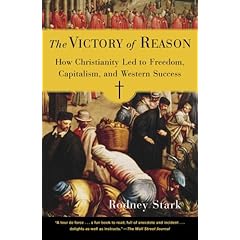 The Victory of Reason: How Christianity Led to Freedom, Capitalism, and Western Success (Random House, 2006). Stark contends that Christianity is a forward-looking religion, evincing faith in progress and in its followers' abilities to understand God over time. Such a future-based rational theology has encouraged the development of technical and organizational advances, such as the monastic estates and universities of the Middle Ages. Stark contends that these developments transformed medieval political philosophy so that democracy developed and thrived in those states, such as northern Italy, that lacked despots and encouraged moral equality. Stark concludes by maintaining that Christianity continues to spread in places like Africa, China and Latin America because of its faith in progress, its rational theology and its emphasis on moral equality. While some historians are likely to question Stark's conclusions, his deftly researched study will force them to imagine a new explanation for the rise of capitalism in Western society (from Publishers Weekly).
 The Rise of Christianity: How the Obscure, Marginal, Jesus Movement Became the Dominant Religious Force (Harper Collins, 1997).
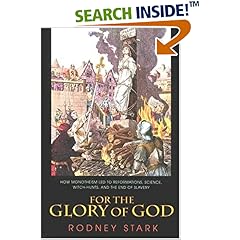 For the Glory of God: How Monotheism Led to Reformations, Science, Witch-Hunts, and the End of Slavery (Princeton University Press, 2004). In One True God: Historical Consequences of Monotheism, sociologist of religion Stark examined the nature of God, the wrath of God, the kingdom of God, the grace of God and the "chosen" of God. In this follow-up volume to his ambitious magnum opus, Stark investigates the role of monotheistic religions in reformations, witch-hunts, slavery and science. Such efforts represent an attempt by monotheistic religions to preserve the idea of the One True God against corrupting influences inside and outside the religions themselves. Stark asserts that, contrary to traditional notions, no single religious reformation can be isolated in any monotheistic religion. Thus, Christianity has experienced not simply the Reformation of Luther but many and various reformations that resulted in a diversity of sectarian movements that practice the worship of the One True God in their own ways. Stark also argues that science could have evolved only out of a monotheistic culture that viewed the world as God's handiwork, and that the witch-hunts of Europe could have taken place only in a culture marred by religious conflict and motivated by the desire to displace heretical religious sects. Despite its purported general focus on monotheistic religions, however, the book devotes very little attention to Islam or Judaism, a serious omission in a study that claims to cover so much ground. In addition, Stark's turgid prose and social-scientific style mar what otherwise could have been an engaging study (from Reed Business Information).
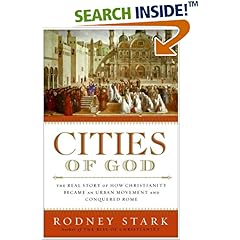 Cities of God: The Real Story of How Christianity Became an Urban Movement and Conquered Rome (Harper Collins, 2006). Contemplating the rapid spread of early Christianity, Lucian the Martyr marveled in the fourth century that "almost the greater part of the world is now committed to this truth, even whole cities." To explain Christianity's remarkable success in capturing the cities of the Roman Empire, Stark deploys an empirical social science that exposes the flaws in previous historical theorizing. By parsing records of church construction, inscriptions on tombs, and names on imperial contract permits, Stark converts plausible conjectures into testable hypotheses about the growth of Christianity in the 31 largest Roman cities. And while some of the statistically validated hypotheses fit within conventional wisdom, others compel fresh thinking. The traditional belief that Christianity spread through mass conversion, for instance, gives way to a numerically substantiated dynamics of person-to-person conversion. And despite recent acclaim for the Gnostics as the true early Christians, the evidence links the Gnostic impulse to dying pockets of stubborn paganism, not the rising new faith. Like Stark's Victory of Reason (2005), this book will spark controversy--the kind that attracts curious readers. (Bryce Christensen).
I am currently reading Cities of God and enjoying it. Stark takes a dig at the "Jesus Seminar", he contends that Paul was a missionary to the Jewish Diaspora, he contends that Gnosticism was a failed attempt to paganize Christianity, paganism was not stamped out by state represssion but gradually faded away, and the cult of Mithraism posed no competing alternative to Christianity.
Tuesday, July 17, 2007
Review of Perrin: Thomas, the Other Gospel
 I have (finally) had the pleasure of reading through Nicholas Perrin's book Thomas: The Other Gospel. The pleasure was heightened by reading it on a sunny beach on the east coast of Australia and also reading it in a small country town located amidst 65 wineries and sipping the local produce as I slowly read over the pages.
Perrin's objective is to give an accessible but scholarly introduction to the Gospel of Thomas especially admidst many (often outrageous) claims about its significance in one corner of North American scholarship. Chapters 1-3 give an overview of the Thomasine scholarship of Stephen J. Patterson, Elaine Pagels, and April DeConick. His analysis here is mostly critical, but sympathetic at certain points. The questions that these scholars seek to address provides the agenda for Perrin's own study of the Gospel of Thomas. Those questions include: (1) what accounts for the strange sequence of sayings in Thomas? (2) How might we explain the ascetical elements in Thomas? (3) Why is Thomas so interested in creation themes? (4) Why is Thomas "according to Thomas"? (5) What accounts for the disparate substance of the sayings? (6) Why are all these sayings connected with Jesus, when most of them cannot be attributed to the historical Jesus? (7) Is there a single hypothesis that accounts for the above questions in a single stroke?
For Perrin, the Gospel of Thomas is not Gnostic, rather it is a late second-century document from Syrian Christianity that exhibits features of Encratism, Hermeticism, and realized-eschatology via the influence of Tatian. To this end he draws on several areas of evidence including: evidence for the misunderstanding of sounds from a Syriac original in translation of the text into Greek and Coptic; evidence for Syriac catchwords and redaction; most Thomasine sayings follow the order in the Diatessaron; Thomas reflects Syrian asceticism associated with Tatian; Thomas draws on Tatian's logos theology; and the soteriology of Thomas reflects Tatian's own view of salvation as something essentially internal. Viewed in this light, the Gospel of Thomas should be viewed in Christian origins as part of the puzzle deriving from late second century Syrian Christianity.
This is a good introduction to the Gospel of Thomas for anyone interested. I find Perrin's proposal quite attractive, but confess that I remain agnostic about his overall thesis. I think the strength of Perrin's argument is that he makes a strong case for a Syrian provenance for Thomas, the Diatessaron may have been the first or only Gospel-like piece of literature available in Syriac at the end of the first century, the reconstruction of common catchwords in Syriac is suggestive of a Syriac original for Thomas, and perhaps the order of the sayings in the Diatessaron in comparison with Thomas is a plausible indication of dependency. On the other hand, an original Greek text for Thomas is not impossible esp. since we do have Greek fragments. Composition in Greek would have also made the document easier to spread to different environments outside of Syria as well. Basically there are simply too many unknowns in the equations to be decisive about the original language of Thomas, esp. when we are talking about texts which we do not have access too. Like many others, I am simply not qualified to be able make an informed decision about matters pertaining to Syriac, Coptic and the Diastessaron in order to be able to either affirm or disagree with Perrin's proposal in full. I also wonder about the possibility of Thomas echoing intra-Jewish debates of a former period given the reference to James and circumcision which occur in polemical contexts. Likewise, I am unconvinced that in logion 13 that Simon Peter is a cipher for the Gospel of Mark. I think Matthew and Peter both represent Jewish Christianity. Also ascetic practices were not limited to eastern Syria as vegetarianism was an issue in Romans and sexual abstinence in 1 Corinthians. The Gospel of John and its relationship to Thomas remains a burning issue that any theory on Thomas must account for, e.g. are Johannine traditions found in Thomas (R.E. Brown), is there a John vs. Thomas polemic going on (G.J. Riley), if Thomas cites the Diatessaron why the absence of Johannine material (Mark Goodacre). That being said, if Perrin is correct then there's a lot of North American scholarship that can be taken to the trash-can for good. I think Perrin's most enduring contribution will be his arguments for a Syrian origin for Thomas in the last quarter of the second century and he has made Tatian and the Diatessaron a plausible source for Thomas as well.
Mark Goodacre coveniently lists the reviews of Perrin by David Parker, Paul-Hubert Poirier, Robert Shedinger, Peter Williams, and see also the in-depth critical interaction from April DeConick.
R.T. France's New NICNT Matthew Commentary now available

I have just heard from Dove Books that Eerdmans has recently released R.T. France's commentary on the Gospel of Matthew in the NICNT series. I had always thought that this volume was cursed because everyone lined up to do it had the habit of dying prematurely, e.g. Ned B. Stonehouhouse and Robert Guelich. I imagine that this text will borrow heavily from France's smaller Matthew commentary in the TNTC series and also from his Mark commentary in the NIGTC series. Should be a good volume to test out. The blurb reads:
Eerdmans is pleased to present the much-anticipated NICNT volume on the Gospel of Matthew. R.T. France offers an extremely thorough exegesis of each section as part of a carefully planned literary whole, supplemented by verse-by verse comment. He focuses on Matthew's text as it stands, rather than the prehistory of the material or any synoptic differences, concerned with what Matthew meant to convey about Jesus. This substantial volume is a sustained attempt to read the text in the cultural and historical context of first-century Palestine, with special attention paid to the distinctiveness of Galilee and the social dynamics involved in a Galilean Messiah in Jerusalem. Based on the author's own English translation of the biblical text, and with an extensive amount of easily accessible footnotes, The Gospel of Matthew reflects both France's deep appreciation of the apostle's authorship and his sense of the importance of Matthew's subject matter.
Friday, July 13, 2007
The Theological Interpretation of Scripture
My focus on NT studies has been largely historical and I have only approached theological questions well-after thoroughly engaging the historical horizon of the biblical texts. But what of theological interpretation and its value? I understand theological interpretation to be the model of interpretation that focuses on the ecclesial context in which Scripture was written and its utility for answering the theological questions confronted by its ecclesial readers, ancient and modern, when reading these texts. That means that one consciously approaches the NT not simply as a historical artifact as any other, nor as a source book for creating religious dogma, but as a document created by Christians and for Christians that speaks fundamentally a word from God and about God. A sympathetic reading of Scripture means that faith and theological perspectives can never be divorced from reading and research of the message of the Bible itself. That does not require jettisoning the historical horizon or blanketing them with theological issues, but theological readings are not ancillary to the task of reading Scripture in and for the church.
In Defence of Gerhardsson
In Memory and Manuscript, Birger Gerhardsson argued for the use of memorization akin to rabbinic methods of learning in the transmission of the Jesus tradition. Gerhardsson argued that memorization was an important feature of education in the ancient world and was exceptionally important in Jewish education according rabbinic sources.
Gerhardsson's thesis came under severe criticism including the constant criticism that he was guilty of projecting post-135 AD views on tradition back in to the pre-70 AD period, esp. in the criticisms of Morton Smith and Jacob Neusner. And yet Gerhardsson never claimed that the rabbinic methods in toto could be traced back to before 70 AD, he always distguished materials about education from the Tannaitic and Amoraic periods, and regarded Rabbi Akiba as a definite marker in a period of transition concerning rabbinic education. His point was that Akiba did not invent memorization and some rabbinic education techniques go back to an earlier period. This is confirmed by the language of "delivering" and "receiving" traditions as stated in the New Testament itself (e.g. Mk. 7.13, 1 Cor. 11.2, 23; 15.2-3). What is interesting is that Jacob Neusner wrote the foreword to the 1998 edition of Gerhardsson's book and basically apologized for his initial review of Gerhardsson which was too reliant on Smith's dismissive essay and did not take into account Gerhardsson's nuancing of his position. On top of that Martin Hengel, Gerd Theissen, and Richard Bauckham have all found in Gerhardsson's theory a genuine analogy with the transmission of the Jesus tradition. Rainer Riesner and Samuel Byrskog have also developed and furthered Gerhardsson's thesis in subsequent publications demonstrating the robustness of his approach. That is not to say that no legitimate criticisms remain valid (e.g. how does memorization account for the diverse details in the tradition and Jesus was more of an eschatological prophet than a rabbi), but critics have been unkindly dismissive of Gerhardsson's view of the traditon.
Gerhardsson's thesis came under severe criticism including the constant criticism that he was guilty of projecting post-135 AD views on tradition back in to the pre-70 AD period, esp. in the criticisms of Morton Smith and Jacob Neusner. And yet Gerhardsson never claimed that the rabbinic methods in toto could be traced back to before 70 AD, he always distguished materials about education from the Tannaitic and Amoraic periods, and regarded Rabbi Akiba as a definite marker in a period of transition concerning rabbinic education. His point was that Akiba did not invent memorization and some rabbinic education techniques go back to an earlier period. This is confirmed by the language of "delivering" and "receiving" traditions as stated in the New Testament itself (e.g. Mk. 7.13, 1 Cor. 11.2, 23; 15.2-3). What is interesting is that Jacob Neusner wrote the foreword to the 1998 edition of Gerhardsson's book and basically apologized for his initial review of Gerhardsson which was too reliant on Smith's dismissive essay and did not take into account Gerhardsson's nuancing of his position. On top of that Martin Hengel, Gerd Theissen, and Richard Bauckham have all found in Gerhardsson's theory a genuine analogy with the transmission of the Jesus tradition. Rainer Riesner and Samuel Byrskog have also developed and furthered Gerhardsson's thesis in subsequent publications demonstrating the robustness of his approach. That is not to say that no legitimate criticisms remain valid (e.g. how does memorization account for the diverse details in the tradition and Jesus was more of an eschatological prophet than a rabbi), but critics have been unkindly dismissive of Gerhardsson's view of the traditon.
For those who want to read more see my WTJ article.
Biblical Theology for Children

As a Father with two small children I am constantly challenged as to how best to impart a Christian worldview and a knowledge of Scripture into my kids. The odd Bible story here and there and a stack of memory verses can help, but getting kids aware of the Bible story-line as a whole is a lot harder. How do ya take these gorgeous little one's from Crayons to Creation, Christ and the Consummation? Well, one good resource that I use is a Kids CD called: King, the Snake, and the Promise which tells the Bible story-line in song form from Genesis to Revelation. If you are weary of "Father Abraham had many sons", then check out this resource. It comes with the Mike Bird four star seal of approval. It is available in Australia from Koorong (see the Link).
Thursday, July 12, 2007
Non-Canonical Fallacies
Tony Chartrand-Burke lists faulty arguments in anti-apocrypha apologetics including these:
1. All non-canonical texts are Gnostic.
2. Canonical texts are early while non-canonical texts are late.
3. The non-canonical gospels are not "gospels".
4. The writers of non-canonical texts were hostile toward canonical texts.
5. Extant versions of non-canonical texts are their autographs.
The key thing is to avoid generalisations and to treat each document on its own merits and on its own terms. Then these fallacies can be avoided.
1. All non-canonical texts are Gnostic.
I agree that this is false, you only have to read Gospel of Peter to figure that one out. What is more, the Gospel of Thomas lacks the sine qua non of Gnosticism which is anti-cosmic dualism or regarding the creator of the universe as an evil demiurge, thus Thomas is probably best characterized as being on a Gnostic trajectory but not quite there yet. Alot of stuff that gets passed off as Gnostic can also be regarded as expressing an acute hellenism or else can be paralleled in Christian/Jewish mystic traditions. But many of the texts are indeed Gnostic as a cursory glance of the NHC shows and trying to say that some of this stuff is not Gnostic just Sapiential often sounds like special pleading.
2. Canonical texts are early while non-canonical texts are late.
There is certainly the possibility that many of the non-canonical texts are either earlier or co-temporous with the canonical writings (it depends when you date the canonicals I guess). But, all things being even, I think we have grounds for seeing the non-canonicals as usually dependent in some form on the canonicals. The Gospel of Thomas I think is definitely dependent on canonical tradition (be it via literary dependency, secondary orality, or from a mediating source like the Diatessaron). Many of the Jewish Gospels sound like diverse renditions of Matthew with some make shift additions.
3. The non-canonical gospels are not "gospels".
Some clearly are, but obviously not all. The Gospel of Peter is a death-resurrection Gospel and may have been part of a larger work that covered the entire ministry and passion of Jesus. The Jewish Christian Gospels were probably modelled on Matthew and followed his outline. But I do not think, pace H. Koester et. al., that Q and Thomas qualify as "Sayings Gospels". The Gospel of Mark, as the first Gospel, is probably the benchmark for any comparisons in terms of genre. To call them "Sayings Gospels" strikes me as a bit of a misnomer since they contain no joined narrative (perhaps a few narrative cameos, but no single story-line can be discerned). Note: I am not implying that a work called "Gospel" is theologically or historically superior to any other work that is not a proper Gospel. The question is does the literary form of the non-canonical documents resemble the literary form of the canonical Gospels. Sometimes it does, sometimes it does not.
4. The writers of non-canonical texts were hostile toward canonical texts.
I think that the authors/editors of Thomas saw their composition as an alternative to the canonical accounts and perhaps even as a rival to them. In some cases, these non-canonical works were merely adaptations or imitations of the canonical documents with no malign intention between them (e.g. Gospel of Peter), at other times an attempt to supplant or replace the other accounts is probable (e.g. Gospel of Thomas), and at other times there is arguably an attempt to indigenize ideas in a literary form analogous to that of the Gospels (e.g. Gospel of Mary or Jewish Christian Gospels).
5. Extant versions of non-canonical texts are their autographs.
I concur, no argument here. Still, if you think you can peel back a fourth century coptic text and discover a first century Greek text benneath, and then map out the various layers of redaction and development inbetween, then you are treading on very thin ice and are arguing for something which simply cannot be proven or falsified. There is nothing wrong with healthy conjecture and making hypothetical proposals, as long as you tell people that it is conjectural and purely hypothetical. Speculation is good and healthy, as long as it does not become dogma.
The key thing is to avoid generalisations and to treat each document on its own merits and on its own terms. Then these fallacies can be avoided.
Tuesday, July 10, 2007
What's at Stake in the Pistis Christou Debate?
Here's a thought provoking quote from Mark Reasoner:
'In the end, the best arguments for the subjective genitive seems to be its theological utility, not the lexical or syntactical difficulties of the objective genitive'.
That confirms to me that one of the reason for the attraction of the subjective genitive is not exegetical but its aesthetical appeal to certain theological implications that arise from it. Thus, it is the theological mileage that one gets out of the subj-gen view that makes it compelling.
Reasoner also says this:
'Why does it matter whether we read pistis Christou as objective (faith in Jesus) or subjective (Jesus' faith)? First, the degree to which we emphasize faith in the human affects how we present the gospel. Proponents of the subjective genitive, who hold that Christ's faith is what saves, will not call for a distinct, conversion-constituting act of placing one's faith in Jesus. They will rather call people to join the church that lives out in a concentric pattern the faith that Jesus displayed. Second, we will begin to read Paul's gospel not as primarily based around the dichotomy of works and faith, which both have a human subject, but rather as a dichotomy between law and Christ. Third, this view of pistis Christou moves students of Paul's letters to see that justification by faith is part of a bigger theme in Paul, participation in Christ.'
My comments are: (1) We should affirm that human faith only has saving value because of God's own faithfulness to Israel and creation has been expressed in the sending of his Son, and that the cross is only efficacious because Jesus himself was obedient/faithful to the Father. But that does not warrant a divide between conversion and community driven cruciformity to the example of Christ. While Paul expected Christians to follow the example of Christ's obedience (e.g. Phil. 2.5-11), he also expected them to turn from idols to God (1 Thess. 1.10). (2) We should also affirm that the primary faultlines in Paul's thinking is not over assent to theological propositions versus merit theology, but whether the salvation of the Gentiles belongs to the epoch of Moses or to the new epoch inaugurated by Jesus' faithfulness.
Sunday, July 08, 2007
Personal Website
The good thing about jet lag is that you need to find something to do between 4.00 a.m. - 7.00 a.m most mornings. After a couple of book reviews and rehashing a book project, I've decided to launch a website on wordpress that gives my various biographic and publication details. It is called: Michael Bird: Lecturer in New Testament Studies, Christian Origins, and the Theological Intepretation of Scripture. This will enable me to de-clutter the sidebar of my blog and use it exclusively for blogging purposes.
Friday, July 06, 2007
New Books from Eerdmans
New books from Eerdmans include these titles:
Greed as Idolatry: The Origin and Meaning of a Pauline Metaphor by Brian S. Rosner
Jesus and Paul Reconnected: Fresh Pathways into an Old Debate edited by Todd Still
Paul, Judaism, and the Gentiles: Beyond the New Perspective by Francis Watson
The New Perspective on Paul by James D.G. Dunn
Recovering Paul's Mother Tongue: Language and Theology in Galatians by Susan G. Eastman.
HT: The newly married Matt Montonini
Around the Blogs
Since I'm on holidays in Zion (= Australia), I'm lurking on blogs more than publishing. A few noteworthy items include:
1. My host here in Australia, Shane Becker, has a blog entitled Lifted Veil: Musings of an Incurable Lover of Jesus Christ for those of you interested in either Reformed Spirituality or New Covenant Theology.
2. Michael Pahl has a brilliant couple of posts on Tracing the Early Jesus Tradition which I recommend (two editions for the Gospel of John! Hmmm?).
3. April Deconick and Doug Chaplin debate the non-canonical Gospels and why some scholars are so apparently uneasy about the non-canonical writings. See here, here and here. I think Doug makes some excellent points on this subject.
4. My dear friend and sparring partner, James Crossley, has a response to N.T. Wright on Resurrection and Scholarly Rhetoric. James and I will be going mano-e-mano on this one in our forthcoming book and I'm not convinced by his explanation that Mark invented the story of the empty tomb or that "resurrection" very quickly came to refer to subjective visionary experiences. More on that next time around. In my mind, Crossley needs to worry more about Dale Allison's objections to him which were far more penetrating than Wright's (admittedly) off the cuff response.
A Forthcoming Book on Scripture

Towards the end of the year, IVP will be publishing a book on Scripture by my colleague Rev. Prof. Andrew McGowan, principal of HTC. This book constitutes a revamp of the doctrine of Scripture and does several things such as argues that a doctrine of inspiration should be situated as part of the doctrine of God (i.e. God speaking) rather than being part of a bibliology. More controversially, McGowan argues for a "European alternative to inerrancy" based on the works of Orr, Bavinck, and Kuyper. McGowan tries to get passed the inerrancy vs. errancy debate that characterized the 1970s and 80s. This is a fascinating volume and is well worth reading for those who want to get beyond the Bible-wars.
Monday, July 02, 2007
The Gospel According to Transformers

I just got back from seeing the new Transformers movie which I would rate at about 6.5-7.0 on the cool-movie-o-metre. Being an early 30s Gen-Xer, watching Transformers brought back alot of childhood memories. My brother and I had lots of the toys: Optimus Prime, Megatron, Starscream, Dinobots, Constructacons, Soundwave, and my personal favourite Sunstreak. One theme that kept emerging out of the movie was "no sacrifice, no victory". This I think is a fitting summary of Col. 2.15 where death and triumph are key elements of the function of Christ's death. Atonement and triumph go hand in hand. The divine victory comes ironically in the midst of death, degradation, and disempowerment. Mark 15 is a parody of the Graeco-Roman triumphal procession and the Evangelist wants us to see that Christ's death is also his coronation. Jesus proclaimed the kingdom of God and yet in the titulus above the cross, we find proclaimed the kingship of the crucified. For further details on the movie see the review by Mark Hadley.
Sunday, July 01, 2007
Mark Reasoner: Romans in Full Circle
Mark Reasoner's volume Romans in Full Circle (see Google Books for a preview) is one of the best volumes I've read in a long time. He concentrates on several loci of Romans such as 1.16-17, 3.21-26, 5.18-21, etc and he looks at how different commentators over the centuries have handled these passages (e.g. Origen, Augustine, Abelard, Aquinas, Luther, Barth, post-Barthians). I learnt several interesting things such as Origen entertained the idea of the subjective genitive interpretation for the pistis christou phrase in Rom. 3.22, Barth and Erasmus both interpreted Rom. 1.17 in terms of God's faithfulness, and there has been some interesting discussions on universalism and Rom. 5.18-21, 11.32. So far (I'm only half-way through the book) I'm disappointed that there wasn't any or much on Ambrosiaster, Chrysostom, and Calvin. I think you need to read Ambrosiaster before you read Augustine esp. on Rom. 5.12. While Reasoners sees the history of interpretation as the salvation of the individual emphasis epitomized by Augustine versus the Jew-ethne line epitomized by Origen, I think Augustine was a little more aware of salvation-historical themes than what Reasoner gives him credit for. This is a good volume that those interested in biblical and theological studies should attempt to read it sometime.
The blurb reads:
The New Testament book of Romans has played an important role in the life of the church from the period of the early church and through to the present day. In this concise survey of the major theological changes associated with Paul's letter, Mark Reasoner focuses on its history and interpretation, particularly through the works of Origen, Augustine, the medieval exegetes, Luther, and Barth. In doing so, he reveals that by a circuitous route, western Christians in the twentieth and twenty-first centuries are returning to reading Romans in ways very similar to Origen's concerns in the third century. This is true particularly in regard to issues of the human will, sensitivity to Jews and Judaism, openness to the possibility of universalism, and a deconstructive reading of the obedience to government passage in Romans 13. Thus, in addition to giving a helpful overview of Romans itself, this book will help readers situate their theological questions within the two thousand-year history of conversations about Paul's letter to Roman believers.
N.T. Wright, Paul Helm and the Ordo Salutis
Theologian Paul Helm has posted some thoughts on N.T. Wright's ordo salutis (the ordo salutis is the 'order of salvation' and it describes the chronological and logical order of the application of salvation to the believer). Here I have a few thoughts on the ordo salutis itself and Wright's understanding of it.
On the Ordo Salutis
1. As someone who comes from the Reformed tradition I am inclined to see regeneration as preceding faith. In fact, regeneration is the efficacious cause of faith in my thinking and God creates faith the same way that he made the universe: he found nothing and made something.
2. I find certain aspects of Wright's ordo salutis dissatisfying since Wright appears to make justification contingent upon regeneration which, in effect, reduces justification to an analytic judgment (it renders the verdict based on what is "there") based on spiritual vitality rather than making the verdict based on a synthetic addition (imputation or union with Christ). I think Wright is simply inconsistent with what he says elsewhere about union with Christ as the grounds of justification. Nonetheless, you cannot read Galatians 4 without realizing that reception of the Spirit and justification are part of the instantaneous experience of faith.
3. In Romans 8.29-30, Paul does give an ordo salutis of sorts (see also Eph. 1.4-5). However, what Paul is doing here is situating the story of the salvation of the believer amidst the larger story of God's cosmic plan for the restoration of creation and the vindication of the people of God at the eschaton. The key issue here is assurance that God's plan will prevail! Paul did not write Rom. 8.29-30 in order to create a neat little box that all conversions must conform to, nor did he think that an ordo salutis was the centre and goal of theology and the test for one's orthodoxy.
Limitations of the ordo salutis
1. As I've said elsewhere, Reformed Theology often reduces Theology itself to the construction of an ordo salutis. This I think was Karl Barth's criticism of the Westminster Confession of Faith, Theology becomes reduced to anthropology or what God does for humanity rather than concerning itself with the sheer God-ness of God!
2. There are roughly 24 conversions in the Book of Acts and no two of them are the same (e.g. the timing of the reception of the Spirit etc) and it is nonsensical to try make any single conversion model universal and normative for all Christians, whether that is the conversion of Cornelius, the Samaritans, the Jews at Pentecost, or even Saul of Tarsus. No systematic ordo salutis will ever survive contact with the Book of Acts!
3. Reading Galatians and Romans via the grid of an ordo salutis has done the most heinous violence to the text of Paul's letters in the history of intepretation. Romans and Galatians are not answering the question, 'What must I do to be saved?' rather they are concerned with the question: 'Who are the people of God and in what economy will they be vindicated?' Paul is concerned in these letters with the unity of Christian Jews and Christian Gentiles around one gospel, under a common Lord, and living in worshipful harmony with each other. He is not trying to refute Pelagius and Erasmus.
4. More important than an ordo salutis is a historia salutis (i.e. history of salvation). Good narrative theology that plugs into the biblical storyline, along with an acute awareness of historical context, is the antidote to bad systematic theology.
Cafe Apocalypsis is Now Open
I am glad to say that Alan Bandy's blog Cafe Apocalypsis is back up and running at his new site. Congrats to Alan for finishing his doctorate and starting his new position.
Subscribe to:
Posts (Atom)