Friday, August 04, 2006

Ecce Homo: Introducing Dr. Joel Willitts


My new co-blogger is not, as was forecast, Jeb W. Bush (he turned me down). It is none other than the Rev. Dr. Joel Willitts of North Park University.

Here's my interview with Joel:

1. Joel, tell us a bit about yourself. Where are you from? What ministry experience do you have? Why did you want to become a NT scholar? Where did you study? Who are your academic heroes?

I am originally from the State of New Jersey, but when I was a young teenager my family moved to Florida. So I consider Florida my home. Karla and I met in college and were married over 13 years ago. She is from Chicago and since we have now lived in Chicago for nearly 5 years at different points through our married years it too is home. We will now live in Chicago for the foreseeable future as I begin teaching at North Park University.

I never intended to be a NT scholar. In fact, it is werid for me to even think of myself as one. When I graduated from college back in 1993, I thought I would be a youth pastor my whole life. However, through the course of my graduate studies I became intensely passionate about study and teaching, although my passion for ministry to students is still as strong as ever. After 7 years of full time youth ministry in Texas, Florida and Chicago, I changed course and began pursuing NT research. I earned a Th.M. from Dallas Seminary in 2000 and then a M.Phil (2002)and Ph.D. (2006) from Cambridge University.

The scholars who have had the greatest impact on my academic development and are my academic heros are Daniel B. Wallace, Scott Hafemann, Markus Bockmuehl and Scot McKnight.

2. Where do you teach now and what are your research interests?

I teach at North Park University as Assistant Professor in Biblical and Theological Studies.

My research interests are Jewish Christianity, Jesus & the Gospels, Hasmonean & Roman Archaeology, Dead Sea Scrolls & NT.

3. How does academic study impact your faith?

Simply stated, my scholarship is an expression of my faith and my faith is an expression of my scholarship. I advocate a view of scholar and scholarship that is confessional in nature, by which I mean one that embraces faith-based presuppositions, although not necessarily Christian or even religious. As such, the scholar and her scholarship are humble and accountable within both her confessional community and within the wider scholarly community. Perhaps J. P. Meier's 'unpapal conclave' of a confessional Catholic, Protestant, Jew and agnostic (and/or even an atheist) can be reintroduced here with significant modification (Marginal Jew I). In my approach this conclave would be locked up in the bowels of a library not until they achieved a 'limited consensus', but until they reach a mutual understanding of each other's views; views based on their distinctive presuppositions and consequent procedures. This setting would not be any less scholarly of an endeavour as their views would be defendable and rooted in the history and culture of Second-Temple Judaism. Yet, rather than being forced to create a document that states the least common denominator, they were forced to listen to each other and learn from each other in the context of community; rather than check their convictions at the door and pursue consensus, they participate in full awareness of themselves and the others and pursue understanding; rather than debate in order to win, they discuss in order to understand, acknowledging that the truth is both self authenticating and convincing in the first instance when demonstrated in life.

4. What do think is the calling of a NT professor?

The calling of a NT professor is not primarily to impart historical and exegetical knowledge and analytical skills to students as important as these are. Instead, empowered by the Holy Spirit and at the impulse of the sovereign God a professor's teaching should lead students into a God-enraptured worldview. I believe my teaching must reach deep into the affections and capture the heart as well as the mind. By the grace of God my students will leave my classes not merely with an exegetical and theological toolbox accompanied by an analytic mind, but knowing God better than they know anything and they enjoy him more than they enjoy anything.

5. What is your relationship to the devilishly handsome Michael Bird who is your co-partner for Euangelion?

I have known Mike for over three years now. We were (and are) modern day 'Pen Pals' as he was living in Australia and I in England (now GB and USA). Back then Mike listened to a paper I had given on the Historical Jesus at the annual meeting of ETS and wrote me a letter . . . yes a letter . . . introducing himself. Who actually writes letters anymore? Well that was the start of a great friendship. The more I learn of Mike the more I like him -- he is like a good beer. Theologically we have a great deal in common, although there are some differences (e.g. he has much to optomistic view about the Thrid Quest and he wants to be the next Stanley Porter).

6. What is your favourite book of the NT and what is your favourite NT text book?

My favourite book in the NT is the Gospel of Matthew.

My favourite NT textbook (at least right now) is P. Tomson's book "If this be from Heaven" Jesus and the New Testament Authors in Their Relationship to Judaism.

7. What is distinctive about being an "evangelical" NT scholar?

I think the distinctive is related to what I discussed about faith and scholarship. The word 'evangelical' means different things to different people. Evangelical scholars, in my view, have a high view of Scripture (not necessarily equated with inerrancy) and are missional (scholarship is not just an academic exercise).

8. Why did a gorgeous and intelligent lady like Karla marry a scrawney little chap like you?

My laid-back personality and sense of humor.


We can now look forward to many pearls of wisdom and gems of learning from Joel in his posts, and we can look particularly forward to his inaugural post!

On behalf of Euangelion and Biblioblogdom - Joel, welcome to the Blogosphere!

Thursday, August 03, 2006

He is Coming!

No, not Jesus (although he is indeed coming again); but another blog member is to be added to Euangelion in the very, very, near future.

I thought it time to inject some fresh material and a new face onto the blog. The guy in question will do all of that and more! In any event, it will be a welcomed change to my normal rantings.

Watch and wait!!!

Wednesday, August 02, 2006

Jesus and the Stoic Tradition

Jesus’ wisdom does not consist of pious, timeless aphorisms on an allegedly Cynic model, as a contingent of New Testament scholars have tried to show. The true analogue between Jesus and the Stoic-Cynic tradition is rather what might be called an eschatological-ethical theme: the gods will reward and sustain the king who honors virtue, who is humane, and who is characterized by prudence (phronesis), temperance (sophrosune), justice (dikaiosune), and courage (andreia).’
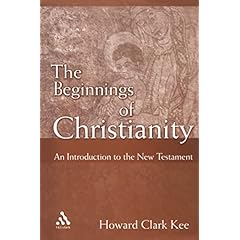
H.C. Kee, The Beginnings of Christianity, 459.

Tuesday, August 01, 2006

Colloquium 38.1 (2006).

The journal Colloquium is the official publication of the Australian and New Zealand Theological Society, which frequently depicts some of the best articles in Antipodian scholarship. The latest issue includes:

Oliphant, Rachel and Paul Babie. ‘Can the Gospel of Luke Speak to a Contemporary Understanding of Private Property? The Parable of the Rich Fool.'

Pembroke, Neil. ‘A Pastoral Perspective on the Suffering of God.’

Tovey, Derek. ‘Stone of Witness and Stone of Revelation: an Exploration of Inter-textual Resonance In John 1:35-51.’

Rivka Ulmer, John D. and Catherine T. MacArthur, ‘The Boundaries of the Rabbinic Genre Midrash.’

Whibley, M.E.L. 'A Postmodern Paradox: Collective Repentance in an Age without Sin.'

Monday, July 31, 2006

Formation of the Gospels article on-line

Thanks to the good fellas at Apollos my article "The Formation of the Gospels in the Setting of Early Christianity: the Jesus Tradition as Corporate Memory," Westminster Theological Journal 67.1 (2005): 113-94 is now available on-line.

Sunday, July 30, 2006

Churches of Asia - Revelation and Paul

In reading through Kee (Beginnings of Christianity, 331, n. 40) I thought it was interesting to note that the letters addressed to the seven churches of Revelation 1-3 are located in an area where Paul, according Acts 16.7, was forbidden from going to. Several short implications come to my mind:

(1) Was the prohibition due to the fact that Paul did not want to tread on someone elses (i.e. John's) territory (cf. Rom. 15.20)? Or did John and the Johannine circle fill in the gap left by Paul's failure to plant churches there himself? (I have to ask where does the church at Colossae and Laodicea fit into all this as well?)

(2) What does this tell us about Luke? Did Luke want to explain why no Pauline churches were established in the interior parts of Asia Minor? Or (and what I think more likely) is that Luke had genuine knowledge of Paul's itinerary.

SNTS 2006 Paper - Kloppenborg on James

One interesting paper given at SNTS was J.S. Kloppenborg: James, Diaspora, and Exemplarity. Here's the blurb.

James 1:1, 'to the twelve tribes in the Diaspora', has routinely been interpreted contrary to its literal sense as an address to Jewish-Christians or to Christians in general living 'metaphorically' in the Diaspora, away from their spiritual home. This paper argues that Jas 1:1 is to be taken in its ordinary sense, and that hte letter was (fictively) addressed to Judaeans of the Diaspora (who may have included members of the Jesus movement). The paper is then concerend with the problems of how an author, (ostensibly) writing to a general audience of Judaeans, establishes ethos , according to Aristled the key means of persuasion. The author does so by invoking and emulating exemplary figures of Israel's past, in particular Solomon, the hero par excellence of biblical wisdom, and for members of the Jesus movement, Jesus himself.
Summary of key points:

- In 1.1 "diaspora" is to be taken literally, to Jews in foreign lands.

- In 1.1 we have "the Lord Jesus Christ" not "our Lord Jesus Christ" implying that the addresees did not necessarily revere Jesus Christ in the same way as the author, although the author clearly identifies with the Jesus movement.

- In 2.1 "brothers" does not necessarily means Christians, but fellow Judaeans.

- In 2.1. Kloppenborg maks a conjectural emmandation whereby the phrase "Jesus Christ" is regarded as an interpolation in the text, so it originally read "our glorious Lord".

- The "royal law" (2.8), "implanted word" (1.21), and "word of truth" (1.18) refer to the Torah and not to Christian proclamation.

- There are echoes of the Jesus Tradition in the letter but it is subtle and only evident to those who know the tradition. James engages in an oblique rebuff of Paul, but without naming him, and in so doing addresses a standard Jewish debate about the nature of true "righteousness".

- Therefore, there is no single feature of the letter that proves that a Christian audience was in mind. This stands in some relation to other proposals like that of A.H. McNeil who supposed that James wrote to Jews in order to show the highest ideals of Judaism were to be found in Jesus and Dale C. Allison who thinks that the author wanted to promote an irenic relationship with Jews.

- According to Kloppenborg the form of the epistle is that of a "diaspora letter" similar to 2, 4 Baruch and the Epistle of Jeremiah. He makes a comparison with 4QMMT (nothing the differences too) where one religious leader tries to persuade another. Kloppenborg also places James in the context of Greco-Roman literature, so at the end of the day the letter of James is somewhat of a hybrid Christianized version of 4QMMT with Stoic influences.

- As such the concern of James is bi-focal: (1) A general Jewish audience with a strong emphasis on Torah-piety and the Wisdom of Solomon; and (2) A Christian audience, a subset of the first audience, who can recognize the Christian coding in the letter (e.g. Jesus Tradition).

My response:

(1) On "diaspora" in 1.1, the same concept emerges in 1 Pet. 1.1 where I think it is obviously "spiritualized" or at least applied to Christians. The only other use of the diaspora image in the NT is one that is fully Christian. I wouldn't argue that "diaspora" was a technical term designating Christians, but I think such language was frequently used to describe Christians. Of course, if we take "diapora" literally do we have to do the same with "twelve tribes" too? Did the author think that he was really addressing the 12 tribes, 10 of which hadn't been seen since the 7th century BC and some rabbinic authors had given up hope of ever seeing them again. Whereas, "diaspora" is somewhat ambiguous as to who it designates, I think alot of language surrounding the number "12" in the NT (e.g. Mark 3.13-13, all over Revelation) is explicitly symbolic of Christians who are the new Israel.

(2) On 2.1 with "Jesus Christ" as an interpolation, not likely in my mind. There are examples of the same phrase elsewhere in the NT. I don't see enough problems with the grammar or confusion with variants to warrant a conjectural emmandation.

(3) On implanted word, royal law, and word of truth, it could go either way. "Royal law" is quite probably Torah, but "word of truth" and "implanted word" certainly have Christian overtones. In fact, I'm certain that "word of truth" was very nearly a technical term for Christian paranesis in some places (e.g. Jn. 17.17; Eph. 1.13; Col. 1.5; 2 Tim. 2.15; Heb. 5.12). Additionally, the reference in 1.18 to "he chose to give us birth through the word of truth, that we might be a kind of firstfruits of all he created" sounds pretty Christian to me.

(4) Is "Lord" in James (with the exception of 1.1) only ever a reference to YHWH? In Christian usage the Hebrew Tetragrammaton (YHWH) is usually designated with an anarthrous Kurios while the titular ho Kurios most frequently denotes Jesus Christ (HT: Larry Hurtado's question to Kloppenborg in the Q-A).

(5) I think James supposes a rural agrarian setting rather than one set in the urban centres of the diaspora.

(6) I believe that 5.7 is a pretty clear reference to the parousia (I confess that I don't remember or didn't hear Kloppenborg's explanation of that one).

The problem is, and I think Kloppenborg and Allison are trying to address it in their own way, to account for the fact that we have a very Jewish letter here, obviously written by a Christian, but it has so little explicitly Christian content. Is that because the author simply drew on a synagogue sermon and made a few cosmetic Christian changes (Dibelius), because it was written largely to non-Christian Jews (McNeil, Kloppenborg, Allison), or because the author drew on the traditions most familar to him (Jewish Wisdom, Jesus Tradition, or perhaps even Stoicism [?]) in order to offer exhortation and spiritual discipline to a group of Jewish-Christians located somewhere in rural Syria? As the flurry of commentaries by Allison, Kloppenborg, Painter, and McKnight come out we can look forward to seeing how they answer such a question.

Meme on Books

Being the victim to fashion and peer pressure that I am, I have added my own two cents to the recent 'meme' of books that have influenced me. I have also resisted the temptation to name the Bible in any of the below:

1. One book that changed your life:

N.T. Wright, Jesus and the Victory of God.

2. One book that you’ve read more than once:

Mark A. Seifrid, Christ, our Righteousness.

3. One book you’d want on a desert island:

The Complete Works of Shakespeare and NT Diglot

4. One book that made you laugh:

Brother Biddle (can't remember the author, it's a comic strip about a presbyterian pastor, absolutely hillarious).

5. One book that made you cry:

Cry? Me? Never? Well, accept with Bruce Longenecker, The Letter's of Pergamum. I love you Antipas!

6. One book that you wish had been written:

Q !!!

7. One book that you wish had never been written:

The Left Behind Series

8. One book you’re currently reading:

Todd Penner, In Praise of Christian Origins.

9. One book you’ve been meaning to read:

Karl Barth, Evangelical Theology (just finished it too)

10: One book you wish you had written:

Dan Brown, The Da Vinci Code (With the money I made I could have gone on the mother-of-all sabbaticals, bought my college, relocated it to Brisbane Australia, and have the board make me "Chancellor-for-life" and spent the rest of my life writing massive tomes on Jesus, Paul, John and James).

Saturday, July 29, 2006

Back from SNTS

Just got back from Aberdeen and had a top time at SNTS, with both people and papers. I also caught up with some old friends like Michael Lattke and many of the Aberdeen Ph.D canidates like Preston, Roh, Ozzy and Joey who always warm my heart when I share their company. It was a job well done by Francis Watson and the divinity faculty in organizing the event and it all went well (even when the police had to get involved!).

Forgive the endemic 'name dropping' but I met some good people. At a dinner I had the pleasure of sitting between Jimmy Dunn and Marianne Thompson which was great - Christianity in the Making volume 2 is about 2 years away. It was good to learn that there is at least one biblical scholar in the world shorter than me, i.e. Richard Bauckham. Always good to have a chat with David Wenham, I. Howard Marshall, and Craig Blomberg too. I finally got acquainted with two great Aussie scholars in the line of Bill Loader and John Painter over breakfast. It was wonderful that Christoph Stenschke introduced himself to me and we chatted about German politics and the benefits of scholarship - a most likable fellow. Probably a big highlight for me was lunch with Mark Seifrid which I had been looking forward to for weeks. I helped Richard Hays find his room and the restaurant so I figure that he owes me a coke (I may call that one up one day). Ulrich Luz stood behind me one day and started adjusting my collar without being asked (or invited) but that was cool. Chris Stanley is an energetic and interesting fellow to talk too, a funny guy as well. I started chatting to the only other red head there only to learn that it was noneother than Beverly Gaventa. Also attended my first service in Deutsche and apart from 'unser vater' and a few verses in the Hymn it didn't make a lot of sense.

I picked up a coupel of cheap books including Luke 1 by F. Bovon and Colossians by M.M. Thompson.

The group seminars I went to weren't great, but the main papers were pretty good. I will post some thoughts and notes about some of the papers in the next few days.

Leon Morris passes away

Sadly, Leon Morris passed away on Monday at the age of 92. Leon is probably one of the greatest evangelical scholars ever to come out of Australia. His work on the atonement in the New Testament (esp. in combat with Dodd) in without peer, while his commentaries on Matthew, Luke, John, Romans, Revelation, 1-2 Thessalonians, studies on Johannine theology and also NT Theology made a visible contribution to NT scholarship and preaching of the Word through-out the world. May he enjoy eternity doing what he would probably want to do most of all: kneel before the throne of the Lamb of God.

See posts by Justin Taylor, Peter Head, and Scot McKnight

Monday, July 24, 2006

Off to SNTS


Tomorrow morning I'm heading off to attend the prestigious Studiorum Novi Testamenti Societas being held at Aberdeen this year. I was lucky enough to get an invitation from my Doktorvater Rick Strelan. The seminar list looks quite interesting:

Catholic Epistles and Apostolic Traditions (Katholische Briefe und Aposteltraditionen) (Profs E. Baasland, K.W. Niebuhr and R. Wall).

Colossians (Profs P. Müller and W. Popkes).

The Greco-Roman World of the New Testament: Language, Culture, Ideas (Docent Dr. L. Rydbeck and Prof. S. E. Porter).

The Greek of the New Testament (Profs C. C. Caragounis and J. W. Voelz).
Inhalte und Probleme einer neutestamentlichen Theologie (Profs U. Schnelle and M. Seifrid).

The Johannine Writings (Prof. Dr R. Bieringer and Prof. C. R. Koester).

The LXX and the NT (Profs W. Kraus and W. R. G. Loader).

The Mission of the Church: Exegesis and Hermeneutics (Profs H. Kvalbein, T. Okure and D. Patte).

New Challenges for New Testament Hermeneutics in the 21st century (Profs. B. McLean & O. Wischmeyer).

The New Testament in History and Culture (Profs R. Fowler, W. Kelber and B. Olsson).

The New Testament, Oral Culture and Bible Translation (Drs P. H. Towner and G. L. Yorke; advisory co-chair Prof. J. D. G. Dunn).

Paul and Rhetoric (Profs P. Lampe and J. P. Sampley).

The Pseudepigrapha and Christian Origins (Profs J. H. Charlesworth and G. S. Oegema).

The Reception of Paul (Profs D. Marguerat and D. Moessner)

Shaping Traditions about Jesus (Profs I. Gruenwald and P. Pokorny).

Textual Criticism (Profs H-G. Bethge and J.K. Elliott).
I'm not a 100% on which seminars I'll be attending, but something like Colossians, the LXX and the NT, and Shaping Jesus Traditions sounds good to me.

Friday, July 21, 2006

The New Covenant People in the NT

I'm currently reading through Howard Clark Kee, The Beginnings of Christianity: An Introduction to the New Testament (New York: T&T Clark/Continuum, 2005) which is essentially a Christian Origins approach to a NT introduction. Kee makes some interesting points about the teaching of the new covenant people in the NT and the Apostolic Fathers:

Jesus’ teaching about the new covenant people of God in the Gospels:

1. How one becomes a member of new people of God.
2. How one is to live in relation to God, other members, and the wider world.
3. How one is to celebrate membership.
4. What one is to expect as God fulfils his purpose for and through his people.
[I wonder if this kind of stuff would make better subject matter for a church membership class than some of the Baptist booklets that I've seen, read, and had re-read to me again and again or every time I moved and changed church and applied for membership].

The teachings about the church in the apostolic fathers and Didache.

1. The prospect of martyrdom for those committed to Jesus and the new community.
2. The need for obedience to leaders in the church.
3. How Christianity is to be differentiated from Judaism
4. How Christians are to behave within their own community and the wider world
5. What is true of Christian doctrine and what Christians should expect in the future.
[Maybe this stuff was emphasized in the apostolic fathers and didache, but I'm fairly sure that I could find these themes in the Gospels, Acts, Paul and Catholic epistles in varying degrees. Sounds alot like Hebrews to be honest.]

In some, I like the first set of points, but I'm not so sure that the second set of points represents a distinct development in the post-apostolic period.

Howard Clark Kee, The Beginnings of Christianity: An Introduction to the New Testament (New York: T&T Clark/Continuum, 2005), 64-65.

McKnight on Seven Theological Convictions of Paul

Paul’s theology is not systematics; instead, he is grasped best when at least the following seven Pauline principles are kept on the table as we proceed through his letters. First, the gospel is the grace of God in revealing Jesus and Messiah and Lord for everyone who believes; second, everyone stands behind one fo the twin heads of humanity, Adam and Christ; third, Jesus Christ is the centre stage, and it is participation in him that transfers a person from the Adam line to the Christ line; fourth, the church is the body of Christ on earth; fifth, (salvation-)history does not begin with Moses but with Abraham and the promise God gave to him, and finds its crucial turning point in Jesus Christ – but will run its course until the consummation in the glorious Lordship of Christ over all; sixth, Christian behaviour is determined by the Holy Spirit, not the Torah; seventh, Paul is an apostle and not a philosopher or systematic theologian. These principles spring into action when Paul meets his various threats (circumcision, wisdom, gifts, works of Torah, ethnocentrism, flesh, rival leaders, and eschatological fights about the Parousia or the general resurrection).
Scot McKnight, Jesus and His Death: Historiography, The Historical Jesus, and Atonement Theory (Waco, TX: Baylor University Press, 2005), 374.

J.A.T. Robinson on Historical Tradition and the Fourth Gospel

Yet when we come to the teaching of Jesus we see him [John] using a different technique to the same end, though the difference is one of degree rather than of kind, for the works and words of Jesus are not sharply distinguished. John is still concerned with what Jesus is really saying and meaning, and the words, like his actions, can be understood at different levels. Yet he does not simply set them down straight, and then comment upon them – allowing the sayings and their interpretation to stand side by side, with the raw material presented in its untreated state. Rather, it is worked up; the interpretation is thoroughly assimilated and integrated.
J.A.T. Robinson, The Priority of John (Oak Park, IL: Meyer Stone, 1987), 72.

I have two questions about this comment:

(1) Is it a fair assessment of how John simultaneously transmits and interprets the Jesus tradition so that memory, history, hermeneutics, and theology are all intertwined?

(2) Could this statement be applied to the canonical Gospels as a whole?

In an on-line interview with Alan Bandy, Craig Evans made some similar remarks about John and History (see the remarks here).

Wednesday, July 19, 2006

Harnack on the Significance of Paul

One might write a history of dogma as a history of the Pauline reactions in the church, and in doing so would touch on all the turning points of the history. Marcion after the Apostolic Fathers; Irenaeus, Clement and Origen after the Apologists; Augustine after the Fathers of the Greek Church; the great Reformers of the Middle Ages from Agobard to Wessel in the bosom of the medieval Church; Luther after the Scholastics; Jansenism after the Council of Trent; everywhere it has been Paul, in these men, who produced the Reformation. Paulinism has proved to be a ferment in the history of dogma, a basis it has never been.


Adolf von Harnack, History of Dogma (trans. Neil Buchanan; Boston: Little, Brown, 1901), 1.136.

Position at Malyon College

My old seminary Malyon College (formerly Queensland Baptist College of Ministries) in Brisbane, Australia is seeking a new lecturer in the field of either: Old Testament, Missiology, or Pastoral Studies. For further information read the advertisement.

Tuesday, July 18, 2006

Reforming Reformed Theology

At the Tyndale Conference Andrew McGowan (principal of HTC) presented an excellent paper on the doctrine of Scripture. One thing caught my hears: Karl Barth noted that the Westminster Confession of Faith (WCF) spends between 70-80% of its sections dealing with individual salvation and personal assurance. That made me think of two things:

1. Surely the issue of how humanity gets right with good should not occupy such a large proportion of theology. The danger I feel is that theological discourse shifts the focus from God (i.e. theology proper), to what God does for humanity (soteriology and anthropology). The trend since the reformation, from Melanchthon to Tillich, has been to reduce Christology to soteriology and likewise reduces Christology to anthropology (i.e. Christology is how Christ saves sinners). I'm not trying to hack on the WCF (me genoito), but I think that Christian Theology should have as its backbone Theos and Christos and not an ordo salutis. To over emphasize soteriology (even for a good cause) can inevitably lead to too much anthropology and to a liberalism that has little place for God. So what is the goal of theology or what should a confession try to do? The goal of Christian Theology is to set forth the sheer God-ness of God and the magnificence of Jesus the Messiah for the Christian life.

2. The WCF was written to address the prevailing problems of its own day esp. debates over salvation; but the issues of today are different. Perhaps we need a new confession that deals not so much with personal soteriology, but grapples with other burning issues like sexuality, hermeneutics, bio-ethics, culture, globalisation, Islam, Israel, women in ministry, etc.

Highlights from Tyndale Conference

These include:

(1) Chris Wright's lecture on social transformation and mission.

Chris did a good job of describing the social concerns of the OT and its NT appropriation. He also said that the issue of balancing social justice and evangelism continues to plague evangelicalism. He didn't like the notion of the "priority" of evangelism since "priority" all to quickly becomes "only". Instead he preferred the "ultimacy" of evangelism.

(2) Drinkies with Steve Walton and Paul Woodbridge at a pub called "The Leopard".

(3) The realization that about 10% of the conference participants were Australian.

All of the Aussies were from NSW except me being from QLD. Oh, the joy in informing these NSWer's that QLD beat NSW in the deciding State of Origin match (i.e. rugby league version of the super bowl).

(4) Gary Burge's paper, "Land inheritance the ethics of the OT prophets for Christian views of justice".

Superb presentation on the mis-application of the OT passages to the situation in the middle east. There are even Christians out there who think that Israel should conquer the land in the same manner as Joshua did and simply drive out or exterminate the populance. I also learnt that the most popular text in Palestinian Christian circles is 1 Kings 21 on Naboth's Vineyard.

(5) K.A. Kitchen's paper on ANE archaeology and the OT.

I liked his point that we should be modest and not minimalist in our conclusions (I couldn't help but think of Jim West and Joe Cathy here).

(6) I. Howard Marshall taking notes.

Howard Marshall has probably forgotten more than many us will ever know about the NT; but at every session he attended this fella took notes. This taught me a few things: the learning never stops and always take a notebook and pen to a lecture no matter what topic, lecturer, or ocassion.

(7) Meeting 3 Italian guys at the conference who were rather thrilled (to say the least) by Italy's semi-final victory over Germany.

Monday, July 17, 2006

Augustine on the Purpose of Romans


After finishing a book on Paul and arguing at length that Romans is concerned both with ethnocentrism and a quasi-legalism (what I call "ethnocentric nomism") I discovered that Augustine himself said something similar long ago:

The Letter of Paul to the Romans, in so far as one can understand its literal content, poses a question like this: whether the Gospel of our Lord Jesus Christ came to Jews alone because of their merits through the works of the law, or whether the justification of faith that is in Christ Jesus came to all nations, without any preceding merits for works. In this last instance, people would believe not because they were just, but justified through belief; they would then begin to live justly. This then is what the apostle intended to teach: that the grace of the Gospel of Lord Jesus Christ came to all people. He thereby shows why one calls this “grace,” for it was given freely, and not as a repayment of a debt of righteousness.
Paula Fredriksen Landes, Unfinished Commentary on the Epistle to the Romans I.1, Text and Translations 23, Early Christian Literature, series 6, ed. Robert L. Wilken and William R. Schoedel (Chico, CA: Scholars, 1982), 53.

Why Reformed and NPP commentators have missed this passage remains oblivious to me. Of course, I count myself among the ignorant!

Romans Commentaries 1532-1542

I am grateful to Gerald Bray who not only alerted me to the existence of T.H.L. Parker's book Commentaries on Romans 1532-1542, but even sent me a copy he found on sale!

During this period no fewer than 35 commentaries were published! Parker surveys 11 of them including:

Catholics

Cardinal Caietan
Gagney of Paris
Cardinal Marino Grimani
Guilliaud of Paris and Autun
Haresche of Paris
Cardinal Sadoleto

Reformers

Martin Bucer
H. Bullinger
Pellican of Zurich
John Calvin
Philip Melanchthon

Parker looks at three key passages: Rom. 1.18-23; 2.13-16, and 3.20-28.

Riveting stuff, esp. what different guys have to say on 2.13-16!


I particularly found interesting the notes on Martin Bucer who has always intrigued me. Martin Bucer appears (I think) to have understood Rom. 2.13-16 to be refering to Christians since only those who are devoted to the Law can actually do the law. The works of the law which justify are Christ's works operating in us through faith [This reminds me of Seifrid in many ways]. Bucer also takes the "works of the law" in 3.20 to be "ceremonies", but it is used as a synecdoche and stands for the whole law. Many of the Reformers, esp. Calvin, repudiated the idea that the works of the law denotes the ceremonial law.

Karl Barth on Evangelical Theology

Over the summer I plan on reading Karl Barth's Evangelical Theology: An Introduction. Here is an interesting quote I found this morning.

[T]he theology to be introduced here is evangelical theology. The qualifying attribute “evangelical” recalls both the New Testament and at the same time the Reformation of the sixteenth century. Therefore, it may be taken as a dual affirmation: the theology to be considered here is the one which, nourished by the hidden sources of the documents of Israel’s history, first achieved unambiguous expression in the writings of the New Testament evangelists, apostles, and prophets; it is also, moreover, the theology newly discovered and accepted by the Reformation of the sixteenth century. The expression “evangelical,” however, cannot and should not be intended and understood in a confessional, that is, in a denominational and exclusive, sense. This is forbidden first of all by the elementary fact that “evangelical” refers primarily and decisively to the Bible, which is in some way respected by all confessions. Not all so-called “Protestant” theology is evangelical theology; moreover, there is also evangelical theology in the Roman Catholic and Eastern orthodox worlds, as well as in many later variations, including deteriorations, of the Reformation departure. What the word “evangelical” will objectively designate is that theology which treats of the God of the Gospel. “Evangelical” signifies the “catholic,” ecumenical (not to say “conciliar”) continuity and unity of this theology. Such theology intends to apprehend, to understand, and to speak of the God of the Gospel, in the midst of the variety of other theologies and (without any value-judgment being implied) in distinction from them. This is the God who reveals himself in the Gospel, who himself speaks to men and acts among and upon them. Wherever he becomes the object of human science, both its source and its norm, there is evangelical theology.
Karl Barth, Evangelical Theology: An Introduction (trans. Grover Foley; Great Britain: Collins, 1963), 11-12.


Anything that makes us ponder the meaning of "evangelical" in "evangelical theology" is worth reading!

Also in the introduction (p. 9) Barth says "But many things can be meant by the word 'God'." This reminded me of NT Wright and his book NTPG who is consistent, albeit eccentric, in his use of "god" in the lower case on the grounds that the word does not have any meaning until you define it. I'm assuming that the goal of COQG (Christians Origins and the Question of God) is take readers from "god" to "God revealed in Jesus Christ".

Sunday, July 16, 2006

Uniting Church of Australia

The UCA is the most liberal and most declining denomination in Australia. A group of orthodox believers in the UCA look like they have finally decided to depart from the denomination and set up their own affiliate organization (many already have when presbyteries were permitted to ordain gay clery). You can read an article about it in the Australian Newspaper. The national assembly website is located here where more news is available. For more info on evangelicals in the UCA see the Reforming Alliance who it seems has failed to reform the UCA!

I know some good folks in the UCA and it is such a pity that they feel that they can no longer stay, but it was inevitable. Please uphold the embattled orthodox believers in your prayers. It looks like the battle is lost and now begins the struggle to retain church property.

Evangelical Review of Theology 30.3 (2006)

The latest issue of ERT is out and includes the following:

David Hilborn and Don Horrocks
Universalism and Evangelical Theology

Brian Edgar
Biotheology: Theology, Ethics and the New Biotechnologies

Bonjour Bay
Glossolalia in Korean Christianity: An Historical Survey

Minho Song
Contextualization and Discipleship

John Lewis
Farewell Gerasenes: A Bible Study on Mark 5:1-20

Corinthians Commentaries


As I'm getting ready to run an honours level course on 1 Corinthians, I've had good fun checking out some commentaries on them. I am quite impressed with Richard B. Hay's volume in the Interpretation series. In particular, it has a good mix of exegetical comment and also practical application. Hay's notes on the Last Supper are worth the price of the book itself. I'd place this under Thiselton as the number two commentary on 1 Corinthians. If you're teaching or preaching through 1 Corinthians make sure you at least check out Hays on this NT epistle. Some of his comments could easily constitute points for your sermon!

I am currently reading through Craig Keener in the NCBC series also but will have to wait before I render a verdict on its utility for teaching and preaching. I've also used Wolfgang Schrage a little, but I need to improve my German and gain access to it again before really grappling with his approach to 1 Corinthians. I found Richard Horsley a bit disappointing, but I still go back to Gordon Fee (NICNT) for his excellent treatment of the letter. Sadly, I have not used Ben Witherington much and do not know how good his volume is or is not.

Any other commentaries on 1 Corinthians that you have found useful?

Friday, June 30, 2006

Markus Bockmuehl's new book


Markus Bockmuehl lectures at Cambridge University (see his website: New Testament Teaching Resources) and he has a new book out entitled: Seeing the Word: Refocusing New Testament Study (Grand Rapids, MI: Baker, 2006).

I haven't been able to find out much about the contents, but I imagine that it might be similar to his articles on New Testament study such as the following:

2004. ‘What’s Under the Microscope? Revisiting E.C. Hoskyns on the Object of New Testament Study.’ Theology 107: 3-13.

1998. ‘Humpty Dumpty and New Testament Theology.’ Theology 101: 330-38.

1998. ‘“To Be or Not to Be”: The Possible Futures of New Testament Scholarship.’ Scottish Journal of Theology 51: 271-306.

Israel, Palestine, the Church, and Eschatology


Several things prompt me to write a post on the controversial topic of Israel and Palestine. I was spurned on by the intriguing post of Ben Witherington Pray for Peace of Jerusalem and Madeleine Albright's book The Mighty and the Almighty which you can read about at CT that (apparently) makes some reflection on God, America, and Politics post-9/11.

Let me say that I am convinced of two basic premises: (a) Israel has the inalienable right to exist in peace, free from terrorism and violence. Suffice to say, I am not a big fan of the President of Iran. (b) The Palestinians need a homeland and one free from walls, check-points, tanks, and rocket attacks. The Israeli occupation of the West Bank is completely illegal.

I am not a fan of the mainline American denominations that want to divest funds from Israel and fail to censure acts of terrorism against the small Israeli state. (In fact some of these denominations love to complain about the human rights abuses perpetrated in Israel, Iraq and Guantanamo bay, but curiously never get round to mentioning absuses perpetrated in Sudan, Saudi Arabia, China or North Korea). I am even less of a fan of ultra-conservatives in American Churches that support Israeli policies uncritically on the grounds that the establishment of the Jewish state in 1948 was a fulfillment of biblical prophecy.

Acts 13.32-33: 'And we bring you the good news that what God promised to the fathers, this he has fulfilled to us their children by raising Jesus.'

2 Corinthians 1.20: 'For all the promises of God find their Yes in him. That is why it is through him that we utter our Amen to God for his glory.'

(Those who are familiar with Graeme Goldsworthy's work will know that these verses form the rubric of his approach to biblical theology).

As I see it, God's promises to Israel were complete and fulfilled in the handing over and raising up of Jesus by God the Father. There is of course still the hope that national Israel will respond to the message of Christ (either as individuals or en masse) but the establishment of Israel in 1948 was not something forecast in the Book of Revelation which we must uphold despite the cost it brings upon the Palestinians.

Let me also be clear that I do not think the Church completely replaces Israel (contra Covenant Theology); nor do I think that a hard and fast distinction can be made between the Church and Israel (contra Dispensationalism). Instead, the church is the representative of Israel in the Messianic age and by virtue of their faith in Jesus Christ they are constituted as the people of God in the era of the New Covenant. I think this comports with the more or less "Reformed" view, but I've had people tell me that I sound like a progressive dispensationalist too.

For sound and sober reflections on the topic from a progressive dispensational perspective I recommend the article by Darrell Bock Some Christians See a 'Road Map' to End Times from the LA Times.

I recommend also the following resources:

Colin Chapman, ‘God’s Covenant – God’s Land,’ in The God of Covenant, eds. Jamie A. Grant & Alistair I. Wilson (IVP, 2005), 221-56.

Gary M. Burge, Who Are God’s People in the Middle East? What Christians Are Not Being Told About Israel and the Palestinians (Zondervan, 1993).

Gary M. Burge, Whose Land? Whose Promise?: What Christians Are Not Being Told About Israel and the Palestinians (Pilgrim, 2003).

Thursday, June 29, 2006

1689 LBC (11.2) on Justification

Faith thus receiving and resting on Christ and his righteousness, is the alone instrument of justification; yet it is not alone in the person justified, but is ever accompanied with all other saving graces, and is no dead faith, but worketh by love.

A useful site: Text Excavations

One superb site I just found is called Text Excavation run by Ben C. Smith which contains an excellent listing of primary sources for ancient Jewish and Christian texts. Including things like a list of all patristic sources that make reference to Jewish Christian Gospels. Includes translations and primary source languages! Besure to browse it. Ben, you deserve a coke!

Where I'm going next week?

See if you can guess the places where I'm going next week:

1. A conference associated with the name of the guy on the left and I look forward to meeting the Australian expat on the right.


2. Then for a holiday I'm off too:


3. After which time I will be besieged by my:

Chrysostom on Rom. 16.7

"Greet Andronicus and Junia ... who are outstanding among the apostles": To be an apostle is something great. But to be outstanding among the apostles - just think what a wonderful song of praise that is! They were outstanding on the basis of their works and virtuous actions. Indeed how great the wisdom of this woman must have been that that she was even deemed worthy of the title apostle. (In ep. Ad Romanos 31.2).

For an alternative perspective on Rom. 16.7 see the post at CBMW.

Wednesday, June 28, 2006

Sexuality in the Bible

For those in denominations fighting over issues pertaining sexuality and the Bible in the PCUSA, United Methodist Church, or the Episcopalian Church (or is it Episgaypalian, I can't remember anymore?) you may find resources by Dr. Robert Gagnon especially helpful. His book The Bible and Homosexual Practice: Texts and Hermeneutics (Nashville: Abingdon, 2001) is simply the best one around. I can honestly say that I have never seen a book with so many endorsements from top scholars inside the dusk cover (from Moo to Aune!). Otherwise, more recently, there is Thomas R. Schreiner, "A New Testament Perspective on Homosexuality," Themelios 31 (2006): 62-75.

The Bird's Nest

I should probably take the time to mention my wife's blog The Bird's Nest which could probably be subtitled: "The Britification of Three Aussie Girls". Which includes photos of some of the most gorgeous girls in the world!!!

A Prayer of John Chrysostom


Almighty God, you have given us grace at this time with one accord to make our common supplication to you; and you have promised through your well-beloved Son that when two or three are gathered together in his Name you will be in the midst of them: Fulfill now, O Lord, our desires and petitions as may be best for us; granting us in this world knowledge of your truth, and in the age to come life everlasting. Amen.

The Gospel for all Nazarenes?

It is often thought that the Gospels were written for isolated and introspective communities. So Matthew was written for a 'Matthean community' and Luke for a 'Lucan community' etc. When Richard Bauckham questioned this assumption in the book The Gospel for All Christians, and advocated that the canonical Gospel authors probably had broader audiences in mind, several scholars responded by appealing to the extra-canonical Gospels (e.g. Gospel of Thomas, Gospel of Peter, and Gospel of the Hebrews). The argument goes something like this:

(1) The extra-canonical Gospels are sectarian and were written for sectarian groups.
(2) The canonical Gospels also exhibit sectarian tendencies.
(3) Therefore, the canonical Gospels were written for sectarian groups as well.

I'm in the process of contesting this claim. Let me give one example. Let's take the Gospel of the Nazarenes (read about it at Text Excavation). It is thought that this Jewish Gospel was composed for a small Jewish Group called the Nazarenes known to Jerome and Epiphanius. Yet Tertullian (Adv. Marc. 4.8; cf. Acts 24.5) notes that the label ‘Nazarenes’ was used by Jews to designate Christians in general and not a specific group of Christians. If ‘Nazarenes’ in Gospel of the Nazarenes has this Jewish meaning of ‘Christians’ in general, then we may have here a document effectively named, to Jewish ears at least, the Gospel of the Christians. One can scarcely think of a more universal title for a book. Thus, some of the extra-canonical Gospels may not be quite so sectarian as many persons think.

Is the Gospel of Peter Docetic?

For translations of all of the patristic citations and papyri fragments associated with the Gospel of Peter see the site Text Excavation.

Eusebius mentions Gos. Peter on three occasions (Hist. Eccl. 3.3.2; 3.25.6-7; 6.12.1-6) and on the third he records that about the year 200 Bishop Serapion of Antioch prohibited the reading of the Gospel of Peter in nearby Rhossus, a city of Syria lying northwest of Antioch. On a former visitation to that church he had allowed the congregation there to read the Gospel of Peter (a work till then unknown to him) in its services. Afterwards however, when heresy broke out in Rhossus some appealed to the Gospel of Peter in support of Docetism. Serapion then scrutinized the document and, finding some parts of it to be unorthodox, he rejected it as a forgery.

The text which Serapion refers to is probably to be identified with the Akhmim fragment. (But for a more careful opinion see Paul Foster, ‘Are there any Early Fragments of the So-Called Gospel of Peter?’ NTS 52 [2006]: 1-28). A translation is available on the above site or try the one at Gospel Net.

Is the Akhmim fragment/Gospel of Peter docetic? Have a look at 4.10; 5.19.

There are several verses that are often thought to support a docetic interpretation. The comment that during the crucifixion ‘he kept silent as though he had no pain’ (Gos. Pet. 4.10) could imply an absence of physical suffering or valiant heroism. Just before he dies the Petrine Jesus cries out, ‘my power, my power, why have you forsaken me’ (Gos. Pet. 5.19) which might signify the departure of the Logos, divine aeon, or Christ-Spirit from Jesus upon his death. Alternatively, ‘power’ (dunami) could be a circumlocution for the divine name (e.g. ‘The Son of Man seated at the right hand of the Power’ in Mk. 14.62, Mt. 26.64; cf. ‘power of God’ added in Lk. 22.69) and is an alternative citation of Ps. 22.1-2. The statement here is no more docetic than Mk. 5.30 where Mark reports that ‘Jesus knew in himself that the power proceeding from him had gone out from him’. The same is perhaps true of the following phrase where it states ‘and after saying this he was taken up’. This could conceivably mean a variety of things including the separation of a heavenly being from the man Jesus at the cross, a confusing reference to an ascension of Jesus’ Spirit at the cross, or merely exclaiming that Jesus died and went to be with the Father somewhat akin to the Lucan Jesus’ prayer: ‘Father, into your hands I commend my spirit’ (Lk. 23.46). If one were concocting an explicitly docetic and/or gnostic interpretation of Jesus’ death then something akin to the Nag Hammadi Apocalypse of Peter would be more appropriate. There Peter witnesses Jesus ‘seemingly’ being seized to be crucified and he then looks upon the cross and observes the ‘living Jesus’ above the cross laughing, on the cross is someone else a ‘substitute being put to shame who came into being in his likeness’, and the ‘Saviour’ explaining the events of the cross to Peter (Apoc. Pet. 81). In retrospect, the Gospel of Peter is not explicitly docetic but it was obviously congenial to a docetic interpretation given its use by Docetists in Rhossus and Serapion himself claimed no more than this. The author(s) may have docetic sympathies or consciously embedded docetic features in the document in deliberately cryptic fashion, but this element is clearly subdued and does not dominate the text. Another possibility is that the docetic elements represent a later gloss.

If the Gospel of Peter is not explicitly docetic it may not be as sectarian as many scholars suppose and it may have been written to be read alongside (or in lieu of) the canonical Gospels.

Monday, June 26, 2006

Where Christology Titles Mix

In reading through John 1.49-51 I was amazed how the Christological titles Son of God, King of Israel and Son of Man all occur in such close proximity. Are these titles synonymous, do they overlap conceptually, or are they different ways of expressing Jesus' messiahship?

The Messiahship of Jesus in the Gospels is one of my "rolling" projects. I've written one article on it so far (on Mark) and hope to write one per year on the Messiah in Luke(-Acts), John, and Matthew, and will hopefully publish them in a collected volume. I'm pursuing this because I think that the Evangelists spend alot of time trying to convince people that Jesus is the Christ. Why did they do that and what did they would achieve by doing so? In the case of Mark, I think he's making an apology for the cross (HT to Bob Gundry) and proclaiming the authority of the crucified Messiah.

For that reason I'm looking forward to Graham Stanton's paper at BNTC on this very topic of the Messiahship of Jesus in the Gospels.

Saturday, June 24, 2006

Grading Papers


I have had a lull in blogging since the frenzy of marking began about 3 weeks ago. So I'm back, at least until I go on my summer holiday to cornwall with my Aussie in-laws, for a while.

After marking papers on Pauline Theology I have discovered some startling facts:

- Galatians 6 is part of Paul's narratio.

- Certain scholars of a liberal bent regard substitutionary atonement as a form of "comic child abuse".

The Son of God and the Cross


In an article on the Gospel of Mark (RTR 2005) I argued that Mark is an apology for the cross and that Mark wants his readers to believe that Jesus is the Son of God not despite the cross, but precisely because of it!

In support of that idea I found this interesting quote from a footnote in Scot McKnight's book on Jesus and His Death:

"From saying that Jesus was the Messiah despite the event of the cross they came to say that he was the Messiah in virtue of that event."
- W. Manson, Jesus the Messiah (London: Hodder & Stoughton, 1943), 169.

Parousia for Paranesis


What function does the parousia (second advent or return of Christ) have in sections of the NT? I am convinced that it is not simply an encourgement for people to buy fire insurance so that they will spend eternity playing volley ball on the clouds with the angels in heaven. It is about the consummation of God's justice in a world that is brutal and dark. It is an encourgement to the oppressed and downtrodden. It is an exhortation to discipleship and perseverance. Consider these two exhortations from two different writers:

"For the Lord himself will come down from heaven, with a loud command, with the voice of the archangel and with the trumpet call of God, and the dead in Christ will rise first. After that, we who are still alive and are left will be caught up together with them in the clouds to meet the Lord in the air. And so we will be with the Lord forever. Therefore encourage each other with these words." (1 Thess. 4.16-18)

"And let us consider how we may spur one another on toward love and good deeds. Let us not give up meeting together, as some are in the habit of doing, but let us encourage one another—and all the more as you see the Day approaching." (Heb. 10.24-25).

I wonder how the parousia fits into a view of Christian discipleship and ethics without lapsing into a Left-Behindesque fiasco?

Luke, Shame, Kingdom, and Prayer - some reflections by a NT tutor

After teaching a course on Jesus and the Gospels which focuses on Luke's parables and another course on Luke-Acts, it has really driven home to me just how many of Luke's parables, esp. those about prayer, appeal to God's honour or not shaming God as a basis for prayer or action.

The parable of the friend at midnite (Lk. 11.5-8) makes the point that God welcomes "shameless" audacity (anadeia) in prayer and will answer because his honour is on the line.

The parable of the persistant widow (Lk. 18.1-8) likewise appeals to God's honour as the basis of his action since he does not want to be worn down or shamed like the unjust judge with the widow.


The parable of the Shrewd Manager (Lk. 16.1-14) seems to propose the idea that the role of disciples is to accrue honour to God by placing others in his debt.

What is quite shocking about many of Luke's parables is that the figures who symbolize/represent God are quite harsh or unsympathetic. Consider these three examples:

1. The "man of noble birth" in the parable of the Ten Minas (Lk. 19.11-27) who was probably based on Archelaus son of Herod the Great.

2. The "manager" in the parable of the Shrewd Manager (Lk. 16.1-14)

3. The "friend" in the parable of the Friend at Midnite (Lk. 11.5-8).

What does this tell us about Luke's doctrine of God? Is Luke being ironic? Is Luke trying to drive home the impartiality and severity of God's judgments? Of course such parables need to be juxtaposed with the parables of Luke 15 and the "lost things" like the coin, sheep and son which underscore the radical compassion of God. Still, it makes for some interesting thinking.

Adolf Schlatter


For an appreciation of the work of Adolf Schlatter see the post by Andreas Kostenberger at his blog Biblical Foundations.

Baur und Bauer

For two studies that deal with the works of F.C. Baur and Walter Bauer see:

I. Howard Marshall, "Orthodoxy and Heresy in Earlier Christianity," Themelios 2.1 (1976): 5-14

Paul Hartog, "Goulder, Baur, and the Corinthian Correspondence: A Review Essay of Michael D. Goulder’s Paul and the Competing Mission in Corinth", JBS 6 (2006)

Unity of the NT - Lemcio

According to E.E. Lemcio "Unifying Kerygma of the New Testament," JSNT 33 (1988): 3-17; idem, JSNT 38 (1990): 3-11, the kerygmatic core of the NT is six constant elements including:

(1) God who (2) sent or raised (3) Jesus and (4) calls for a response, i.e. receiving, repentance, faith, (5) towards God (6) which in turn brings various benefits such as salvation, redemption, reconciliation etc.

Thursday, June 22, 2006

Three Guys Called "Chuck"

If I had to ever so briefly summarize the history of twentieth-century NT research in Britain it would have to be based around three guys called "Chuck": Charles Haddon Dodd, Charles F. D. Moule, and Charles Kingsley Barrett.

What are the three best and/or most useful works by this trio of Charles'? Here's my take:

C.H. Dodd

See his list of works here

1) The Parables of the Kingdom
2) Apostolic Preaching and its Development
3) History and Interpretation in the Fourth Gospel

That reminds me of a limerick about him I heard from Don Carson:

There once was a man called Dodd
Who had a name that was exceedingly odd
He spelt, if you please,
His name with three D's
When one is sufficient for God


C.F.D. Moule

1) The Origins of Christology
2) The Phenomenon of the New Testament
3) The Birth of the New Testament

C.K. Barrett

1) The Gospel According to St. John
2) International and Critical Commentary on Acts
3) From First Adam to Last: Study in Pauline Theology

Wednesday, June 21, 2006

Pistis Christou - a bibliography

Since Richard Hay's book The Faith of Jesus Christ, there has been an explosion of articles and studies weaving their way through the pistis christou ('faith of Christ') debate. To date I am not aware of any extant bibliography that catalogues all of the materials both pre- and post-Hays.

Would anyone like to join with me in composing such a bibliography? What I have in mind is something like what I've done for my New Perspective on Paul Bibliography. The plan is to make it available on-line for everyone to see and use. Who is up for it?

Tuesday, June 20, 2006

Fourth Race

If I had to give a local church a name, and since "Scum of the Earth" is already taken, I'd probably go for "Fourth Race". The name is taken from Aristides, Apol. 2 (Syriac).

Since, then, we have addressed you concerning God, so far as our discourse can bear upon him, let us now come to the race of men, that we may know which of them participate in the truth of which we have spoken, and which of them go astray from it.

This is clear to you, O King, that there are four classes of men in this world:--Barbarians and Greeks, Jews and Christians. The Barbarians, indeed, trace the origin of their kind of religion from Kronos and from Rhea and their other gods; the Greeks, however, from Helenos, who is said to be sprung from Zeus. And by Helenos there were born Aiolos and Xuthos; and there were others descended from Inachos and Phoroneus, and lastly from the Egyptian Danaos and from Kadmos and from Dionysos.

The Jews, again, trace the origin of their race from Abraham, who begat Isaac, of whom was born Jacob. And he begat twelve sons who migrated from Syria to Egypt; and there they were called the nation of the Hebrews, by him who made their laws; and at length they were named Jews.

The Christians, then, trace the beginning of their religion from Jesus the Messiah; and he is named the Son of God Most High. And it is said that God came down from heaven, and from a Hebrew virgin assumed and clothed himself with flesh; and the Son of God lived in a daughter of man. This is taught in the gospel, as it is called, which a short time was preached among them; and you also if you will read therein, may perceive the power which belongs to it. This Jesus, then, was born of the race of the Hebrews; and he had twelve disciples in order that the purpose of his incarnation might in time be accomplished. But he himself was pierced by the Jews, and he died and was buried; and they say that after three days he rose and ascended to heaven. Thereupon these twelve disciples went forth throughout the known parts of the world, and kept showing his greatness with all modesty and uprightness. And hence also those of the present day who believe that preaching are called Christians, and they are become famous.

So then there are, as I said above, four classes of men:--Barbarians and Greeks, Jews and Christians.


Christians constitute an ethnicity of their own where other ethnicities do not matter. Neither Jew nor Gentile, Greek nor Barbarian, American nor Arab. Being among the Christianoi is to have both a religion, an ethnic identity, and a nationality distinct from the world but remaining in the world. This fourth race is meant to be the true Adamic race modelling before the world what God intends humanity to be: redeemed, renewed, transformed and conformed to the image of God's Son.

[On the topic of church names the weirdest one's I've heard of are "Matthew's party" and "The Holy Church of Whooping Satan's Butt". I think I'll stick with "Fourth Race"].

Monday, June 19, 2006

Euangelion is now 1 year old!

It is now the first birthday of this blog Euangelion. I hope the last year of content has been true to it's name. There should be alot more to come of news, quotes, and reflections on biblical studies and Christian Origins. Can I ask those out there in the blogosphere what have been the most memorable posts at Euangelion?

Sunday, June 18, 2006

Judaisms and Christianities

In a recent post Mark Goodacre writes:

Is it just me or is there something rather annoying about the trend over the last twenty years or so to talk about early Christianity as "Christianities" and early Judaism as "Judaisms"? I must admit that I am hoping that this is going to prove to be just a fad and something that we will look back on in twenty years time as an odd terminological aberration that characterized a particular kind of scholarship at the turn of the millennium.

The diversity of beliefs among Jewish authors and groups in the second-temple period has led some to speak of ‘Judaisms’. For example Kraft and Nickelsburg (1986:2) write, ‘early Judaism appears to encompass almost unlimited diversity and variety – indeed, it might be more appropriate to speak of early Judaisms.’ Yet one must wonder if this term, 'Judaisms' is really helpful at all. ‘Judaism’ in the singular is a word that was used by Jews themselves in the second-temple period: 2 Macc. 2.21; 8.1; 14.38; 4 Macc. 4.26; Gal. 1.13-14 (see for discussion Cohen 1999: 7-8, 105-06). These Jewish authors were probably more aware of diversity and varieties of Jewish belief than modern authors are. Judaisms can give the wrong impression that there was no underlying beliefs or praxis that held Jewish groups, however diverse, together. Several scholars then, whilst fully recognizing the varieties of Jewish belief, employ the singular noun 'Judaism' as a general term to refer to the religion of the Jewish people (e.g. Sanders 1990: 255-56; Bauckham 1993: 137-38; Goodman 1994: 39; Barclay 1996: 401).

I think the same goes for 'Christianities'. Ever since Bauer's Heresy and Orthdoxy and similar works by Koester and Robinson Trajectories in Early Christianity, Dunn Unity and Diversity, and more recently with volumes by Pagels and Ehrman, there is a tendency to over-play diversity in the early Christian movement. In fact using words like 'diversity' function much in the same way that 'kerygma' and 'hermeneutics' did a couple of generations ago: it is scholarly lingo that indicate that one is part of the NT academic club. Over and against 'unity and diverstiy' I prefer the terms 'complexity and accordance' because in some literature diversity means hostility, competition and opposition; whereas some groups were different but compatible (I think of Pauline and Johannine Christian groups for instance). Likewise, unity can be thought of as unanimity which is not the case and some Christian groups held to an accord of commonly agreed beliefs about Jesus as Messiah, Lord, Jewish Scriptures, monotheism, etc. To say that Christianity was diverse is a no-brainer, but that does not provide a license for anachornistic labels such as 'Christianities'.

Barclay, J.M.G. 1996. Jews in the Mediterranean Diaspora from Alexander to Trajan (323 BCE – 117 CE). Edinburgh: T&T Clark.

Bauckham, Richard. 1993. ‘The Parting of the Ways: What Happened and Why.’ ST 47: 135-51.

Cohen, S.J.D. 1999. The Beginnings of Jewishness: Boundaries, Varieties, Uncertainties. Berkeley: University of California.

Goodman, Martin. 1994. Mission and Conversion: Proselytizing in the Religious History of the Roman Empire. Oxford: Clarendon.

Kraft, Robert A. and Nickelsburg, George W.E. Editors. 1986. Early Judaism and Its Modern Interpreters. Atlanta: Scholars.

Sanders,E.P. 1990. Jewish Law from Jesus to the Mishnah. Five Studies. London: SCM.

Friday, June 16, 2006

Early Catholicism

The favourite slogan and label “early Catholicism” is less helpful for understanding Luke; it cannot really make any contribution to a historical and theological understanding of earliest Christianity. On the contrary, it fits all too well with today’s widespread desire for handy clichés. As far as Luke is concerned, both his enthusiastic conception of the spirit and his understanding of the ministry of the church, which at least outside of Jerusalem still did not have any hierarchical structure, fail to match the label … The auctor ad Theophilum is oriented more on the past period of Christian origins than on the arrival of the second century.

Martin Hengel, Earliest Christianity (trans. John Bowden; London: SCM, 1986), 65.

Thursday, June 15, 2006

A Confession

I have a confession to make, but before I do let me tell you of my miserable and wrteched state. I am shrouded in shame and self-loathing, I am consumed with guilt and selfj-mockery, I am unworthy to be called a NT scholar, I should be slapped in the face with a soggy fish for my sin, I should even be tied to a chair and have my eyelids glued open and be forced to watch a video tape of "Al Gore's greatest political speeches" as my penance. My sin is this: upon inspecting my library I discovered that I do not own one single commentary on the epistle of James.

Oh Saint James the Just forgive me for neglecting your wisdom in my study.

On a happier note, which commentary on James is the best? Moo, Davids, Bauckham, Johnson, who is the greatest on James?

Tom Wright's letter to the ECUSA

Rt. Rev. Dr. Tom Wright has written a letter to the ECUSA convention entitled: The Choice Before USA. The conclusion reads as follows:

"If these resolutions [ECUSA's reponse to the Windsor report] are amended in line with Windsor, and passed, then the rest of the Communion will be in a position to express its gratitude and relief that ECUSA has complied with what was asked of it. Should that happen, I will be the first to stand up and cheer at such a result, and to speak out against those who are hoping fervently for ECUSA to resist Windsor so that they can justify their anti-ECUSA stance. But if the resolutions are not amended, then, with great sadness and with complete uncertainty about what way ahead might then be found, the rest of the Communion will have to conclude that, despite every opportunity, ECUSA has declined to comply with Windsor; has decided, in other words, to 'walk apart' (Windsor 157)."

That is Anglican-speak for "it's time to see who is bluffing?"

What is the Historical Jesus?

I've finally been able to get to Scot McKnight's book, Jesus and His Death, and the opening chapter on historiography, postmodern and post-postmodern, is superb. I found this little gem of a quote too:

"What do historical Jesus scholars mean when they speak of the historical Jesus? ... the historical Jesus is a narrative representation of the existential facts about Jesus that survive critical scrutiny."

Recent SBC events

The SBC convention in Greensboro, NC has elected Dr. Frank Page as the SBC President which sounds like a good thing. In particular, I hope he can steer the SBC back towards the middle-ground within evangelicalism rather than out to the theological right. I really, really, really liked this quote from him (HT: CT): "I believe in the Word of God," he said. "I am just not mad about it. Too long Baptists have been known for what we are against. Please let us tell you what we are for." To my SBC friends, I hope you are listening to this. My old theology professor Jim Gibson (a Wheaton and Dallas grad) said that the difference between an Evangelical and a Fundamentalist is that a Fundamentalist is more excited about what he's against (anti-NIV, anti-charismatic, anti-ecumenical, anti-alcohol etc) while an Evangelical is more interested in what he is for, i.e. gospel proclamation, God's glory, Spirit led holiness, kingdom building missions, discipleship and so forth.

On the other hand, I read over at RNS this report:

Southern Baptist delegates meeting here on Wednesday (June 14) approved a resolution that declared their “total opposition” to alcohol use in this country. The statement was amended to specifically urge that no one be appointed to Southern Baptist-related trustee boards who is “a user of alcoholic beverages.” While one pastor pointed to biblical references to wine as a reason not to pass the statement, others said it was important to take a stand on the biblical admonition against “the very appearance of evil.”


I come from a family and a non-Christian lifestyle where alcohol abuse or abuse caused by alcohol was rampant, but I do not find in Scripture any calls for the complete and total abstination from alchol for Christian leaders. No doubt getting drunk is ruled out but a glass of cab sav at dinner with a pasta cabonara is heavenly. Watch out for my future post: "What wine would Jesus drink?" Wolf Blass cab sav yellow label of course! Folks, read Rom 14-15 and 1 Cor 8, alcohol is adiaphora. But those who enjoy a drink should exercise their convictions loving so as not to offend the weaker brother.

Monday, June 12, 2006

Books on Scripture

Over at Reformation 21 D.A. Carson has a reviews on three books about Scripture by Tom Wright, John Webster, and Peter Enns.

I should also plug HTC's college Principal, Andrew McGowan, who has a volume on Scripture coming out some time next year with IVP. It is one that promises to set forth a European, as opposed to a North American view, of inerrancy and inspiration.

Sunday, June 11, 2006

Current project

My EABS paper is entitled: The Historical Jesus and the Early Christian Gentile Missions - Continuity and Discontinuity.

This paper addresses the issue of continuity and discontinuity between Jesus and the early church regarding the salvation of the Gentiles. The first phase of the study is to examine the variety of Gentile missions in the early church paying particular attention to their distinctive characteristics and motivations. The second phase outlines the basic contours of Jesus’ view of the Gentiles which are shaped principally by his restoration eschatology. The third phase compares and contrasts these perspectives with a view to identifying how the missionary ethos of the early church is both continuous and discontinuous with that of the historical Jesus.

Here's some choice quotes from the work-in-progress:

The irresistible expansion of Christian faith in the Mediterranean world during the first 150 years is the scarlet thread running through any history of primitive Christianity.
- Martin Hengel, Between Jesus and Paul: Studies in the Earliest History of Christianity (trans. John Bowden; London: SCM, 1983), p. 48.

The mission is not so much a matter of a “realized eschatology” as of a substitute for an eschatology that has been deferred.
- C.K. Barrett, ‘The Gentile Mission as an Eschatological Phenomenon’, in Eschatology and the New Testament: Essays in Honor of George Raymond Beasley-Murray (ed. W. Hulitt Gloer; Peabody, MA: Hendrickson, 1988), p. 71.

In retrospect, the absence of debate over the Gentile mission as such and the limitation of debate to the status of Gentiles in the church and to relations between them and Jewish believers positively support the Jesuanic origin of that mission, for otherwise the debate would probably have started with the question of evangelizing Gentiles versus waiting for them to stream in at the consummation.
- Robert H. Gundry, Mark: A Commentary on His Apology for the Cross (Grand Rapids, MI: Eerdmans, 1993), p. 767.

Die Bekehrung der Heiden ist die Erfüllung der Verheissungen an Israel …Dies stimmt mit dem jüdischen Gedankengang überein, nachdem die Heiden in der Endzeit sich dem wiederaufgerichteten Israel anschliessen warden.
- Jacob Jervell, ‘Das gespaltene Israel und die Heidenvolker,’ ST 19 (1965), pp. 80-81.

My Contribution

The obvious problem in addressing this topic is that different groups in the early church sometimes had different ideas about Gentiles or how the Gentiles should come to faith (with or without Torah?). Many of the Hellenists, Paul, Peter, James, the Judaizers and John did not always see eye-to-eye on this topic. After noting this diversity I also argue that:

"At the same time there was some degree of cross-fertilization between the two missions as Barnabas belonged to both the Jerusalem church and also to the Hellenistic Christian mission to the Gentiles. Despite the scholarly penchant for divisions, diversity, and rival factions in early Christianity we are also given a picture of a movement in the New Testament that was in some respects relatively homogenous. Paul’s collection for the saints in Jerusalem was an olive branch trying to bring Gentile and Jewish Christians together. In 1 Cor 15.11, Paul assumes that the Corinthians could have heard the same Gospel from Peter or James and in Gal 1.6-9 the other ‘gospel’ is one different from the one that he and the Jerusalem pillars agreed on. Hill is right to say: ‘Paul assumed that the Jerusalem Christians were Christians, that there was a unity and a consistency to the gospel both they and he preached (Rom. 15:27; Gal. 2:7-10).’ According to Ellis, the apostolic missions of James, Paul, Peter and John worked in a cooperative enterprise to ‘promote the messianic person and teaching of Jesus’. That means that we are dealing with more than two missions and those missions often co-existed, co-operated, clashed, and even coalesced in hybrid form."

Jesus, the Tribulation and the End of the Exile

I've been working my way through the book by Brant Pitre, Jesus, the Tribulation and the End of the Exile (WUNT 2.204; Tubingen: Mohr/Siebeck, 2005). All in all, it's a good read and it scores a lot of points. It's a long, long book, but I recommend at least reading the conclusion which is a good precis of the project. The length is attributable mainly to Pitre's rigorous and thorough argument for the authenticity of every logion he addresses.

In sum, Pitre's contention is that the eschtological tribulation provides the background to much of Jesus' teaching and also his death; accordingly echoes of Schweitzer, Allison, Wright, and Meyers abound. He gives the mandatory outline of the tribulation in scholarship (chapter 1), surveys the tribulation in second-temple literature and notes how it was integral to Jewish restoration eschatology (chapter 2), he examines several of Jesus' sayings about entering into the peirasmos (Lk. 11.4 and par.) and how the tribulation has already begun in the death John the Baptist (chapter 3), the Olivet discourse of Mark 13 gets a thorough treatment with elaborate arguments for its authenticity (chapter 4), and finally he proposes that Jesus understood his death in terms of tribulation whereby his death would become an eschatological passover and inaugurage the end of exile and new exodus.

Pitre's discussion of the exile is sober and effective (Wright is right that the Jews were still in exile but about the wrong exile; the Assyrian exile was on-going, the Babyonian exile was over). He also says alot of things about Jesus, the salvation of the Gentiles, and the End-of-Exile/New Exodus which could have easily come straight out of my thesis (Doh!).

I only have two small quibbles with this book: (1) In discussing the various passages for his thesis, Pitre typically exegetes a passage before discussing its authenticity. That can give the impression that "authenticity" is merely an afterthought to his exegesis, and he doesn't pay as much attention as he should to the redactional activity of the Evangelists. (2) He does not really distinguish between remnant theology and restoration theology. Trying to establish a remnant within Israel is not the same as trying to restore all of Israel. Leander Keck and Mark Elliott have argued for remnant theology over restoration theology. Pitre, like Ben F. Meyers, seems to regard these themes as almost the same.

But this is a good book and one worth being familiar with, esp. for everyone doing HJ research. If Ph.D cands. want a lesson in thoroughness, this is a decent book to consider.

Note: A fuller review will be published in European Journal of Theology.

Friday, June 09, 2006

2006 Scottish Postgraduate Conference - NT Papers

At the recent Scottish Postgrad Conference there were some interesting papers at the NT session including:

Judy Diehl (Edinburgh)
Character Development in John 17 and the Farewell Discourses

Mark DeNeui (Aberdeen)
The Body-Metaphor in Greco-Roman Usage

Scot Becker (Aberdeen)
The Resumption of Biblical Narrative in Luke and 1 Maccabees

Rohintan Mody (Aberdeen)
The Relationship Between Daimonia and Idolatry in 1 Cor. 10.20

Joseph R. Dodson (Aberdeen)
The Personification of Creation in Wisdom of Solomon and Romans

Micahel Leary (Edinburgh)
Book Culture in Early Christianity: Text, Technology, and Early Christian Theology


But without doubt the highlight of the day was the panel discussion and seeing Simon Gathercole talk into a lamp that he thought was a microphone.

Wednesday, June 07, 2006

Frank Thielman on Faith-based and Secular Histories of Early Christianity

Whereas both the New Testament theologian and the secular historian are interested in the history to which the canonical text give access, they differ on the importance that they grant to the perspectives of the texts themselves. Historians who stand outside the church employ every means at their disposal to render the perspectives of the canonical texts inoperative in their thinking. The texts then provide the raw data with which the secular historian attempts to reconstruct the story of early Christianity according to another perspective. The New Testament theologians, however, through the basic insight of faith, want to embrace the perspectives of the texts on the events that provoked their composition. The perspectives of the texts on the history of early Christianity are not husks to be peeled away so that the historian might see more clearly. They are not merely historical data that provide information about early Christian religion. For New Testament theologians who regard the texts as authoritative, the perspectives of the texts speak of their true significance. They are, in other words, objects of faith.

Frank Thielman, Theology of the New Testament: A Canonical and Synthetic Approach, 31-32.

New Blogs

Matthew D. Montonini has a M.Th from Ashland and has started his own blog called Pauline Perspectives: Old, New & Fresh: A place to discuss Paul's life, theology, and use of Scripture. I think we may have start a new blogging category called "NPPBlog". Matt has a couple of posts up already including one one Paul and sin, as well as his justification for starting a blog on the interpreation of Paul.

He has links to David DeSilva's homepage where I learnt that DD is writing the NICNT commentary on Galatians due out in 2010. (On a side note, my NT 101 students can't decide whether they loath DD and his NT Intro, or whether they loathe me for making them read 200 pages of it in one week).

Welcome to the blogosphere Matt!!

Tuesday, June 06, 2006

Charity Auction - HC Kee's book on Christian Origins


To understand the historical beginnings of Christianity requires one not only to examine the documents that the movement produced, but also to scrutinize other evidence—historical, literary, and archaeological—that can illumine the socio-cultural context in which Christianity began and how it responded to the influences that derived from that setting. This involves not only analysis of the readily accessible content of the relevant literary evidence, but also attention to the world-views and assumptions about reality that are inherent in these documents and other phenomena that have survived from this period. Attention to the roles of leadership and the modes of formation of social identity in Judaism and the continuing influence of these developments as Christianity began to take shape is important for historical analysis.

Distinguished New Testament scholar Kee performs such readings of the texts and communities in this dazzling study of early Christian origins. In methodological terms, the historical study of Christian Origins in all its diversity must involve three different modes of analysis: (1) epistemological, (2) sociological, and (3) eschatological. The first concerns the way in which knowledge and communication of it were perceived. The second seeks to discern the way in which the community or tradition preserving and conveying this information defined its group identity and its shared values and aims. The third focuses on the way in which the group understood and affirmed its ultimate destiny and that of its members in the purpose of God. These factors are interrelated, and features of one mode of perception strongly influence details of the others, but it is useful to consider each of them in its own category in order to discern with greater precision the specific historical features of the spectrum of facets which appear in the evidence that has survived concerning the origins of Christianity.


I have acquired myself a second copy of H.C. Kee, The Beginnings of Christianity Context and Controversy (Edinburgh: T&T Clark, 2005). The volume is essentially a Christian Origins version of a New Testament Introduction. It retails for about $25-27 (USD).

I would like to sell the book and give the proceeds to my favourite charity being
Compassion UK

I would like a potential buyer to send me a cheque or international money order made out to Compassion UK and I will happily forward the cheque onto them. I will then mail the book to the buyer free of charge!

Let's start the bidding at USD $15.00 (a bargain) and we'll see by Friday who the winner is. So who wants a choice book on Christian Origins going very cheaply! C'mon, it's for a good cause!!

Monday, June 05, 2006

ETS Paper Accepted

I've had a paper accepted at the Evangelical Theological Society meeting in Washington.

The paper is entitled, Meeting the New Perspective Half-Way: Jew-Gentile Relationships and Justification by Faith in Paul.

Here's a foretaste:

I enjoy asking my undergraduate students why or for what purpose did Christ become accursed on the cross in Gal. 3.13? My students always reply with something along the lines of “so that we might be forgiven, so we could be redeemed, have peace with God, and have eternal life, etc”. I then ask them, what did Paul think was the purpose of Christ being cursed? The answer of course is provided in Gal. 3.14, “in order that the blessing given to Abraham might come to the Gentiles through Christ Jesus, so that by faith we might receive the promise of the Spirit”. Whereas my students always answer in terms of individual, vertical, soterilogy; Paul’s answer is along the lines of corporate, horizontal, pneumatology and ecclesiology. Whatever the failings of the New Perspective, and there are a few, I suspect that they on the right track on some points.

Sunday, June 04, 2006

Purpose and Preservation of the Jesus Tradition

Thanks to Eisenbrauns, IBR, and the Apollos website, my 2005 article: Michael F. Bird, “The Purpose and Preservation of the Jesus Tradition: Moderate Evidence for a Conserving Force in its Transmission.” Bulletin for Biblical Research 15.2 (2005): 161-85 is now available online.

Here's the blurb:

An important preface to historical Jesus research involves formulating a theory of the transmission of the traditions underlying the Gospels. Scholarship frequently exhibits either an inherent skepticism towards trying to uncover how this tradition was handled or else is saturated with multiple proposals concerning the means of its formation. In any event, important questions to be asked include what purpose the Jesus tradition had in early Christian circles and what factors or controls may have enabled that tradition to be effectively preserved. This study addresses such questions and, with careful qualification, contends that the Jesus tradition probably had a variety of functions in the early church and there were several reasons why the words and deeds of Jesus may have been consciously preserved.

Saturday, June 03, 2006

Hey, I'm on Amazon!

My book Jesus and the Origins of the Gentile Mission (Library of New Testament Studies; London: Continuum, 2007) is now available for ordering at amazon.com. Sorry, it isn't released until January so it unfortunately won't be available for Christmas!

Gos. Thom. 114 and Mary

Simon Peter said to them, "Make Mary leave us, for females don't deserve life." Jesus said, "Look, I will guide her to make her male, so that she too may become a living spirit resembling you males. For every female who makes herself male will enter the kingdom of Heaven." (trans. Stephen Patterson and Marvin Meyer)

See the string of comments and posts at Early Christian Writings

What I find incredible is the claim that this logion was added by orthodox persons in order to discredit the Gospel of Thomas by making it sexist. There are several reasons why this is unlikely.

(1) There is no mss to my knowledge where 114 does not occur. It is certainly in the Nag Hammadi version. This is a gnostic collection, not an orthodox collection and we have no reason to think that orthodox scribes have tinkered with Thomas' textual tradition.

(2) If an orthodox scribe were to get a copy of Gos. Thom. I think that he (or she) would be more inclined to destroy it than to edit it. But let's say that the scribe was a bibliophile and couldn't bring himself to burn any codex or papyrus. If he did want to correct the document he would be more likely to add a comment decrying one of the gnostic distinctives about gnosis or God. He might also insert a remark about the incarnation or of christology that was uncompromisingly orthodox and was opposed to gnostic understandings of the person of Christ.

(3) Other gnostic writings such as Pistis Sophia 1.36 and the Gospel of Mary 9.1-10 include negative remarks about Mary by Peter and the other disciples. Derogatory remarks against Mary as in Gos. Thom. 114 are not unique to Gos. Thom. Given that in many gnostic writings that Mary was the gnostic par excellence (she is called the "the pleroma of pleromas" in Pistis Sophia 1.19) these conflict stories are most likely symbolic of the persecution of gnostics (represented by Mary) by the orthodox church (represented by Peter).

(4) The concept of salvation by androgyny (i.e. by becoming male) was not unknown in gnostic writings. First Apocalypse of James 41.15-19: "The perishable has gone [up] to the imperishable, and [the] element of femaleness has attained to the element of this maleness." Hippolytus (Ref. V. 8. 44.) says of that the Nassenes believed that "spiritual beings will come to 'the house of God'; there they will cast off their garments and all of them will become bridegrooms, having been made male by the virginal Spirit." Gnostics could renounce all gender distinctions as in Gos. Thom. 22 and the Nassenes (somewhat akin to Gal. 3.28) or else associate becoming "a living spirit" with maleness.

(5) I am hesisitant to try to "deconstruct" certain peoples motives, but I suspect that the rationale for making Gos. Thom. 114 an orthodox interpolation is perhaps more cultural than textual. Some people like the spirituality and religion of the Gos. Thom. but don't like the apparent denigration of femaleness in 114, therefore, they plead "interpolation" and attribute this sexist remark to the orthodox church.

Friday, June 02, 2006

John Armstrong on Questions for Reformed Christians

John Armstrong has a good post on Questions I Ponder as a Reformed Christian.

I ask myself these same questions all the time!!!

Thursday, June 01, 2006

New Books - 1

Westminster John Knox has a new book list and the interesting volumes include:

Charles B. Cousar, An Introduction to the New Testament: Witnesses to God's New Work

Francois Bovon, The Last Days of Jesus

M. Eugene Boring, Mark: A Commentary (NTL)

Luke Timothy Johnson, Hebrews: A Commentary (NTL)

James G. Crossley, Why Christianity Happened: A Sociohistorical Account of Christian Origins (26-50 CE)

Shaye J. D. Cohen, From Maccabees to the Mishnah

Anne Loades & Robert MacSwain, The Truth-Seeking Heart: An Austin Farrer Reader

Wayne A. Meeks, Christ is the Question

Tom Wright, The Scriptures, The Cross and the Power of God


Notes:

- Cousar's NT commentary should be interesting, although I'm also waiting to see the one by Kostenberger and Quarles before I put away DeSilva. I tend to think that a NT Intro is good for about 5-7 years before it becomes dated, unless it gets revized regularly like Bob Gundry's.

- Johnson on Hebrews, should be good. I like anything he writes.

- Crossley on Christian Origins, well, I can feel an extended review article coming on prior to our melee next year on the topic.