Monday, October 15, 2007

Howard Marshall: Aspects of Atonement

I've just finished reading through Howard Marshall's new book Aspects of Atonement. The main strength of this book is not in some wild and outrageously new intepretation of Jesus' death, rather, its strenght lies in the common sensical and straight forward argumentations that typifies Marshall's approach. Marshall engages a topic that is heated, disputed, prone to misunderstandings of the text, and prone to misrepresentations about what recent interpreters think the text says. To cut a long story short, Marshall believes in penal substitution, but he also shows how the death of Jesus must be understood in categories wider than penal substitution.

Chapter one: The Penalty of Sin

Marshall here sets out the debate about penal substitution and offers a discussion about biblical metaphors and he offers several "basic affirmations" including:

1. We are saved from the consequences of our sin by the grace of God and not by anything that we ourselves can do.
2. In the death of Jesus, the Father and the Son are acting together in love, so that there is no question that the Son was acting to persuade an otherwise unwilling Father to forgive; the source of the atonement lies in the gracious agreement of Father and Son.
3. The decisive element in our salvation is the death of Jesus, or rather, the death and resurrection of Jesus.
4. This death is the death of one who is, at one and the same time, the Son of God and the sinless human being, the second Adam.
5. It follows that the incarnation was an essential condition of that saving action.
6. The salvation secured by the death and resurrection of Jesus becomes effective through the work of the Holy Spirit and through the faith of the recipient.
7. The main results of the atonement are, negatively, to deliver us from the guilt and power of sin and, positively, to restore us to a right relationship with God with all that that involves (pp. 9-10).

Chapter two: The Substitutionary Death of Jesus

Here Marshall discusses the holiness and wrath of God (with a good discussion of P.T. Forsyth) and how it relates to various metaphors for atonement: sacrifice, curse, redemption/ransom, reconciliation, forgiveness. Marshall also deals with the view that penal substitution implies a violent and angry God. In an extended footnote he takes Joel Green and Mark Baker to task on the grounds that: (1) Their book ignores or caricatures the NT teaching on wrath and judgment; (2) The sacrificial languge of the NT is largely set aside and its implications ignored. I like Marshall's quote about Gal. 3.13: "Jesus bears the curse of God on our behalf. If that is not penal substitution I do not know what it is". Marshall does note though that one aspect that does count in Green and Baker's favour is Acts where "Salvation is understood as status-reversal, but what makes the status-reversal possible is not disucssed" (pp.53-54). On the allegation of divine child abuse he says: "There is an indissoluble unity between Father, Son, and Spirit in the work of redemption. The recognition that it is God the Son, that is to say quite simply God, who suffers and dies on the cross, settles the question finally. This is God himself bearing the consequences of sin, not the abuse of some cosmic child" (p. 56). Marshall does however think that what some Evangelicals say about Jesus' death (e.g. Grudem, Systematic Theology, p. 575) assert an unbiblical position that God was angry with his Son, but this is a clear minority position (p.63). He regards Rom. 3.25 as teaching both expiation and propitiation or when sin is cancelled God's wrath is appeased (p. 42). Against those who link penal substitution to limited atonement (e.g. Jeffery, Ovey, and Sach, Pierced for our Transgression), Marshall says: "Those of us who were brought up on Hammond, T.C. In Understanding be Men were forewarned against that misapprehension. The doctrine of penal substitution is not part of package which also contains as essential the concepts of particular election and limited (or definite) atonement" (p. 63). In the end, Marshall prefers the term: "substitutionary suffering and death" (pp. 65-66).

Chapter three: Raised for our Justification

This was a chapter near and dear to my heart. Marshall shows how atonement, forgiveness, and justification are indebted to BOTH the cross of Christ and the resurrection of Christ. Sad to say, I have not yet convinced Marshall that 1 Tim. 3.16 refers to "justification" as opposed to "vindication".

Chapter four: Reconciliation: Its Centrality and Relevance

Marshall proposes that reconciliation is the central concept underlying the biblical teaching on atonement (somewhat reminiscient of R.P. Martin). He concludes with these words: "I would claim, then, that our enquiry has demonstrated that reconciliation is a model that expresses clearly the basic pattern of human need, God's action, and the resultant new situation that shapes all the biblical imagery of salvation, and that it does so in a way that is particularly comprehensive and is especially relevant in a world where the need for new relationships between human beings is so clamant" (p. 132).

All in all this is a good little book and one for all young students and pastors should read. This is classic Marshall (not bad for an Arminian!) and welcome successor to his earlier book, Jesus the Saviour.

Sunday, October 14, 2007

Undergraduate Research?

Do you think undergrads can do research? Do you promote research among undergrads with whom you work? Do those of us whose job is primarily among undergrads by definition miss out on supervising and promoting research projects among students? Are there limitations with undergrads that prohibit research on the New Testament and Second Temple Judaism and early Christianity?

Perhaps you are like me and believe that while there are clearly limitations at the undergraduate level on the depth of research, it is possible and commendable to supervise and promote research among undergrads. I would like to know if you are supervising research with undergrads and what lessons you have learned in the process. What are the limitations you have discovered?

I am working on a Research Assistant Program in corrdination with our university which is beginning to encourage (provide financing in other words) for undergraduate research. Here is a draft description of the program I am seeking to establish.


Research Assistant Program

Professor Joel Willitts, Ph.D.
Biblical and Theological Studies
North Park University

Rationale
Learning is best done in community and for this reason students and professors benefit from pursuing academics in relationship. An undergraduate setting is an ideal time for students with interests in graduate work in biblical studies to begin developing skills in the basics of research method and critical thinking. Strong graduate programs in biblical studies are highly competitive and demand increasingly better preparation at the undergraduate level. What is most needed for an exceptionally prepared application to graduate school is (1) a developing research facility and evidence of critical thinking sometimes evinced in a piece of written work and (2) a strong academic recommendation. In addition, professors in undergraduate settings like NPU have significant course loads and the ability to continue working on research projects becomes acutely challenging. A research assistant program, then, can be an effective tool for both student development and professorial research.

Description
The student will assist in research projects and the more general academic responsibilities of the professor as well as be responsible to conduct individual research on a topic in the area of the New Testament or Second Temple Judaism.

Student Responsibilities
1. Student will have taken one year of Greek.
2. Student will purchase the following books:
  • Booth, Wayne, Gregory G. Colomb and Joseph M. Williams, The Craft of Research, 2nd ed.(University of Chicago Press: Chicago) 2003 (ISBN: 0226065685)
  • Turabian, Kate L, A Manual for Writers of Term Papers, Theses, and Dissertations, 6th ed. University of Chicago Press: Chicago) 1996 (ISBN: 0226816273)

3. Student will work between 5 and 10 hours a week. This may vary significantly from week to week but the balance of personal research and assisting the professor will demand time.
4. Student will assist the professor in research and writing projects in whatever capacity is needed. Professor will seek to match gift and skill sets to particular tasks.
5. Student will assist the professor in academic administrative duties, e.g. data entry.
6. Student will present their research at an academic meeting, e.g. University Symposium and/or ETS/SBL regional meeting

Thursday, October 11, 2007

4Q521 and Lk. 7.22-23 - Evidence for A Messianic Jesus?

Does 4Q521 teach that certain mighty-deeds will be performed by the Messiah and how does these relate to Lk. 7.22-23/Mt. 11.3-6 (= Q 7.22-23)?

4Q521

[The hea]vens and the earth will obey His Messaih [... and all that]at is in them. He will not turn aside from teh commandments of the holy ones. Take strength in His service (you) who seek the Lord. Will you not find the Lord in this, all you who wait patiently in your hearts? For the Lord will visit the pious ones, and the righteous ones He will call by name. Over the meek His Spirit will hover, and the faithful He will restore by His power. He will glorify the pious ones on the throne of the eternal kingdom. He will release the captives, make the blind see, raise up the downtrodden. For[ev]er I shall cling to him ... and [I shall trust' in His loving kindness, and [His] goodness of holiness and will not delay. And as for the wonders that are not the work of the Lord, when He [...] then he will heal the slaint, resurrect the dead, and announce glad tidings to the poor. He will lead the [hol]y ones; he will shepherd [th]em; he will do and all of it ....

Lk. 7.22-23

And he answered them, "Go and tell John what you have seen and heard: the blind receive their sight, the lame walk, the lepers are cleansed, the deaf hear, the dead are raised, the poor have good news brought to them. 23 And blessed is anyone who takes no offense at me."

Joseph Fitzmyer and Michael Labahn (among others) argue that the deeds are done by YHWH and not by the Messiah, while others such as Craig Evans and John Collins see this as describing activities of the anointed one himself. Here's my take: (1). Many texts do not make such a sharp bifurcation between what God does and what the Messiah/Davidic king does. Ezekiel 34 is a prime example where God says "I will come and shepherd my people" and it is also said a few verses later that a Davidic shepherd "will come and shepherd my people" and so forth. In the Psalms of Solomon 17 the focus is not merely on the Messiah but on God as King and God's own deliverance and actions for the Israelites which are correlated (somehow) with the activities of this Davidic king. (2) In Lk. 7.22-23 the question and answer seem to have a clear messianic sense. The title "coming-one" certainly designated an eschatological deliverer and quite probably a messianic figure. Jesus' oblique answer would suggest that the signs speak for themselves and John the Baptist and his disciples should not mistake the reception of the kingdom with its reality and the reality is attested by the mighty deeds that follow the Isaianic script for restoration. (3) The fact that the Qumran text begins with "heaven and earth will listen to His Messiah" implies that the Messiah is the one doing many of these actions described below. (4) That makes sense of the allusion to Isa. 61.1 where it is the "Anointed One" who preaches good news etc. (5) Lk. 4.18-21 and Q 7.22-23 provide an incidence of multiple-attestation where the activities of Isa. 61.1 are correlated with what Jesus is doing and in the last instance in the context of a messianic question.

HT: My thanks also to an email correspondence with Craig Evans on this matter!

Wednesday, October 10, 2007

Latest issue of JTI

The latest issue of Journal of Theological Interpretation is out and includes:

The (Re)Turn to Theology
Joel B. Green (now of Fuller Seminary!)

Reading the Bible with Eyes of Faith: The Practice of Theological Exegesis
Richard B. Hays

Texts in Context: Scripture in the Divine Economy
Murray Rae

Mission, Hermeneutics, and the Local Church
Micahel A. Rynkiewich

Trust and the Spirit: The Canon's Anticipated Unity
Christine Helmer

Christ in All the Scriptures? The Challenge of Reading the Old Testament as Christian Scripture
R.W.L. Moberly

Interpretation on the Way to Emmaus: Jesus Performs His Story
D. Brent Laythan

A "Seamless Garment" Approach to Biblical Interpretation?
Michael J. Gorman

Sunday, October 07, 2007

Two Views on NT Theology

It is a remarkably interesting exercise to compare the Studiorum Novi Testamenti Societas presidential addresses of Martin Hengel (1993) and Wayne A. Meeks (2004) and what they both have to say about the field of New Testament theology.[1] Both addresses set forth a proposal for the future direction of scholarly study of the New Testament and, while they share a commitment to historical study of the New Testament and other sources, they have violently different opinions about the role of biblical theology in that future.

Hengel notes the efforts of several scholars (e.g. W. Wrede, G. Lüdemann, and H. Räisänen), who have made the NT canon obsolete as a historical entity with the result that: ‘In place of Introduction to the New Testament we are to have the History of Early Christian Literature; in place of a New Testament Theology, the History of the Religion of Earliest Christianity.’[2] He says in counter-point:

"To be sure, I cannot share this fear of the concept ‘theology,’ the Christian understanding of which is ultimately grounded in the Prologue of John. It is not by chance that an irreducible connection between the word of God, faith, and history is presented to us in this particular passage. The concepts theologos, theologia, and theologein enter at first on the basis of the Johannine logos in the language of the early Church Fathers and preserve over against the Greek environment a wholly new meaning. Our discipline would self-destruct were it to give up the question of truth pressed by Pauline and Johannine theological thinking and transform itself into a merely descriptive history of religion. For this is the salt that seasons our work and warrants its existence."[3]

Hengel acknowledges that study of the NT should be comprehensive and the boundary of study should be expanded to include the Judaism of the early Hellenistic period and in reference to Christian writings the upper echelon should pushed up towards the third century CE.[4] At the same time, Hengel affirms the value of the canon precisely on historical grounds since the decisive boundary-markers for the canon have already been established by 180 CE. In Hengel’s view, the writings deemed canonical by the church are not only earlier than the extra-canonical writings, but also:

"[T]he genuine Corpus Paulinum and Johanneum together with the synoptics represent the basis of Christian theology—who would doubt this? And on what would it base itself otherwise, if it expects to be and to remain Christian theology? And what authorizes the existence of our Societas, if these things were no longer so? These texts do certainly form the center of our efforts, but we shall only do them justice if we draw the circle around them more broadly, so that we grasp them in relation to their Jewish and Hellenistic antecedents as well as to their early Christian effects."[5]

According to Meeks New Testament scholars need to press on in the pursuit of history, they must pay greater attention to Wirkungsgeschichte (or reception-history), and they also should ‘erase from our vocabulary the terms “biblical theology” and, even more urgently, “New Testament theology”’ and whatever ‘contribution these concepts may have made in the conversation since Gabler, we have come to a time when they can only blinker our understanding’.[6] He substantiates that on the grounds that, first, biblical theology smuggles in a cognitivist model of religion that privileges doctrine at the expense of life. Second, biblical theology claims textual and historical warrant for propositions that emerge out of the relationship between text and reader and tacitly masks authoritative truth claim embedded in biblical texts. Third, biblical theology has functioned ideologically in order to secure one’s beliefs in a theological hierarchy within the church.[7]

There are elements from both addresses that I would be prepared to affirm and reject. Against Hengel, I find it fiercely ironic that he should minimize the significance of Religionsgeschichte when he himself has led a resurgence in the new Religionsgeschichte schule in New Testament christology (along with Richard Bauckham and Larry Hurtado)[8] in undermining the older theories on christological evolution asserted by Wilhelm Bousett and Rudolf Bultmann and their theological progeny. Moreover, Hengel has not assuaged the doubts of those who think that one can and should construct a Christian theology from sources broader than Paul, John and the Synoptics. For example, Helmut Koester writes: ‘The canon was the result of a deliberate attempt to exclude certain voices from the early period of Christianity: heretics, Marcionites, Gnosticism, Jewish Christians, perhaps also women. It is the responsibility of the New Testament scholar to help these voices to be heard again’.[9] Who decides the ‘theological quality’ of Mark over the Gospel of Thomas or Marcion’s Luke over canonical Luke? Against Meeks, I would be prepared to argue that George Lindbeck’s attack on the cognitivist model of doctrine is greatly overstated and amounts to a straw man argument. Alister McGrath has shown that the cognitivist-linguistic model has a lot more going for it than what critics acknowledge.[10] Likewise, theology does not necessarily promote antipathy towards authentic Christian living, but rather, it constitutes the generative force for a Christian praxis soaked in the world of the biblical texts. In addition, while all truth claims may amount to a claim to power, those who attempt to deconstruct these truth claims are themselves engaging in an ideological power play by attempting to dismantle the permanent structures of human existence (church, society, collective identity) in order to create a vacuum that can be filled with another ideological platform that is instantly immune from criticism since all criticism are a claim to power.

[1] Martin Hengel, ‘Aufgaben der neutestamentlichen Wissenschaft,’ NTS 40 (1994): 321-57 = ‘Tasks of New Testament Scholarship,’ BBR 6 (1996): 67-86; Wayne A. Meeks, ‘Why Study the New Testament?’ NTS 51 (2005): 155-70.
[2] Hengel, ‘Tasks’, 72.
[3] Hengel, ‘Tasks’, 72.
[4] Hengel, ‘Tasks’, 72-73.
[5] Hengel, ‘Tasks’, 74.
[6] Meeks, ‘Why Study the New Testament?’ 167-68.
[7] Meeks, ‘Why Study the New Testament?’ 168.
[8] Martin Hengel, The Son of God: The Origin of Christology and the History of Jewish-Hellenistic Religion (London: SCM, 1976); Richard Bauckham, God Crucified: Monotheism and Christology in the New Testament (Carlisle, UK: Paternoster, 1999); Larry Hurtado, One God, One Lord: Early Christian Devotion and Ancient Jewish Monotheism (Philadelphia: Fortress, 1988); idem, The Lord Jesus Christ: Devotion to Jesus in Earliest Christianity (Grand Rapids, MI: Eerdmans, 2003).
[9] Helmut Koester, ‘Epilogue: Current Issues in New Testament Scholarship,’ in The Future of Early Christianity: Essays in Honor of Helmut Koester, ed. Birger A. Pearson (Minneapolis: Fortress, 1991), 472.
[10] George A. Lindbeck, The Nature of Doctrine: Religion and Theology in a Post-Liberal Age (Philadelphia, PN: Westminster, 1984); Alister E. McGrath, The Nature of Doctrine: A Study in the Foundations of Doctrine Criticism (Oxford: Blackwell, 1990).

Friday, October 05, 2007

Ad Fontes not Fads

If you read only one thing this week, I would hope that it is this piece from Martin Hengel now available on the IBR webpage.

Martin Hengel, "Tasks of New Testament Scholarship," BBR 6 (1996): 67-86.

"New Testament scholarship must move beyond its current preoccupation with faddish methods (as evidenced by several variations of the so-called new literary criticism) and return to a solid grounding in history, primary source materials, archaeology, and competence in the pertinent languages. This also entails familiarity with early Judaism, the Greco-Roman world, and early patristics. The exemplary contributions of major biblical scholars of the last century are viewed."

Teaching Textual Criticism

Over at ETC, I've added a post about Teaching Textual Criticism.

Divorce and Remarriage in the New Testament

Over at Christianity Today, David Instone-Brewer of Tyndale House has an article on: "What God has Joined: What does the Bible really teach about divorce?". This is a topic that needs to be approached with great exegetical precision and applied with great pastoral sensitivity. I've always found the exception clauses of Matthew most perplexing (I've flirted with the incest interpretation in the past), but Instone-Brewer's approach that sees Jesus as refuting the "any cause" ruling of the Hillelites seems plausible.

Arab Christians in Israel

Jim West has a post on Christians, Israel, and the Palestinian Question which is quite coincidental since at our missions prayer lunch at HTC on Wednesday we had a guest speaker from Israel. Sadly his name alludes me, but he was an Arab Christian from Israel, specifically, the Galilee, and a lawyer by vocation. He gave a good overview of Christian groups in Galilee/Lebanon including the Marionites, the Orthdodox Church, Protestants, and the Greek Catholic Church (about 300 years ago a number of Greek Orthodox churches seceded and entered into fellowship with Rome although they retain their own liturgy and rites which are still Orthodox for the most part). Our speaker told the story of how Israeli troops forcibly expelled whole villages and simply told them to go Lebanon. These were Christian villages that have never resisted Israeli rule/occupation (delete as preferred) or fired a shot in anger. His attitude towards Israel was one of frustration rather than hatred and he just wanted a fair deal, a place to live, and some political rights for Arab Christians. He talked about how Christians largely run the education and health care system in the Galilee and the ministry that they have there. It was a good talk! Personally, I remain perplexed as to why certain Christians, predominantly Americans, feel a closer degree of affinity with the secular state of Israel than they do with Palestinian Christians! I'm not anti-Israel (I think that the President of Iran, Ahmydinnerjacket [sic], has more fruit cakes in his head than an Aussie Christmas party) but we should support the plight of our Christian and brothers and sisters in the land of Palestine and object when they are boxed into ghettos.

Wednesday, October 03, 2007

SNTS membership

I was elated this morning when I get an email informing me that I have been accepted into membership of the Studiorum Novi Testamenti Societas (= Society for New Testament Studies). I am most grateful to Dr. Rick Strelan and Prof. Michael Lattke for nominating me. It is a real priviledge to be a member. I had an absolute ball of a time as an invitee to the SNTS meeting in Aberdeen last year and I got to meet many European scholars that I do not normally cross paths with. Robert McL. Wilson told me that he and his wife used to plan their holidays around the annual SNTS meeting and when he thought about not going one year, his wife insisted they go or otherwise she would not get the chance to meet all of the friends she had made over the years. Next years meeting is in Lund, Sweden which would be nice to go to.

Tuesday, October 02, 2007

Review of Yarbrough: The Salvation-Historical Fallacy

Andy Naselli offers an excellent review 0f Robert Yarbrough's The Salvation Historical Fallacy which is worth checking out. I purchased this book at last year's BNTC and still have not got around to reading it. Andy also offers a summary of some of the reviews of Yarbrough's book from JETS, Biblica, and CBQ which is handy.

The Death of Charles Moule

I think that the history of British NT scholarship in the twentieth century could be said to revolve around three guys named "Chuck" (Charles Kingsley Barrett, Charles Haddon Dodd, and Charles Moule). Alas, I have just learnt today the sad news that Charles Moule has passed away. Only yesterday I was reading Moule's sober and succint work, The Origins of Christology (Moule believed in a messianic Jesus!). See the Obituaries here:

The Reverend Professor CFD Moule

The Rev Professor C. F. D. Moule

I remember hearing D.A. Carson talk with great respect and affection about Charles Moule. Carson tells the funny story about how Moule was asking him what he thought about the pistis christou debate. After some discussion Moule turned around and said, "It really is a load of rubbish isn't it!" Carson then sent Moule some articles to read in order to help him, "keep his disgust fresh" as Carson put it.

HT: Jim West

Monday, October 01, 2007

If you like the Apostle Paul and love a good pun ...

Well, today we finally decided on a name for my new Paul book. It will be called ...

A Bird’s Eye View of Paul: The Man, His Mission, and His Message
(Nottingham: IVP, forthcoming May 2008).

This is not a joke, we're serious! When Phil Duce (IVP) suggested the title to me I nearly fell off my chair in laughter. Several minutes and several hankerchief full of tears of laughter later I began to think that it could actually work. I don't know what reviewers will make of it, but at least the title is catch.

In sum the book is meant as a fresher on Paul for pastors and as an introduction to Paul for lay people and undergraduate students.

Sunday, September 30, 2007

Book Review: The Nature of Biblical Criticism

John Barton
The Nature of Biblical Criticism
Louisville/London: Westminster John Knox, 2007., pp. 206, paper back.
Available through Alban Books in the UK and Amazon.com in the USA

In this volume John Barton seeks to defend the purpose and practice of biblical criticism at a time when post-critical approaches like theological exegesis and postmodern interpretations abound. Barton aims to show that biblical criticism is neither rationalistic, nor positivistic, nor anti-faith. John Barton stands in the tradition of the late James Barr (to whom the book is dedicated) and Barton wants to show that Biblical criticism ushers forth out of a desire to read the biblical texts faithfully. He sets forth ten theses about biblical criticism that the book explicates which I summarize below (pp. 5-7 of chapter 1):

1. Biblical criticism is a literary operation that focuses on the semantics of texts.
2. Biblical criticism is concerned with questions related to the Einleitung or Introduction and involves the task of historical reconstruction with the aim of understanding a text’s historical origins.
3. Biblical criticism is said to be a product of the Enlightenment whereas in fact biblical criticism it is motivated by the Renaissance and Reformation catch cry of ad fontes that includes the freedom to read Scripture apart from ecclesiastical tradition and this has roots in Christian scholarship from Calvin to Origen.
4. Biblical criticism is not reductive or skeptical in essence even if some practitioners have been.
5. Biblical criticism is not a scientific study of the Bible as much as it shares with other areas of the humanities a concern for evidence and reason.
6. Biblical criticism requires that the reader does not foreclose the question of the truth of a text before reading it, but only seeks to uncover its semantic possibilities before the question of truth or falsehood are engaged.
7. Biblical criticism is not the only worthwhile way of reading biblical texts and readings with a devotional or liturgical slant are not ruled out.
8. Biblical criticism is ‘liberal’ insofar as it recognizes the validity of secular reasoning, but it is not committed to ‘theological liberalism’. A ‘critical faith’ (cf Gerd Theissen, Argument für einen kritischen Glaube [1978]) is not necessarily a liberal faith.
9. Biblical criticism tried to be objective insofar as it attends to what the text actually says and without importing foreign readings into the study of the text. While no biblical critic can be thoroughly objective it does not mean that the whole enterprise is compromised.
10. Biblical criticism is concerned with the ‘plain’ sense of texts which is not the same as the ‘original’ sense of texts. Rather, biblical critics are equally concerned with what the text meant as well as what it means (following Krister Stendahl).

In chapter one, Barton defines biblical criticism using the OED definition and explains the objective of the book as to nuance what biblical criticism really is (at a time of misconception and caricature by its critics) and to argue for the validity of pursuing the plain meaning of biblical texts. In chapter two, Barton discusses the approach that sees the purpose of biblical criticism as to deal rationally with difficulties that arise in a text. He finds that insufficient because the observation of difficulties is not itself evidence of a critical approach. It depends entirely on how those difficulties are dealt with. On top of that the observation of textual difficulties is not the sufficient or necessary condition of a critical approach to the Bible. Instead, biblical criticism is ‘an inquiry into the biblical text that takes its starting point from the attempt to understand, a desire to read the text in its coherence and to grasp its drift’ (p. 30). In chapter three, Barton discusses the approach that maintains that biblical criticism is concerned principally with the quest for historical truth. He rejects the supposition that biblical criticism is purely a historical enterprise or a methodology, instead it is concerned with ‘a series of explanatory hypotheses’ geared towards texts and textual meaning (p. 67-68). In chapter four, Barton defends the quest for the plain sense of meaning by linking it to semantics and the study of linguistic operations. He distinguishes this from the original sense, the intended sense, the historical sense, and the literal sense. The plain sense is only indirectly interested in these other senses. In chapter five, Barton pursues the historical origins of biblical criticism beyond the Enlightenment and he detects antecedents in the Renaissance, Reformation, classical sources, and in patristic literature. He thinks it profitable to see biblical criticism as less about historical-critical approaches and more about the meaning of words and the genre of texts and in that light biblical criticism has an ancient and honourable pedigree. In chapter six, Barton argues that biblical criticism does not dismiss the task of application but honours the givenness of the text as a precondition to its contemporary appropriation. While many may think that the Bible has become the mainstay of secular and skeptical approaches, Barton identifies with a strand of scholarship that maintains that the Bible is still in the grip of ecclesial authorities.

Barton’s task is a noble one and that is to secure the validity of critical study of the biblical texts at a time when it is regarded as passé or antiquated. If one wanted to defend this critical discipline from reproach then this is the book for doing so. Barton shows that biblical criticism is more robust and potentially more useful than what many of its critics realize. I still get the feeling though that Barton is trying to dress up a Dinosaur in a modern garb. Alas, the bridge to Modernity along with its strategies and aims for reading texts has been burned – and with some good reasons too – and the post-critical methods might be the way to overcome the defects and failures of biblical criticism. The days of Baur, Wellhausen, de Wette, Dibelius, Bultmann, and Barr are finished and are no more. It is now the age of Foucault, Derrida, Rorty, Fish, and Eco. In biblical interpretation, the old has gone and behold, the new has come. That said, readers of biblical texts need not wholly embrace the postmodern/post-critical turn nor attempt to reconstruct the shaken foundations of old school biblical criticism. What is needed is a realistic epistemology of how we know things from texts, a literary theory explaining how texts do things to readers, a hermeneutical explanation for how authors communicate through the signs/symbols of language, and a definition of history and historiography. The approaches that I have found the most fruitful in that regard are those of Anthony Thiselton, N.T. Wright, Kevin Vanhoozer, and especially Scot McKnight. I should also acknowledge the works of Markus Bockmuehl and Francis Watson who have shown the advantages of maintaining an ecclesial reading of Scripture in tandem with historical-critical investigation. For those of us who have no interest in or see no purpose for undertaking a Eco-Eskimo-Evangelical reading of Codex Vaticanus, biblical criticism will always have an important place, and Barton’s nuancing and defence of the discipline is welcomed. However, it will take much more than that for biblical criticism to survive the postmodernist onslaught and further modification is required if the discipline is to take serious the postmodernist objections. What is more, while Barton certainly takes the Bible seriously as an ancient text, I remain unsure whether he does justice to it as Scripture or as the principle artifact of the church’s testimony about God. In order to do so, scholars like Barton need to raise the Barr to a whole new level!

Saturday, September 29, 2007

Really Together in the Gospel

Registration is open for Together for the Gospel 2008 (T4G). Last year I had some impassioned things to say about T4G in a previous post (let's just say I discovered my anger). My gripe was that women who had registered for the conference were asked to give up their places so that more pastors could attend. My issue was, why were women the only one's asked to give up their places? Anyone who was not a pastor should have been asked to give up their spot. I think it led to the situation where some pew-sitting-couching potato guy could attend the conference, but a woman actually involved in ministry (university ministry, youth, women-t0-women, missions, etc) could not attend. I don't think this was done maliciously but it was an administrative decision that did not bode well for regarding women as partners in the gospels. While I stand by the validity of my original protest, I am very glad to say that my concerns have now been assuaged. The registration for T4G reads: "If you are a pastor, church leader, or an individual heading towards the ministry, please join us - and, brothers, bring your Timothy's! Women in ministry and wives are also welcome, yet keep in mind that each will focus on pastoral ministry". While being clear that the conference is orientated towards pastors, there is also a willingness to allow women to attend and to benefit from the teaching and fellowship of T4G. This is a good thing. That is what "Together" in the gospel should really be about. It allows the conference to remain committed to training pastors, to retain its complementarian ethos, but does not exclude any particular group. T4G gets the Bird-man stam of approval!

Over at the T4G Blog there is an interesting series of posts about exactly how "together" the conveners of T4G are (Al Mohler, C.J. Maheney, Al Mohler, Lig Duncan, Mark Dever). They obviously have different points of view about baptism. What is more, Mohler and Dever (as Southern Baptists) would not give communion to Lig Duncan if he came to their church since he's a Presbyterian. On baptism, I'm siding with Piper and first-edition-Grudem, because, even as a Baptist, I think that non-Baptist's can be members (what I would call "associate members") of a local Baptist church if they have a real and authentic faith. On communion, Lig Duncan is welcomed to have communion in my church any time, in fact, if he did come I would probably insist that he leads the communion service (but if we went out for lunch afterwards we'd probably have a very free and frank exchange of ideas about N.T. Wright and Reformed Orthodoxy). This is not because I am "soft" on Baptist distinctives, rather, it is because I am "tough" on the theological implications of the gospel. If we really believe that the gospel is theological and not just a ticket to heaven, then the gospel has got to affect our ecclesiology (or doctrine of the church). The "church" consists fundamentally of the gospelized, viz., of those who believe, confess, and profess the good news of Jesus Christ. We baptize those who are gospelized. But being gospelized (converted and commissioned) takes precedent over baptism which is a symbol of the gospel itself. Similarly, for the Lord's Supper, that meal is an effective sign of gospel fellowship, and all those who confess Jesus as Lord and Saviour are welcomed to attend. This meal foreshadows who will be at the wedding supper of the Lamb. Jesus has already sent out his invitations and how can I withold communion from someone that the Lord has invited to the eschatological banquet? What gives the sacraments/ordinances (delete as preferred) their power is the gospel. These symbols of the gospel were meant to facilitate fellowship rather than to hinder it. This isn't going for the lowest common theological denominator (gosh darn it, "household" means slaves and retainers not children), but we must not allow the emblems of the gospels to interfere with the ends for which the gospel was given.

My Name is Legion!

Mk. 5.1-20 (= Mt. 8.28-34; Lk. 8.26-39) tells the story of Jesus' encounter with a wild demoniac on the eastern shore of the Sea of Galilee (see the textual problems on the location of the event in Mk. 5.1: Gerasa, Gedara, or Gergasa?). In the story the demons are named "Legion" which is coincidentally the label for a standard Roman fighting unit. It is kind of like the demons saying "My name is the 101st Airborne Division" or "The Royal Scots Guards" or "Russian Infantry". Consequently, some interpret the story as a symbolic representation of colonial oppression and indigenous disempowerment. The connection with Roman imperialism is validated further when it is remembered that the Roman 10th Legion Fretensis stationed in Syria from 6 BCE had the image of a boar on its standards (thus fitting for a story involving pigs). As to the value of this approach for historical Jesus studies, I like the comment of John Meier (Marginal Jew, vol. 1, p. 652) asserts: ‘Even if one wants to see in the name “Legion” a reference to the Roman occupation that tormented the indigenous population – a dubious mixture of political and psychological theories in any event – such interpretations are best kept to the level of Mark’s redaction.’

Friday, September 28, 2007

New Blogs 18

Torrey Seland has started a new blog called Research Notes on 1 Peter which will be a great way of keeping abreast of research into 1 Peter.

Incidentally, the NT group of the Tyndale Fellowship has as its 2008 theme Perspectives on Peter: Peter and the Petrine Writings in History, Tradition, and Theology. Speakers will include Richard Bauckham and Markus Bockmuehl. The meeting is scheduled for July 7-9 in Cambridge.

Tuesday, September 25, 2007

NT Christology

The christological battles of the third and fourth centuries of the common era focused on explicating the divine and human nature of Christ as the Second Persons on the Trinity (e.g. Nestorianism, Apollinarianism, etc). The christological disputes of the second century seemed to have focused on whether Jesus was human at all (e.g. Caprocrates) or whether he was only human and adopted into God's favour (e.g. Ebionites). In contrast, the christological issues of the first century as found in the NT appear to have revolved around two important matters:

1. The identification of Jesus Christ with the God of Israel.

2. The identification of the risen and exalted Christ with the person Jesus of Nazareth.

Recent Blogs on Scripture

There have been some interesting posts on Scripture in recent days including that by Michael Pahl on Popular myths of evangelicals: inerrancy guarantees orthodoxy and another one by Michael Jensen on the Power of Scripture.

The Death of Blogs?

Christianity Today has an interesting piece on the Death of Blogs by Ted Olsen. While the gimmick may be passing for many, I think that biblioblogs and theoblogs are in full swing. I feel like quoting Mark Twain: "The reports of my death are greatly exaggerated".

Sunday, September 23, 2007

Arland Hultgren: Q and Early Christianity

I have benefitted from several of Arland Hultgren's books (e.g. The Parables of Jesus, Paul's Gospel and Mission, Jesus and his Adversaries - evidently a Synoptics and Paul man!) and I found this quote in his book The Rise of Normative Christianity:

What seems particularly strange in some of the current discussions of Q is that, precisely at the moment when scholars far and wide are calling for the dismantling of long-standing conceptual walls between religious and cultural traditions of antiquity (for example, between Palestinian Judaism and Hellenistic Judaism, or between orthodoxy and heresy), some are portraying the Q community as walled off from the rest of early Christianity, even though such persons will claim that itinerant missionaries went out from (and presumably returend to) the Q community, traveling about Palestine and Syria! Surely the theology and life of the Q community had dimensions that are not reflected in the Q document itself. Since it narrates no fellowship meals, must we assume that the community had none? (p. 38).

Apparently Hultgren is working on a Romans commentary (though I cannot remember this source of this information).

Friday, September 21, 2007

Gotta Love Gospel

As I often say, what makes someone an evangelical is how they articulate, proclaim, and live out the evangel. I love hearing good expositions of what the gospel is, what it means, and how we "live a life worthy of the gospel" as Paul says in Philippians. As such, I'm glad to say that my friend Denny Burke has a great sermon about "The Gospel as the Power for Perseverance" which can be listend to online and it focuses on 1 Corinthians 15. In my opinion, discipleship is the process of gospelizing, whereby we begin to reflect the power and goodness of the gospel in our lives and in our relationships with other Christians and with the world at large.
Oh, that reminds me, did you know that Jesus was black? Think about it. He loved gospel. He called everyone brother. And he couldn't get a fair trial (I say that tongue in cheek).

Walter Bauer Revisited

Over at Apocryphicity, Tony Chartrand-Burke notes Walter Bauer's argument that heresy preceded orthodoxy in Edessa (contra Eusebius). Tony says this about Bauer:

Bauer’s work is helpful for making the point that the labels of “orthodoxy” and “heresy” depend on one’s perspective. The acrobatics that Bauer must perform to make this point are impressive; he must examine several sources for Christianity in the area and determine that many of them have been invented (including the Abgar correspondence, the Doctrina Addai, and 3 Corinthians) or interpolated (sections of the Edessene Chronicle) by later orthodox Christians (the production of Apocrypha is not limited to so-called heretics). If accurate, Bauer shows that orthodox Christians are quite effective at rewriting history to buttress their claim that in all places Christianity began as orthodoxy and was later corrupted by heretics. Though they accede that Bauer is correct about Edessa, conservative writers do not want to accede that Christianity could have developed similarly in other places. Certainly we should be careful not to make arguments from silence, but it is possible that the evidence is simply lost to us. Bauer also illustrates the need to treat orthodox claims about their origins with suspicion; as he states regarding the orthodoxy portrayal of Christian history: “I do not mean to say that this point of view must be false, but neither can I regard it as self-evident, or even as demonstrated and clearly established” (p. xxiv).

I wish more lecturers would introduce students to Bauer and similar such works, it is good to see. Let me say several things about Tony's comments on Bauer and "conservatives":

1. I'm most curious as to what Tony means by "conservative" and who counts as a conservative (Craig Evans, Ben Witherington?) and what makes them "conservative" (e.g. belief that Scripture is inspired?). I suspect that what Tony means by "conservative writers" is someone who believes the official version of church history given by Eusebius and Luke. While someone who is conservative might be inclined to disagree with Bauer (and Koester, Robinson, Ehrman, etc), nonetheless, and mark this well, disagreeing with Bauer does not make one conservative. I sometimes suspect that Bauer is orthodoxy for the unorthodox and if one disagrees with him one can be (deviant) labelled as a "conservative". Alas the door of ideological orthodoxy swings both ways.

2. The reason why "conservative writers" and others accede to Bauer on Edessa is because he might actually be correct! But this recognition is not a concession granted so that they can say that on the one hand that they take Bauer seriously and then on the other hand deny Bauer's conclusions about orthodoxy and heresy in other regions because it threatens their conservative views. The reason why "conservative writers" and other disagree with his depiction of Christianity in Egypt and Asia Minor is not necessarily because they are conservative, but because they honestly believe that Bauer might actually be wrong!

3. Let me cite the words of Larry Hurtado from his book Lord Jesus Christ: Devotion to Jesus in Earliest Christianity (if this book is not in your library and marked with notes in the margin then go to the fish market and ask the fishmonger to slap you in the face with a soggy fish, preferably a barramundi!) about Walter Bauer.

This characterization of the historical process differs from a view preferred by some scholars. In this other, somewhat romanticized picture, the dominance of "orthodoxy" is asserted to have been only a later and coercive imposition of one version of early Christianity that subverted an earlier and more innocent diversity. Indeed, what became orthodoxy is alleged to have been initially a minority or secondary version in most of the major geographical areas of Christianity's early success. Those who take this view today often cite as the scholarly basis Walter Bauer's 1934 book, Orthodoxy and Heresy in Earliest Christianity, which unquestionably has had great influence, especially since its English translation in 1971. Over the years, however, important studies have rather consistently found Bauer's thesis seriously incorrect. In particular, Thomas Robinson's detailed analysis of earliest Christianity in Asia Minor, and studies of Alexandrian Christianity by James McCue and Birger Pearson as well, concur that forms of Christianity that became designated "heretical" seem to have emerged characteristically in settings where prior versions of Christianity represented emergent proto-orthodox faith and practice. Moreover, Bauer's claim that the second-century Roman church was able to impose its own forms of belief and order translocally is not borne out. In fact, about all that remains unrefuted of Bauer's argument is the observation, and a rather banal one at that, that earliest Christianity was characterized by diversity, including serious differences of belief. Those who laud Bauer's book, however, obviously prefer to proceed as if much more of his thesis is unstainable. Unfortunately, for this preference, Bauer's claims have not stood well the test of time and critical examination. There was, after all, no real means of "top-down" coercive success for any version of Christianity over others until after Constantine, when imperial endorsement and power could be brought to bear. Second-century bishops were elected by Christians of the locale in which they were to serve. So, for example, if a bishop did not have (or could not win) sufficient support from the local Christians, he could hardly impose on them some version of faith contrary to the preferences of the majority. Thus, if any version of Christianity enjoyed success and became more prominent than others in the first three centuries (wehther locally or translocally), it was largely the result of its superior ability to commend itself to sufficient numbers of adherents and supporters. To reiterate the point, the apparent success of what I am calling "proto-orthodox" Christianity was probably the result of teaching and behavior that were more readily comprehended and embraced by larger numbers of ordinary Christians of the time than were the alternatives (pp. 552-53 - I think).

In a footnote, Hurtado mentions an ABD article "Christianity in Asia Minor" by Richard Oster which refers to the curious "apologetic zeal" of some scholars with reference to early Christian heterodoxy (1.943).

Over the weekend I hope to read Arland Hultrgren's book The Rise of Normative Christianity and comment on it.

Thursday, September 20, 2007

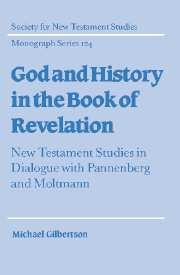
Book Review: God and History in the Book of Revelation


Michael Gilbertson
God and History in the Book of Revelation:
New Testament Studies in Dialogue with Pannenberg and Moltmann (SNTS 124; Cambridge: CUP, 2003).
See google books for a quick read.
See Amazon.com for purchase.

Blurb from Cambridge: "This is an interdisciplinary study which constructs a dialogue between biblical interpretation and systematic theology. It examines how far a reading of the Book of Revelation might either support or question the work of leading theologians Wolfhart Pannenberg and Jürgen Moltmann on the theology of history, exploring the way in which the author of Revelation uses the dimensions of space and time to make theological points about the relationship between God and history. The book argues that Revelation sets the present earthly experience of the reader in the context of God’s ultimate purposes, by disclosing hidden dimensions of reality, both spatial - embracing heaven and earth - and temporal - extending into the ultimate future. Dr Gilbertson offers a detailed assessment of the theologies of history developed by Pannenberg and Moltmann, including their views on the nature of the historical process, and the use of apocalyptic ideas in eschatology".

My Review (forthcoming in EuroJTh 17.1)

Summary: This volume represents a cross disciplinary study between biblical interpretation and systematic theology. The author examines to what degree a reading of the Book of Revelation supports or undermines the theologies of Wolfhart Pannenberg and Jürgen Moltmann on the theology of history. He does this by exploring the way in which the Book of Revelation employs the dimensions of time and space in order to establish a conception of God’s relationship to history. The author concludes that Pannenberg and Moltmann’s theologies are both continuous and discontinuous with the Book of Revelation and its approach to God and history.

The objective of Gilbertson’s study is to examine the relation of the divine reality to the world of historical events. In chapter one, Gilbertson opens with discussion of twentieth-century debates about the relationship between history and faith. He surveys the work of Ernst Troeltsch who argued that the historical-critical method could not accommodate divine interaction with the world, Rudolf Bultmann who posited a strict dichotomy between history and God via his neo-Kantian dualism that separated fact from value, Wolfhart Pannenberg who advocated that the divine self-communication occurs through historical events, and finally he surveys Jürgen Moltmann who endeavoured to draw the horizons of God’s ultimate future and the human present together in order for their to be real hope in Christian thought.

In chapter two, Gilbertson examines the relationship between scripture and systematic theology. He draws attention to Krister Stendahl’s two-stage model which begins with the descriptive task of biblical theology followed by the practice of a normative systematic theology in order to prevent theological commitments from damaging the interpretation of the text. Gilbertson questions, however, whether ‘descriptive’ and ‘normative’ are really antithetical and whether the differentiation between what the text ‘meant’ and what it ‘means’ is really straightforward. Instead, Gilbertson prefers Nicholas Lash’s dialectic model of a more dynamic interface between exegesis and theology. On the role of scripture in theology, he accepts Alister McGrath’s defence of the cognitive-propositionalist approach which maintains an external referent in the story of Jesus.

Gilbertson addresses the overall perspective of Revelation in chapter three by focusing on Revelation’s representation of history, the rhetorical situation of the text, and the genre of Revelation. He examines preterist, historicist, and salvation-historical accounts of Revelation’s representation of history and finds fault with all three. Instead, Gilbertson argues that the framework of Revelation is temporal (= not about abstract principles) yet not chronological (= not about speculative future events). He locates the text in an environment that was not necessarily in crisis but the Seer aims to reveal the true nature of the situation to his readers. Accordingly, Gilbertson rejects seeing the symbology of Revelation as functioning as a psychological mechanism designed to induce certain states. He maintains that due regard should be given to the truth claims that the text makes. Thus, however the rhetorical function of the book is construed it must remain rooted in the truth-claims that the book itself makes about reality. On genre, Revelation is an apocalypse, though lacking some features of an apocalypse (e.g. pseudonymity), and the Seer attempts to influence his audience by locating the earthly present in the context of ultimate spatial and temporal horizons.

Chapters four and five deal with the spatial and temporal dimensions of Revelation. Gilbertson argues that Revelation is concerned with ‘the expansion of spatial horizons to include a transcendent spatial reality and the expansion of temporal horizons include transcendent temporal reality’ (p. 82). He finds that the juxtaposition of 2:1–3:22 and 4:1–11 create a dissonance between the crisis situation of John’s audience and the absolute sovereignty of God. This dissonance is resolved, spatially, by the future descent of the New Jerusalem from heaven to earth, and temporally, by the everlasting sovereignty of God being manifest on the earth at the same time. Although, as he points out, this imagery can also intensify the dissonance since the spatial and temporal transitions are yet to take place.

Gilbertson then compares his findings about Revelation with the theologies of Pannenberg and Moltmann in chapter six. He focuses on the dynamics of history, proleptic revelation, eschatological consummation, and the relationship of the present to the eschatological horizon. He notes the differences between Pannenberg and Moltmann not the least of which is that Pannenberg emphasizes the unity and coherence of history with God’s self-revelation, while Moltmann emphasizes discontinuity and contradiction between the present historical reality and the coming of God. Beyond this, Gilbertson adds a caveat that the conceptual worlds of John of Patmos and twentieth century theologians such as Pannenberg and Moltmann are very different, but what they have in common is a theology whose orientation is towards the ultimate future and the impact of this ultimate future upon the present. Where Pannenberg and Moltmann appear to depart from Gilbertson’s analysis of Revelation, is that the Seer can identify God’s rule as a hidden reality, whereas for Pannenberg and Moltmann, God’s rule is of the future.

In his conclusion, Gilbertson finds Pannenberg and Moltmann’s theology as being continuous and discontinuous from his analysis of Revelation. In line with the intention of the text, Moltmann and Pannenberg both posit a vision of the ultimate power of God that will ultimately shape the future but such power is for the moment hidden and not publicly manifest. Overall, a theological reading of Revelation is both a welcomed and profitable exercise if done with historical sensitivity and theological acumen. Gilbertson does both fairly well and succeeds in bringing the disciplines of biblical and theological studies together. The only misgiving I have is that while Gilbertson rejects Stendahl’s two-stage model for biblical and systematic theology, in the end his monograph is a perfect example of it as he moves from analysis of the text of Revelation (chapters 3–5) to systematic observations (chapter 6). Apart from that, this volume is a good example of how biblical interpretation and systematic theology can and should be brought together.

What not to do at your Viva!

I read that Michael Pahl is getting ready for the oral defence of his Ph.D thesis on 1 Thessalonians. Michael, here's some advice of what not to say:

HT: Sean Winter

Wednesday, September 19, 2007

Two Recent Books on Messianism

I thought I'd draw attention to two books that have just come out dealing with the topic of messianic hopes and expectations in Judaism and Christianity.

Markus Bockmuehl and James Carleton Paget, eds., Redemption and Resistance: The Messianic Hopes of Jews and Christians in Antiquity (London: T&T Clark, 2007).

Magnus Zetterholm, ed., The Messiah: In Early Judaism and Christianity (Minneaplis: Fortress, 2007).

Tuesday, September 18, 2007

New Blogs 17

One day I just happen to be in the SPCK bookshop in Durham when I began talking to a chap in the biblical studies section. I learned that his name was Nijay and he was doing his Ph.D in Durham under John Barclay. I told him my name and where I was from and he said, "Oh, Highland Theological College, I read your blog sometimes". It was most flattering. I thought the only people who read it where my brother and Chris Tilling. Well anyway, I've been meaning to point out for some time that Nijay K. Gupta has his own blog which contains a good many things and he's another one of those Durham bloggers. So Nijay, good to have you around the biblioblogosphere.

Rodney Decker on Con Campbell

Over at NT Resources Blog, Rodney Decker reviews Contantine R. Campbell's book Verbal Aspect, the Indicative Mood, and Narrative: Soundings in the Greek of the New Testament. Studies in Biblical Greek, vol. 13. New York: Peter Lang, 2007. Con Campbell teaches at Moore Theological College and besides his interest in Greek linguistics and discourse analysis, he is also a noted evangelist - rare traits in a biblical scholar these days!

Sunday, September 16, 2007

The Rhetorical Setting of Revelation

I am currently reading Michael Gilbertson God and History in the Book of Revelation: New Testament Studies in Dialogue with Pannenberg and Moltmann, and it includes this quote about the rhetorical setting of Revelation in light of recent scholarship:
Yarbro Collins stresses the phenomenon of relative deprivation and perceived crisis; Thompson argues rather for a conflict between two different views of reality; Fiorenza is more ready to assume an element of actual persecution in the background. Ultimately, however, it may be misleading to seek to tie the genesis of the text to one particular social setting. The text itself suggets strongly that the book was addressed to a variety of different settings. The messages to Smyrna, Pergamum and perhaps hiladelphia suggest an atmosphere of oppression, while those to Thyatira, Sardis and Laodicea do not appear to refer to any existing persectuion. The book's message of judgement against Babylon (and hence the need to avoid compromise), the expectation that Christian witness will provoke hostility, and the assurane of ultimately vindication are relevant to a variety of different situations (p. 60).

Saturday, September 15, 2007

Ben Witherington on Scripture


Ben Witherington is Professor of New Testament at Asbury Theological Seminary and I interviewed him about his forthcoming book on Scripture.

1. What led you to write your triology of books on the sacraments?

There has been far too much fuzzy thinking, or indeed, no thinking in some cases, about the sacraments in many Evangelical and Protestant contexts, and what passes for thinking is so poorly grounded in what the NT says about baptism, the Lord's Supper, and the Word of God that I thought it was time to offer three short pithy discussions on these inter-related topics.

2. By way of summary, what is your forthcoming book The Living Word of God: Rethinking the Theology of the Bible arguing for?

I am arguing for a lot of different things in my Living Word book out this fall. One of the main points is that we are making a mistake by looking at the Bible as a 'text' in the modern sense of the word. The environment in which the Bible was written is an oral culture, a culture in which only 10% or so of the populus could read and write. Among other things then, the fact that we have a plethora of people leading Christianity who could read and wrote these books speaks volumes about the social level of the authors. They were not bucolic peasants, and they were all deeply steeped in the OT. Furthermore, they all had a strong sense of how sacred texts, inspired texts, functioned in a basically oral culture. A good example of where this study is going comes early when I deal with what Paul says in 1 Thess. 2-- he says that his converts received his preaching of the Gospel as not merely the words of human beings, but as it really was, the inspired word of God. In other words, the primary sense of the phrase word of God applies in the first instance to an inspired oral proclamation, in the second instance to Christ himself, and in the third instance, to a written sacred text, the OT (see 2 Tim. 3.16). In other words, Paul, and other NT writers believed they were speaking and writing God's Word, inspired by God's Spirit telling the truth about God, Christ, salvation and other subjects.

3. What do you make of terms such as "inerrant" and "infallible"?

The terms inerrant and infallible are modern ways of attempting to make clear that the Bible tells the truth about whatever it intends to teach us about. I much prefer the positive terms truthful and trustworthy. When you start defining something negatively (saying what it is not) then you often die the death of a thousand qualifications, not to mention you have to define what constitutes an error. I am happy to say that the Bible has three main subjects-- history, theology, and ethics, and that it tells us the truth about all three.

4. How do Scripture and Tradition relate together?

It is true to say that Scripture is one form of tradition that has become a sacred text. So yes, Scripture contains a plethora of different traditions. But to say this is not enough. What was believed about these sacred texts is that they were God-breathed, and so different in various ways from other traditions which were more mundane or purely human. Without an inadequate undestanding of ancient views of inspiration and how they effects texts, we can't get very far in discussing the relationship of ordinary traditions to inspired or sacred ones.

5. What place should the Bible have in the Church?

The Bible, as the written expression of the Word of God, should have final authority in and over the church in all matters of faith and practice, at least in regard to those subjects on which it makes pronouncements.

6. How important is it to learn how to interpret the Bible properly?

This question is too broad. I will simly respond by saying 'a text without a context is just a pretext for whatever you want it to mean'. That is, unless the Bible is interpreted in its various historical and literary and rhetorical and social contexts, it will inevitably be misused and abused.

7. For many of my students topics such as source criticism, debates about authorship, ancient standards of history, textual criticism, and the process of canonisation, often make them nervous and even defensive at times. As a New Testament lecturer I am constantly challenged as to how introduce them to the humanity of Scripture and the phenomenon of how Scripture came into existence, but without them thinking that they have to forfeit their high view of Scripture. What are your thoughts on that problem?

I think that one has to have a certain amount of insight into one's audience's level of Christian maturity to decide how to talk to them about the humanness as well as divine character of Scripture. It never helps to just blow them out of the water. I do however think that if one is commited to the Bible as the Word of God, then one needs to be honest with them about the 'truth' and the 'Word'. Among other things, bibliolatry is as much of a problem as too low a view of Scripture.

8. To follow that up, based on your forthcoming volume Letters and Homilies for Hellenized Christians: A Socio-rhetorical Commentary on 1-2 Peter what is your opinion on the authorship of 2 Peter, and how does your conclusion to that issue relate to your view of Scripture?

2 Peter is a composite document involving some genuine Petrine material in chapter one, some material from Jude in chapter 2, and a knowledge of a collection of Paul's letters in chapter 3. The book is labeled according to its most famous contributor Peter, but it has been put together probably in the 90s by a member of the Petrine circle, probably in Rome (Linus would be a good guess). Ancient documents which were composite could be anonymous, or could be attributed to their most famous contributor-- in this case because of a testimony of Peter about his experience at the Mt. of Transfiguration. In other words, I do not think that even this document should be labeled pseudonymous, nor do I think there are any such documents in the NT if this one is not.

9. What are the failings of some evangelical approaches to the Bible and what are the failings of some liberal approaches to the Bible?

Too often Evangelicals tend to treat the Bible in a Gnostic manner, as if it dropped straight from heaven, and that the human contribution to the text is nil, or unimportant. This of course is false, and it is also a violation of the very character of these texts which are historical documents through and through, written in specific languages to specific people at specific times with timely (as well as timeless) remarks. Liberals on the other hand, tend to underestimate the divine inspiration of these documents and their profound truth content in regard to matters of history, theology, and ethics.

10. Finally, what makes you believe that Scripture is Inspired and what do you find inspiring about Scripture?

What makes me think the Scriptures are inspired comes not merely from studying them so long, and finding they stand up to every sort of challenge including the intellectual ones, but seeing how many millions of lives they had and continue to change. This did not happen by accident, and certainly not over thousands of years. There is no comparable ancient document that had had, and continues to have that sort of effect. Period. As for what I find inspiring about it, the answer is-- basically everything. Here is a book which provides us with a clear window into the mind and character of God, the nature of the human dilemma, and the nature of salvation. It answers the deeps questions and longings we could have.

BW3

Thanks Ben!

SBL: Tis the Season for Johannine Studies

I am by trade and by taste largely a Synoptics and Paul specialist who often pines for the exotic and sometimes esoteric jungles of Johannine studies. In looking over this years SBL list of seminars, I am convinced that Johannine studies is the place to be (S17-17; S17-65; S19-22; and esp. S19-71 & S19-117). There are some good papers lined up and I really like the "John, Jesus, and History Group / Johannine Literature Section" which have three sessions planned on The Past, Present, and Future of Johannine Studies. See the SBL website for info here. Of course, Friday afternoon with the "Faith of Jesus Christ" seminar is also a must.

I also suggest that S18-150 on "Books on the Gospel of Judas: An Evening with the Authors" should be renamed "An Evening with Every Man and His Dog" because it seems to me that every man and his dog has written a book about the Gospel of Judas. I am ashamed to attend because I may well be the only member of the audience who hasn't written a book on the subject.

There will be a panel discussion on Scot McKnight's book Jesus and His Death at ETS and a panel discussion on Richard Bauckham's book Jesus and the Eyewitnesses at both ETS and SBL. James Crossley is doing a response to Bauckham at the SBL session and James is always animated if not argumentative when he wants to be (S17-79).
Sadly, this will be the last joint AAR-SBL conference and in keeping with my Johannine theme, I am reminded of 1 John 2.19 which you can read here.

Aussie Bloggers Reunited


And who says New Testament scholars and Theologians can't get along?
This photo is taken from my recent trip back to Zion (aka Australia) where I was able to reacquaint myself with the sun, a decent Merlot that did not taste like the juice of a rotten French turnip, and my good friend the Rt. Rev. Dr. Ben Myers. Our families got together for a lovely dinner and some great fellowship. I look forward to doing it again at San Diego where Ben will be giving the inaugural address for the "Self-Appointed Guardians of Orthodoxy" working-group at AAR and a paper on "Why Karl Barth would be a Republican" for the Karl Barth Society. At a recent conference in Edinburgh, Bruce McCormack told me that "Ben runs the best theology blog on the internet" so check out his blog Faith and Theology if you want a good run down on some (Barthianesque) theology and reflections about that boring musician Bob Dylan.

Friday, September 14, 2007

Ben Witherington on the Lord's Supper

Ben Witherington introduces his new book Making a Meal of it: Rethinking the Theology of the Lord's Supper. Here's his description:

In this study I argue that the Lord's Supper was originally part of a large meal, not a separate ritual or ceremony, and as such brought into play all the ancient understandings about hospitality, the welcoming of people to the table, and the like. I am also arguing that the early church did not see the Lord's Supper as merely a symbolic memorial ceremony. They actually saw some sort of spiritual transaction happening in the partaking of the Lord's Supper, and believed that partaking in an unworthy manner was spiritually dangerous, as Paul suggests in 1 Cor. 11. But what sort of spiritual transaction is going on in the Lord's Supper? This is discussed in some detail in the book, and I won't spoil it for you by dealing with that here.

Sounds interesting. I think Protestant churches should turf out their morsel of bread and drop of juice and its accompanying three minute guilt-trip sermonette in favour of a communal love feast instead.

A Theology of Early Christianity: A Rationale

A Theology of Early Christianity: A Rationale

I am intending to write a ‘Theology of early Christianity’ as opposed to a book on ‘New Testament Theology’ or a book 'Christian Origins'. That is because I hope to integrate together the field of Christian Origins with the discipline New Testament Theology. That integration is needed because of the relative weaknesses of the discplines of New Testament Theology and Christian Origins.

The Problem with Christian Origins

The problem with Christian Origins is that, while adequately capturing the generative power of sociological forces for fostering theological beliefs, it fails to recognize that theology can also create a sociological dynamic. The door of cause and effect between theology and sociology swings both ways since what people do and what they believe are intimately intertwined. A further problem is that practitioners of Christian Origins deliberately avoid and even eschew exploring the theological texture of these documents. That inevitably results in an unsympathetic treatment of the texts precisely because of their largely theological nature. It also means that the theology of each book or letter cannot be so neatly deconstructed to be ‘really’ about ecclesial machinations, imperial politics, the suppression of minorities, the rising power of an orthodox collegiate, or comprise weapons of intra-Christian factionalism, when in fact they are trying to say something about God and the human condition. Whatever social complexity or religious context lies behind the texts of the New Testament we cannot shirk away from the fact that these writings are fundamentally concerned with an otherworldly reality known as God and the world to come. A history of early Christianity is only available through the theological witness of the New Testament, so historians of Christianity must do business with early Christian theology. It is, then, unsatisfactory to merely list and describe the beliefs and rituals of the early church, to plot the origin and evolution of beliefs from other sources, to map out factional differences and splits, and to point the finger at endless instances of diversity. Commentators, by negating the theological dimension of the New Testament in their inquiry, ignore the primary message of these writings which is largely theological. In the end, such commentators leave us with nothing more than ‘historicism or anti-quarianism, with its lack of interest in relevance’.[1] No-one can hope to understand the origin of Christianity without sympathetically listening to the theological beliefs, hopes, and creeds of the first Christians. It may be fashionable to say that there is no single theology of early Christianity to study, but in the final dust up they did opt for a single theology and they called it the Holy Scriptures.

The Problem with New Testament Theology

First, for a historical reason, we may consider the relationship of the first Christians themselves to the New Testament writings. In writing a New Testament Theology one may choose to focus exclusively upon the text of the New Testament given a presupposition of its ontological status as inspired, canonical, and authoritative (and why not!). Such an exercise will be concerned with the major theological themes of each book, how to explicate the unique theological contribution of each New Testament book, as well as expositing the New Testament’s theological message as a whole. The problem I have with this approach is that while it appropriately upholds the singularity of Scripture as inspired and normative for faith communities and it studiously engages the content of the New Testament itself, it still abstracts the New Testament from its historical origin and its impact upon the early church. New Testament Theology is not a systematic theology derived from the New Testament, it should be a theology derived the early Christianity community including their history and testimony as represented in the text. Theology, especially New Testament Theology, does not occur in a vacuum and it is the result of a long historical process of debate, conflict, struggle, and reflection with the competitors and collaborators of one’s environment over the question of God. Theology is created in the historical journey from struggle to Scripture and narrating that journey helps to explain the theology. In other words, there can be no theology of the New Testament without a description of the early Christians themselves. As an example, a theology of Romans must take into account: (1) the history of Christianity in Rome; (2) Jewish and Christian relations in Rome up to the mid-50s; (3) the social and religious context of the Roman Christians in the city of Rome; (4) Paul’s own circumstances including his motivation for writing, the relationship of the epistle of the Romans to the epistle to the Galatians, and also the evidence that Romans represents a distillation of previous debates in Antioch, Galatia, and Corinth; and (5) the immediate reception of Romans in the early church. Whereas New Testament theologies have focused on the main themes of the text and how those themes relates to the other New Testament writings, I think that a more profound set of questions to ask is what did the text do, to whom, why, and how does that relate to other Christian communities? By doing that, one is keeping the theology of the text rooted in the situation of the author and recipients and placing the findings in the wider context of the first Christians as a whole. Second, for a theological reason, we must consider the phenomenon that birthed the New Testament. The New Testament was written, copied, transmitted, preserved, preached from, and disseminated by Christians. A Protestant apologetic ploy is to say that the Church did not create the canon, but discovered the canon created by God.[2] A passing read of Eusebius’ History of the Church indicates that this is flat out false. God created the canon through the Church. The Bible may have been written for us, but its composite parts were not written to us. It is perfectly natural then to see the New Testament as the witness of a constellation of communities to their own story and beliefs, to their relationship with other groups (Christian and non-Christian), and to their own life in God. The New Testament is in part the biography of the Church and what God has done, is doing, and will do for the Church. The story of God becomes available only through the story of the Church. The New Testament had a formative role for the faith and praxis of particular communities from the very beginning. In fact, the New Testament writers are fundamentally concerned with a world beyond the text and thus we find the locus of meaning situated in the interface between text and community or between author and audience. A theology of Paul’s epistle to the Romans as a thing-in-itself is impoverished without taking into account the Roman Christians who comprise far more than the happenstance for writing, but their theological and pastoral instruction is the goal of epistle. The epistle to the Romans is not theology unless it is a theology for the Roman Christians. At the end of the day, I am arguing for the integration of ecclesiology into a doctrine of Scripture (a frightening task for a self-confessed evangelical). In my mind, such a perspective not only justifies the continuing inquiry as to what the text originally meant, but it secures the validity of theological exegesis as the enterprise by which the Church continually searches, studies, and sermonizes the Scriptures. By theological exegesis I mean, ‘theological interpretation of the Bible seeks to relate the ancient text to the religious question of the modern reader, without doing violence to either’.[3] Another corollary is that studies in reception-history (wirkungsgeschichte) become of vital significance as the division between implied readers and real readers may not be as wide as is often thought and so we must bring later witnesses with us in investigation of the New Testament documents. Meaning is created through fusing together the horizons of author, recipient, and reader. This justifies taking into account the wider ecclesial context from which and for which the New Testament was written.

In Summary

What I am arguing for is for the integration of Christian Origins into the study of New Testament Theology, or in other words, a theology of early Christianity. What this gives us, in terms of history, is a fuller picture of literary and social environment of the biblical authors and the effect that their writings had upon Christian communities both singular and global. As such the background of the New Testament in Second Temple Judaism, the Graeco-Roman world, and in early Christianity history becomes crucial for animating the world of the text by taking into account the world around the text. What this approach also gives us, in terms of theology, is a greater awareness of the overarching theological message of the New Testament by expounding the formative context and subsequent effect of these writings in the early church. By ‘theology’ I am referring here to ‘biblical theology’ which is the task of describing and expressing the theological message of the biblical books by paying careful attention to the context, genre, language, subjects, and purposes of the biblical authors. This biblical theology is the attempt to understand the theological contributions of the biblical writers on their own terms and without importing artificial categories on to the text. In the end, biblical theology is the attempt to tell the story of the early Christians by using their own language and symbols. In sum, the approach I am outlining attempts to uncover the theological message of each document and each corpus but in the context of the emergence of early Christianity. To give an example, what Paul says about the Law in Romans takes on far richer significance when placed in the wider context of Jewish and Christian debates about the Law which were related to issues of group boundaries, self-definition, ethics, and eschatology. That, however, feeds directly into the theological issue raised by Paul being who are the people of God, how will they be vindicated in the final assize, and how are God’s people to live a life that honours him? Thus, the theology of Romans is properly grasped within its particular historical circumstance and when taking into account the function of this theology in shaping the praxis and self-definition of Christian communities. A theology of early Christianity should illuminate the content and concern of each biblical book and should also illuminate the context and consequence of each biblical book. By bringing in the historical context we avoid a New Testament Theology that is essentially atemporal and purely propositional. By acknowledging the theological character of the New Testament we avoid the trap of substituting the context for the content of each book. In this way, the theological nature of New Testament Theology is preserved even when situated in the wider framework of historical description.

[1] Krister Stendahl, ‘Biblical Theology, Contemporary,’ in Interpreter’s Dictionary of the Bible (New York: Abingdon, 1962): 1.419.
[2] Cf. e.g. Norman R. Geisler, ‘Bible, Canonicity of,’ Baker Encyclopedia of Christian Apologetics (Grand Rapids, MI: Baker, 1999), 81-86.
[3] John Barton and Robert Morgan, Biblical Interpretation (Oxford: OUP, 1988), 37.

Tuesday, September 11, 2007

Scottish Northern Convention, 22-27 September 2007

At this years Scottish Northern Convention I will be preaching at the Saturday night youth special on "The Gospel according to Star Wars" on 22nd September, 7:30 - 9.00 p.m. at Castle Street Church of Scotland. There there or be elsewhere!

Stephen Patterson's RBL review of Craig A. Evans

Over at RBL, Stephen J. Patterson does a review of Craig A. Evans' volume, Fabricating Jesus: How Modern Scholars Distort the Gospels and it goes to show that biblical scholarship is never dull! While his review offers much for comment, I'll restrict myself to one item.

Patterson notes Evans' critique of the theory that the historical Jesus was essentially a Palestinian Cynic philosopher. And Patterson points out the apprent irony that one of the endorsements of the book was written by Gerd Theissen who was responsible for originating the Cynic hypothesis, citing an article by Theissen written in the 70s (ZTK 70 [1973]: 245-71; I would add here also Gerd Theissen, Sociology of Early Palestinian Christianity [trans. John Bowden; Philadelphia: Fortress, 1978], 14-15 and Martin Hengel, The Charismatic Leaders and His Followers [trans. James C. G. Greig; Edinburgh: T&T Clark, 1981 [1968]], 54). However, niether Theissen nor Hengel ever argued that Jesus was a Cynic philosopher, they only pointed out analogies of Cynic practices with the Jesus movement. So I would not call Theissen the originator of the Cynic hypothesis as it pertains to Historical Jesus studies. About the Jesus of the Jesus Seminar, Theissen wrote with a comic flare that is rarely found in a German scholar: ‘The “non-eschatological Jesus” seems to have more Californian than Galilean local colouring’ (Gerd Theissen and Annette Merz, The Historical Jesus: A Comprehensive Guide [trans. John Bowden; Minneapolis: Fortress, 1998], 11). John Dominic Crossan's co-author, Jonathan L. Reed, has written this about the Cynic Jesus hypothesis as well: ‘In this context it should be stressed that lacking a substantial component of gentile inhabitants, having only two Jewish cities in their infancy of Hellenization, and lacking much evidence for interregional trade, notions of Cynic itinerants influencing Jesus or his first followers makes little sense. Though the scholarly comparison of Jesus’ teaching with that of Cynicism merits attention as an analogy, any genealogical relationship between Jesus and Cynics is highly unlikely' (Jonathan L. Reed, Archaeology and the Galilean Jesus [Harrisburg: TPI, 2000], 218). Thus, Evan's critique of the Cynic hypothesis cannot be laid at the feet of his evangelical convictions and then swept aside because of it.
See further Michael F. Bird, 'The Peril of Modernizing Jesus and the Crisis of Not Contemporizing the Christ,' EQ 78 (2006): 291-312.