Thursday, September 20, 2007

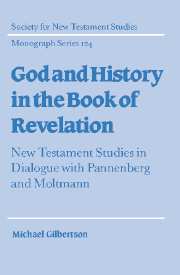
Book Review: God and History in the Book of Revelation


Michael Gilbertson
God and History in the Book of Revelation:
New Testament Studies in Dialogue with Pannenberg and Moltmann (SNTS 124; Cambridge: CUP, 2003).
See google books for a quick read.
See Amazon.com for purchase.

Blurb from Cambridge: "This is an interdisciplinary study which constructs a dialogue between biblical interpretation and systematic theology. It examines how far a reading of the Book of Revelation might either support or question the work of leading theologians Wolfhart Pannenberg and Jürgen Moltmann on the theology of history, exploring the way in which the author of Revelation uses the dimensions of space and time to make theological points about the relationship between God and history. The book argues that Revelation sets the present earthly experience of the reader in the context of God’s ultimate purposes, by disclosing hidden dimensions of reality, both spatial - embracing heaven and earth - and temporal - extending into the ultimate future. Dr Gilbertson offers a detailed assessment of the theologies of history developed by Pannenberg and Moltmann, including their views on the nature of the historical process, and the use of apocalyptic ideas in eschatology".

My Review (forthcoming in EuroJTh 17.1)

Summary: This volume represents a cross disciplinary study between biblical interpretation and systematic theology. The author examines to what degree a reading of the Book of Revelation supports or undermines the theologies of Wolfhart Pannenberg and Jürgen Moltmann on the theology of history. He does this by exploring the way in which the Book of Revelation employs the dimensions of time and space in order to establish a conception of God’s relationship to history. The author concludes that Pannenberg and Moltmann’s theologies are both continuous and discontinuous with the Book of Revelation and its approach to God and history.

The objective of Gilbertson’s study is to examine the relation of the divine reality to the world of historical events. In chapter one, Gilbertson opens with discussion of twentieth-century debates about the relationship between history and faith. He surveys the work of Ernst Troeltsch who argued that the historical-critical method could not accommodate divine interaction with the world, Rudolf Bultmann who posited a strict dichotomy between history and God via his neo-Kantian dualism that separated fact from value, Wolfhart Pannenberg who advocated that the divine self-communication occurs through historical events, and finally he surveys Jürgen Moltmann who endeavoured to draw the horizons of God’s ultimate future and the human present together in order for their to be real hope in Christian thought.

In chapter two, Gilbertson examines the relationship between scripture and systematic theology. He draws attention to Krister Stendahl’s two-stage model which begins with the descriptive task of biblical theology followed by the practice of a normative systematic theology in order to prevent theological commitments from damaging the interpretation of the text. Gilbertson questions, however, whether ‘descriptive’ and ‘normative’ are really antithetical and whether the differentiation between what the text ‘meant’ and what it ‘means’ is really straightforward. Instead, Gilbertson prefers Nicholas Lash’s dialectic model of a more dynamic interface between exegesis and theology. On the role of scripture in theology, he accepts Alister McGrath’s defence of the cognitive-propositionalist approach which maintains an external referent in the story of Jesus.

Gilbertson addresses the overall perspective of Revelation in chapter three by focusing on Revelation’s representation of history, the rhetorical situation of the text, and the genre of Revelation. He examines preterist, historicist, and salvation-historical accounts of Revelation’s representation of history and finds fault with all three. Instead, Gilbertson argues that the framework of Revelation is temporal (= not about abstract principles) yet not chronological (= not about speculative future events). He locates the text in an environment that was not necessarily in crisis but the Seer aims to reveal the true nature of the situation to his readers. Accordingly, Gilbertson rejects seeing the symbology of Revelation as functioning as a psychological mechanism designed to induce certain states. He maintains that due regard should be given to the truth claims that the text makes. Thus, however the rhetorical function of the book is construed it must remain rooted in the truth-claims that the book itself makes about reality. On genre, Revelation is an apocalypse, though lacking some features of an apocalypse (e.g. pseudonymity), and the Seer attempts to influence his audience by locating the earthly present in the context of ultimate spatial and temporal horizons.

Chapters four and five deal with the spatial and temporal dimensions of Revelation. Gilbertson argues that Revelation is concerned with ‘the expansion of spatial horizons to include a transcendent spatial reality and the expansion of temporal horizons include transcendent temporal reality’ (p. 82). He finds that the juxtaposition of 2:1–3:22 and 4:1–11 create a dissonance between the crisis situation of John’s audience and the absolute sovereignty of God. This dissonance is resolved, spatially, by the future descent of the New Jerusalem from heaven to earth, and temporally, by the everlasting sovereignty of God being manifest on the earth at the same time. Although, as he points out, this imagery can also intensify the dissonance since the spatial and temporal transitions are yet to take place.

Gilbertson then compares his findings about Revelation with the theologies of Pannenberg and Moltmann in chapter six. He focuses on the dynamics of history, proleptic revelation, eschatological consummation, and the relationship of the present to the eschatological horizon. He notes the differences between Pannenberg and Moltmann not the least of which is that Pannenberg emphasizes the unity and coherence of history with God’s self-revelation, while Moltmann emphasizes discontinuity and contradiction between the present historical reality and the coming of God. Beyond this, Gilbertson adds a caveat that the conceptual worlds of John of Patmos and twentieth century theologians such as Pannenberg and Moltmann are very different, but what they have in common is a theology whose orientation is towards the ultimate future and the impact of this ultimate future upon the present. Where Pannenberg and Moltmann appear to depart from Gilbertson’s analysis of Revelation, is that the Seer can identify God’s rule as a hidden reality, whereas for Pannenberg and Moltmann, God’s rule is of the future.

In his conclusion, Gilbertson finds Pannenberg and Moltmann’s theology as being continuous and discontinuous from his analysis of Revelation. In line with the intention of the text, Moltmann and Pannenberg both posit a vision of the ultimate power of God that will ultimately shape the future but such power is for the moment hidden and not publicly manifest. Overall, a theological reading of Revelation is both a welcomed and profitable exercise if done with historical sensitivity and theological acumen. Gilbertson does both fairly well and succeeds in bringing the disciplines of biblical and theological studies together. The only misgiving I have is that while Gilbertson rejects Stendahl’s two-stage model for biblical and systematic theology, in the end his monograph is a perfect example of it as he moves from analysis of the text of Revelation (chapters 3–5) to systematic observations (chapter 6). Apart from that, this volume is a good example of how biblical interpretation and systematic theology can and should be brought together.

What not to do at your Viva!

I read that Michael Pahl is getting ready for the oral defence of his Ph.D thesis on 1 Thessalonians. Michael, here's some advice of what not to say:

HT: Sean Winter

Wednesday, September 19, 2007

Two Recent Books on Messianism

I thought I'd draw attention to two books that have just come out dealing with the topic of messianic hopes and expectations in Judaism and Christianity.

Markus Bockmuehl and James Carleton Paget, eds., Redemption and Resistance: The Messianic Hopes of Jews and Christians in Antiquity (London: T&T Clark, 2007).

Magnus Zetterholm, ed., The Messiah: In Early Judaism and Christianity (Minneaplis: Fortress, 2007).

Tuesday, September 18, 2007

New Blogs 17

One day I just happen to be in the SPCK bookshop in Durham when I began talking to a chap in the biblical studies section. I learned that his name was Nijay and he was doing his Ph.D in Durham under John Barclay. I told him my name and where I was from and he said, "Oh, Highland Theological College, I read your blog sometimes". It was most flattering. I thought the only people who read it where my brother and Chris Tilling. Well anyway, I've been meaning to point out for some time that Nijay K. Gupta has his own blog which contains a good many things and he's another one of those Durham bloggers. So Nijay, good to have you around the biblioblogosphere.

Rodney Decker on Con Campbell

Over at NT Resources Blog, Rodney Decker reviews Contantine R. Campbell's book Verbal Aspect, the Indicative Mood, and Narrative: Soundings in the Greek of the New Testament. Studies in Biblical Greek, vol. 13. New York: Peter Lang, 2007. Con Campbell teaches at Moore Theological College and besides his interest in Greek linguistics and discourse analysis, he is also a noted evangelist - rare traits in a biblical scholar these days!

Sunday, September 16, 2007

The Rhetorical Setting of Revelation

I am currently reading Michael Gilbertson God and History in the Book of Revelation: New Testament Studies in Dialogue with Pannenberg and Moltmann, and it includes this quote about the rhetorical setting of Revelation in light of recent scholarship:
Yarbro Collins stresses the phenomenon of relative deprivation and perceived crisis; Thompson argues rather for a conflict between two different views of reality; Fiorenza is more ready to assume an element of actual persecution in the background. Ultimately, however, it may be misleading to seek to tie the genesis of the text to one particular social setting. The text itself suggets strongly that the book was addressed to a variety of different settings. The messages to Smyrna, Pergamum and perhaps hiladelphia suggest an atmosphere of oppression, while those to Thyatira, Sardis and Laodicea do not appear to refer to any existing persectuion. The book's message of judgement against Babylon (and hence the need to avoid compromise), the expectation that Christian witness will provoke hostility, and the assurane of ultimately vindication are relevant to a variety of different situations (p. 60).

Saturday, September 15, 2007

Ben Witherington on Scripture


Ben Witherington is Professor of New Testament at Asbury Theological Seminary and I interviewed him about his forthcoming book on Scripture.

1. What led you to write your triology of books on the sacraments?

There has been far too much fuzzy thinking, or indeed, no thinking in some cases, about the sacraments in many Evangelical and Protestant contexts, and what passes for thinking is so poorly grounded in what the NT says about baptism, the Lord's Supper, and the Word of God that I thought it was time to offer three short pithy discussions on these inter-related topics.

2. By way of summary, what is your forthcoming book The Living Word of God: Rethinking the Theology of the Bible arguing for?

I am arguing for a lot of different things in my Living Word book out this fall. One of the main points is that we are making a mistake by looking at the Bible as a 'text' in the modern sense of the word. The environment in which the Bible was written is an oral culture, a culture in which only 10% or so of the populus could read and write. Among other things then, the fact that we have a plethora of people leading Christianity who could read and wrote these books speaks volumes about the social level of the authors. They were not bucolic peasants, and they were all deeply steeped in the OT. Furthermore, they all had a strong sense of how sacred texts, inspired texts, functioned in a basically oral culture. A good example of where this study is going comes early when I deal with what Paul says in 1 Thess. 2-- he says that his converts received his preaching of the Gospel as not merely the words of human beings, but as it really was, the inspired word of God. In other words, the primary sense of the phrase word of God applies in the first instance to an inspired oral proclamation, in the second instance to Christ himself, and in the third instance, to a written sacred text, the OT (see 2 Tim. 3.16). In other words, Paul, and other NT writers believed they were speaking and writing God's Word, inspired by God's Spirit telling the truth about God, Christ, salvation and other subjects.

3. What do you make of terms such as "inerrant" and "infallible"?

The terms inerrant and infallible are modern ways of attempting to make clear that the Bible tells the truth about whatever it intends to teach us about. I much prefer the positive terms truthful and trustworthy. When you start defining something negatively (saying what it is not) then you often die the death of a thousand qualifications, not to mention you have to define what constitutes an error. I am happy to say that the Bible has three main subjects-- history, theology, and ethics, and that it tells us the truth about all three.

4. How do Scripture and Tradition relate together?

It is true to say that Scripture is one form of tradition that has become a sacred text. So yes, Scripture contains a plethora of different traditions. But to say this is not enough. What was believed about these sacred texts is that they were God-breathed, and so different in various ways from other traditions which were more mundane or purely human. Without an inadequate undestanding of ancient views of inspiration and how they effects texts, we can't get very far in discussing the relationship of ordinary traditions to inspired or sacred ones.

5. What place should the Bible have in the Church?

The Bible, as the written expression of the Word of God, should have final authority in and over the church in all matters of faith and practice, at least in regard to those subjects on which it makes pronouncements.

6. How important is it to learn how to interpret the Bible properly?

This question is too broad. I will simly respond by saying 'a text without a context is just a pretext for whatever you want it to mean'. That is, unless the Bible is interpreted in its various historical and literary and rhetorical and social contexts, it will inevitably be misused and abused.

7. For many of my students topics such as source criticism, debates about authorship, ancient standards of history, textual criticism, and the process of canonisation, often make them nervous and even defensive at times. As a New Testament lecturer I am constantly challenged as to how introduce them to the humanity of Scripture and the phenomenon of how Scripture came into existence, but without them thinking that they have to forfeit their high view of Scripture. What are your thoughts on that problem?

I think that one has to have a certain amount of insight into one's audience's level of Christian maturity to decide how to talk to them about the humanness as well as divine character of Scripture. It never helps to just blow them out of the water. I do however think that if one is commited to the Bible as the Word of God, then one needs to be honest with them about the 'truth' and the 'Word'. Among other things, bibliolatry is as much of a problem as too low a view of Scripture.

8. To follow that up, based on your forthcoming volume Letters and Homilies for Hellenized Christians: A Socio-rhetorical Commentary on 1-2 Peter what is your opinion on the authorship of 2 Peter, and how does your conclusion to that issue relate to your view of Scripture?

2 Peter is a composite document involving some genuine Petrine material in chapter one, some material from Jude in chapter 2, and a knowledge of a collection of Paul's letters in chapter 3. The book is labeled according to its most famous contributor Peter, but it has been put together probably in the 90s by a member of the Petrine circle, probably in Rome (Linus would be a good guess). Ancient documents which were composite could be anonymous, or could be attributed to their most famous contributor-- in this case because of a testimony of Peter about his experience at the Mt. of Transfiguration. In other words, I do not think that even this document should be labeled pseudonymous, nor do I think there are any such documents in the NT if this one is not.

9. What are the failings of some evangelical approaches to the Bible and what are the failings of some liberal approaches to the Bible?

Too often Evangelicals tend to treat the Bible in a Gnostic manner, as if it dropped straight from heaven, and that the human contribution to the text is nil, or unimportant. This of course is false, and it is also a violation of the very character of these texts which are historical documents through and through, written in specific languages to specific people at specific times with timely (as well as timeless) remarks. Liberals on the other hand, tend to underestimate the divine inspiration of these documents and their profound truth content in regard to matters of history, theology, and ethics.

10. Finally, what makes you believe that Scripture is Inspired and what do you find inspiring about Scripture?

What makes me think the Scriptures are inspired comes not merely from studying them so long, and finding they stand up to every sort of challenge including the intellectual ones, but seeing how many millions of lives they had and continue to change. This did not happen by accident, and certainly not over thousands of years. There is no comparable ancient document that had had, and continues to have that sort of effect. Period. As for what I find inspiring about it, the answer is-- basically everything. Here is a book which provides us with a clear window into the mind and character of God, the nature of the human dilemma, and the nature of salvation. It answers the deeps questions and longings we could have.

BW3

Thanks Ben!

SBL: Tis the Season for Johannine Studies

I am by trade and by taste largely a Synoptics and Paul specialist who often pines for the exotic and sometimes esoteric jungles of Johannine studies. In looking over this years SBL list of seminars, I am convinced that Johannine studies is the place to be (S17-17; S17-65; S19-22; and esp. S19-71 & S19-117). There are some good papers lined up and I really like the "John, Jesus, and History Group / Johannine Literature Section" which have three sessions planned on The Past, Present, and Future of Johannine Studies. See the SBL website for info here. Of course, Friday afternoon with the "Faith of Jesus Christ" seminar is also a must.

I also suggest that S18-150 on "Books on the Gospel of Judas: An Evening with the Authors" should be renamed "An Evening with Every Man and His Dog" because it seems to me that every man and his dog has written a book about the Gospel of Judas. I am ashamed to attend because I may well be the only member of the audience who hasn't written a book on the subject.

There will be a panel discussion on Scot McKnight's book Jesus and His Death at ETS and a panel discussion on Richard Bauckham's book Jesus and the Eyewitnesses at both ETS and SBL. James Crossley is doing a response to Bauckham at the SBL session and James is always animated if not argumentative when he wants to be (S17-79).
Sadly, this will be the last joint AAR-SBL conference and in keeping with my Johannine theme, I am reminded of 1 John 2.19 which you can read here.

Aussie Bloggers Reunited


And who says New Testament scholars and Theologians can't get along?
This photo is taken from my recent trip back to Zion (aka Australia) where I was able to reacquaint myself with the sun, a decent Merlot that did not taste like the juice of a rotten French turnip, and my good friend the Rt. Rev. Dr. Ben Myers. Our families got together for a lovely dinner and some great fellowship. I look forward to doing it again at San Diego where Ben will be giving the inaugural address for the "Self-Appointed Guardians of Orthodoxy" working-group at AAR and a paper on "Why Karl Barth would be a Republican" for the Karl Barth Society. At a recent conference in Edinburgh, Bruce McCormack told me that "Ben runs the best theology blog on the internet" so check out his blog Faith and Theology if you want a good run down on some (Barthianesque) theology and reflections about that boring musician Bob Dylan.

Friday, September 14, 2007

Ben Witherington on the Lord's Supper

Ben Witherington introduces his new book Making a Meal of it: Rethinking the Theology of the Lord's Supper. Here's his description:

In this study I argue that the Lord's Supper was originally part of a large meal, not a separate ritual or ceremony, and as such brought into play all the ancient understandings about hospitality, the welcoming of people to the table, and the like. I am also arguing that the early church did not see the Lord's Supper as merely a symbolic memorial ceremony. They actually saw some sort of spiritual transaction happening in the partaking of the Lord's Supper, and believed that partaking in an unworthy manner was spiritually dangerous, as Paul suggests in 1 Cor. 11. But what sort of spiritual transaction is going on in the Lord's Supper? This is discussed in some detail in the book, and I won't spoil it for you by dealing with that here.

Sounds interesting. I think Protestant churches should turf out their morsel of bread and drop of juice and its accompanying three minute guilt-trip sermonette in favour of a communal love feast instead.

A Theology of Early Christianity: A Rationale

A Theology of Early Christianity: A Rationale

I am intending to write a ‘Theology of early Christianity’ as opposed to a book on ‘New Testament Theology’ or a book 'Christian Origins'. That is because I hope to integrate together the field of Christian Origins with the discipline New Testament Theology. That integration is needed because of the relative weaknesses of the discplines of New Testament Theology and Christian Origins.

The Problem with Christian Origins

The problem with Christian Origins is that, while adequately capturing the generative power of sociological forces for fostering theological beliefs, it fails to recognize that theology can also create a sociological dynamic. The door of cause and effect between theology and sociology swings both ways since what people do and what they believe are intimately intertwined. A further problem is that practitioners of Christian Origins deliberately avoid and even eschew exploring the theological texture of these documents. That inevitably results in an unsympathetic treatment of the texts precisely because of their largely theological nature. It also means that the theology of each book or letter cannot be so neatly deconstructed to be ‘really’ about ecclesial machinations, imperial politics, the suppression of minorities, the rising power of an orthodox collegiate, or comprise weapons of intra-Christian factionalism, when in fact they are trying to say something about God and the human condition. Whatever social complexity or religious context lies behind the texts of the New Testament we cannot shirk away from the fact that these writings are fundamentally concerned with an otherworldly reality known as God and the world to come. A history of early Christianity is only available through the theological witness of the New Testament, so historians of Christianity must do business with early Christian theology. It is, then, unsatisfactory to merely list and describe the beliefs and rituals of the early church, to plot the origin and evolution of beliefs from other sources, to map out factional differences and splits, and to point the finger at endless instances of diversity. Commentators, by negating the theological dimension of the New Testament in their inquiry, ignore the primary message of these writings which is largely theological. In the end, such commentators leave us with nothing more than ‘historicism or anti-quarianism, with its lack of interest in relevance’.[1] No-one can hope to understand the origin of Christianity without sympathetically listening to the theological beliefs, hopes, and creeds of the first Christians. It may be fashionable to say that there is no single theology of early Christianity to study, but in the final dust up they did opt for a single theology and they called it the Holy Scriptures.

The Problem with New Testament Theology

First, for a historical reason, we may consider the relationship of the first Christians themselves to the New Testament writings. In writing a New Testament Theology one may choose to focus exclusively upon the text of the New Testament given a presupposition of its ontological status as inspired, canonical, and authoritative (and why not!). Such an exercise will be concerned with the major theological themes of each book, how to explicate the unique theological contribution of each New Testament book, as well as expositing the New Testament’s theological message as a whole. The problem I have with this approach is that while it appropriately upholds the singularity of Scripture as inspired and normative for faith communities and it studiously engages the content of the New Testament itself, it still abstracts the New Testament from its historical origin and its impact upon the early church. New Testament Theology is not a systematic theology derived from the New Testament, it should be a theology derived the early Christianity community including their history and testimony as represented in the text. Theology, especially New Testament Theology, does not occur in a vacuum and it is the result of a long historical process of debate, conflict, struggle, and reflection with the competitors and collaborators of one’s environment over the question of God. Theology is created in the historical journey from struggle to Scripture and narrating that journey helps to explain the theology. In other words, there can be no theology of the New Testament without a description of the early Christians themselves. As an example, a theology of Romans must take into account: (1) the history of Christianity in Rome; (2) Jewish and Christian relations in Rome up to the mid-50s; (3) the social and religious context of the Roman Christians in the city of Rome; (4) Paul’s own circumstances including his motivation for writing, the relationship of the epistle of the Romans to the epistle to the Galatians, and also the evidence that Romans represents a distillation of previous debates in Antioch, Galatia, and Corinth; and (5) the immediate reception of Romans in the early church. Whereas New Testament theologies have focused on the main themes of the text and how those themes relates to the other New Testament writings, I think that a more profound set of questions to ask is what did the text do, to whom, why, and how does that relate to other Christian communities? By doing that, one is keeping the theology of the text rooted in the situation of the author and recipients and placing the findings in the wider context of the first Christians as a whole. Second, for a theological reason, we must consider the phenomenon that birthed the New Testament. The New Testament was written, copied, transmitted, preserved, preached from, and disseminated by Christians. A Protestant apologetic ploy is to say that the Church did not create the canon, but discovered the canon created by God.[2] A passing read of Eusebius’ History of the Church indicates that this is flat out false. God created the canon through the Church. The Bible may have been written for us, but its composite parts were not written to us. It is perfectly natural then to see the New Testament as the witness of a constellation of communities to their own story and beliefs, to their relationship with other groups (Christian and non-Christian), and to their own life in God. The New Testament is in part the biography of the Church and what God has done, is doing, and will do for the Church. The story of God becomes available only through the story of the Church. The New Testament had a formative role for the faith and praxis of particular communities from the very beginning. In fact, the New Testament writers are fundamentally concerned with a world beyond the text and thus we find the locus of meaning situated in the interface between text and community or between author and audience. A theology of Paul’s epistle to the Romans as a thing-in-itself is impoverished without taking into account the Roman Christians who comprise far more than the happenstance for writing, but their theological and pastoral instruction is the goal of epistle. The epistle to the Romans is not theology unless it is a theology for the Roman Christians. At the end of the day, I am arguing for the integration of ecclesiology into a doctrine of Scripture (a frightening task for a self-confessed evangelical). In my mind, such a perspective not only justifies the continuing inquiry as to what the text originally meant, but it secures the validity of theological exegesis as the enterprise by which the Church continually searches, studies, and sermonizes the Scriptures. By theological exegesis I mean, ‘theological interpretation of the Bible seeks to relate the ancient text to the religious question of the modern reader, without doing violence to either’.[3] Another corollary is that studies in reception-history (wirkungsgeschichte) become of vital significance as the division between implied readers and real readers may not be as wide as is often thought and so we must bring later witnesses with us in investigation of the New Testament documents. Meaning is created through fusing together the horizons of author, recipient, and reader. This justifies taking into account the wider ecclesial context from which and for which the New Testament was written.

In Summary

What I am arguing for is for the integration of Christian Origins into the study of New Testament Theology, or in other words, a theology of early Christianity. What this gives us, in terms of history, is a fuller picture of literary and social environment of the biblical authors and the effect that their writings had upon Christian communities both singular and global. As such the background of the New Testament in Second Temple Judaism, the Graeco-Roman world, and in early Christianity history becomes crucial for animating the world of the text by taking into account the world around the text. What this approach also gives us, in terms of theology, is a greater awareness of the overarching theological message of the New Testament by expounding the formative context and subsequent effect of these writings in the early church. By ‘theology’ I am referring here to ‘biblical theology’ which is the task of describing and expressing the theological message of the biblical books by paying careful attention to the context, genre, language, subjects, and purposes of the biblical authors. This biblical theology is the attempt to understand the theological contributions of the biblical writers on their own terms and without importing artificial categories on to the text. In the end, biblical theology is the attempt to tell the story of the early Christians by using their own language and symbols. In sum, the approach I am outlining attempts to uncover the theological message of each document and each corpus but in the context of the emergence of early Christianity. To give an example, what Paul says about the Law in Romans takes on far richer significance when placed in the wider context of Jewish and Christian debates about the Law which were related to issues of group boundaries, self-definition, ethics, and eschatology. That, however, feeds directly into the theological issue raised by Paul being who are the people of God, how will they be vindicated in the final assize, and how are God’s people to live a life that honours him? Thus, the theology of Romans is properly grasped within its particular historical circumstance and when taking into account the function of this theology in shaping the praxis and self-definition of Christian communities. A theology of early Christianity should illuminate the content and concern of each biblical book and should also illuminate the context and consequence of each biblical book. By bringing in the historical context we avoid a New Testament Theology that is essentially atemporal and purely propositional. By acknowledging the theological character of the New Testament we avoid the trap of substituting the context for the content of each book. In this way, the theological nature of New Testament Theology is preserved even when situated in the wider framework of historical description.

[1] Krister Stendahl, ‘Biblical Theology, Contemporary,’ in Interpreter’s Dictionary of the Bible (New York: Abingdon, 1962): 1.419.
[2] Cf. e.g. Norman R. Geisler, ‘Bible, Canonicity of,’ Baker Encyclopedia of Christian Apologetics (Grand Rapids, MI: Baker, 1999), 81-86.
[3] John Barton and Robert Morgan, Biblical Interpretation (Oxford: OUP, 1988), 37.

Tuesday, September 11, 2007

Scottish Northern Convention, 22-27 September 2007

At this years Scottish Northern Convention I will be preaching at the Saturday night youth special on "The Gospel according to Star Wars" on 22nd September, 7:30 - 9.00 p.m. at Castle Street Church of Scotland. There there or be elsewhere!

Stephen Patterson's RBL review of Craig A. Evans

Over at RBL, Stephen J. Patterson does a review of Craig A. Evans' volume, Fabricating Jesus: How Modern Scholars Distort the Gospels and it goes to show that biblical scholarship is never dull! While his review offers much for comment, I'll restrict myself to one item.

Patterson notes Evans' critique of the theory that the historical Jesus was essentially a Palestinian Cynic philosopher. And Patterson points out the apprent irony that one of the endorsements of the book was written by Gerd Theissen who was responsible for originating the Cynic hypothesis, citing an article by Theissen written in the 70s (ZTK 70 [1973]: 245-71; I would add here also Gerd Theissen, Sociology of Early Palestinian Christianity [trans. John Bowden; Philadelphia: Fortress, 1978], 14-15 and Martin Hengel, The Charismatic Leaders and His Followers [trans. James C. G. Greig; Edinburgh: T&T Clark, 1981 [1968]], 54). However, niether Theissen nor Hengel ever argued that Jesus was a Cynic philosopher, they only pointed out analogies of Cynic practices with the Jesus movement. So I would not call Theissen the originator of the Cynic hypothesis as it pertains to Historical Jesus studies. About the Jesus of the Jesus Seminar, Theissen wrote with a comic flare that is rarely found in a German scholar: ‘The “non-eschatological Jesus” seems to have more Californian than Galilean local colouring’ (Gerd Theissen and Annette Merz, The Historical Jesus: A Comprehensive Guide [trans. John Bowden; Minneapolis: Fortress, 1998], 11). John Dominic Crossan's co-author, Jonathan L. Reed, has written this about the Cynic Jesus hypothesis as well: ‘In this context it should be stressed that lacking a substantial component of gentile inhabitants, having only two Jewish cities in their infancy of Hellenization, and lacking much evidence for interregional trade, notions of Cynic itinerants influencing Jesus or his first followers makes little sense. Though the scholarly comparison of Jesus’ teaching with that of Cynicism merits attention as an analogy, any genealogical relationship between Jesus and Cynics is highly unlikely' (Jonathan L. Reed, Archaeology and the Galilean Jesus [Harrisburg: TPI, 2000], 218). Thus, Evan's critique of the Cynic hypothesis cannot be laid at the feet of his evangelical convictions and then swept aside because of it.
See further Michael F. Bird, 'The Peril of Modernizing Jesus and the Crisis of Not Contemporizing the Christ,' EQ 78 (2006): 291-312.

Monday, September 10, 2007

Foretaste of my Forthcoming book on Matthew

I recently published an article in a journal called Theological Studies published in South Africa at the University of Pretoria. The article is a distillation of my forthcoming book by the same title (due sometime this year -- when I have time to finish the formating and indexing). You can read the article and decide if you wish to read more. The article is entitled: Matthew's Messianic Shepherd-King: In Search of the Lost Sheep of the House of Israel.

The Son of Man - Past, Present, and Future

Jens Schröter in his book, Jesus and the Beginning of Christology, writes this about the Son of Man in Mark and Q:

Die selbstbezeichnung Jesu als Menschensohn wird aufgegriffen und auf sein zukünftiges Wiederkommen zur Vollendung der Gottesherrschaft bezogen. Die Konstruktion on der Vergangenheit wird auf diese Weise Zugleich zu einer Deutung von Gegenwart und Zukunft, wobei die Gegenwart zu einer ,Zwischenzeit’ wird: Den Nachfolgern Jesu ist Aufrichtung der Gottesherrschaft mitzuwirken, bis Gottselbst und der Menschensohn diese ihre Herrschaft vollständig aufrichten werden. Es ist diese spezifische, Vergangenheit, Gegenwart und Zukunft verbindende Perspektive, die christliche Theologie in den Diskurs um die Deutung von Zeit und Geschichte einzubringen hat.

[My quick translation] "The self-designation of Jesus as Son of Man is taken up and refers to his future return for the completion of the kingdom of God. The construction of the past becomes an interpretation of the present and future at the same time, whereby the present becomes ‘between-time’: The followers of Jesus are to participate in erecting the kingdom of God, until God and the Son of Man themselves erect their reign completely. It is this specific, past, present, and future connecting perspective, which brings Christian theology into the discourse around the interpretation of time and history."

Jens Schröter, Jesus und die Anfänge der Christologie (Neukirchen-Vluyn: Neukirchener, 2001), 221.
I hope to explore this theme of history, text, and theology in a review of an SNTS monograph that examines Revelation in light of the theologies of Moltmann and Pannenberg.

Saturday, September 08, 2007

Calvin on the Authorship of 2 Peter

About the doubts of many of the Fathers concerning Petrine authorship of 2 Peter, Calvin wrote this:

"The doubts respecting this Epistle mentioned by Eusebius, ought not to keep us from reading it. For if the doubts rested on the authority of men, whose names he does not give, we ought to pay no more regard to it than to that of unknown men. And he afterwards adds, that it was everywhere received without any dispute. What Jerome writes influences me somewhat more, that some, induced by a difference in the style, did not think that Peter was the author. For though some affinity may be traced, yet I confess that there is that manifest difference which distinguishes different writers. There are also other probable conjectures by which we may conclude that it was written by another rather than by Peter. At the same time, according to the consent of all, it has nothing unworthy of Peter, as it shews everywhere the power and the grace of an apostolic spirit. If it be received as canonical, we must allow Peter to be the author, since it has his name inscribed, and he also testifies that he had lived with Christ: and it would have been a fiction unworthy of a minister of Christ, to have personated another individual. So then I conclude, that if the Epistle be deemed worthy of credit, it must have proceeded from Peter; not that he himself wrote it, but that some one of his disciples set forth in writing, by his command, those things which the necessity of the times required. For it is probable that he was now in extreme old age, for he says, that he was near his end. And it may have been that at the request of the godly, he allowed this testimony of his mind to be recorded shortly before his death, because it might have somewhat availed, when he was dead, to support the good, and to repress the wicked. Doubtless, as in every part of the Epistle the majesty of the Spirit of Christ appears, to repudiate it is what I dread, though I do not here recognize the language of Peter. But since it is not quite evident as to the author, I shall allow myself the liberty of using the word Peter or Apostle indiscriminately."

One has to ask if Calvin is drawing the concept of Petrine authorship so widely and broadly that we have to ask if Peter is really the author any more. If all that Peter provided was the instigation, inspiration, or reminiscences for the letter, and it was (as Calvin suggests) penned by a disciple in a style of Greek altogether different from 1 Peter, does Peter still constitute its author? Is conformity to the Apostolic message more important than authorship in determining canonicity? Can one have and entertain doubts about the authorship of certain NT documents and still possess a high and orthodox view of Scripture? These are questions which I think that Calvin's remarks raise.

Colossians Conference

Now I really do wish I was back in Australia because there is a conference on that I'd love to go to, the Colossae Conference on September 21-23, 2007 in Adelaide, Australia (the land of plenty and the city of churches). The keynote speakers include Paul Trebilco, Rosalinde Kearsley, Rick Strelan (my doktorvater). When they finally excavate Colossae, I'd love to be there!

HT: Alan Bandy

Kruse reviews McKnight's new book on the Atonement

Michael Kruse reviews Scot McKnight's new book: A Community Called Atonement. Should be one to watch out for!

Preston Sprinkle on Lev. 18.5

My friend Jim Hamilton interviews my other friend Preston Sprinkle about his monograph on Lev. 18.5 and its relevance for NT study. Jim has his own short study on the passage as well.

Systematic Theology vs. Biblical Theology

I remember reading Mark Seifrid's 1992 monograph Justified by Faith where Seifrid commented that alot of the debate about the New Perspective on Paul comes down to a difference between those who want to read their Bible's historically and those who want to read the Bible theologically. This is particularly true in the Reformed world and is confirmed to me by two things:
(1) I read one book about the NPP which attacked the 18th century German scholar J.P. Gabler for allegedly trying to prevent systematic theology from being a tool for the church. That is just patternly false (if you don't believe me go read D.A. Carson's article on NT Theology in DLNTD or better yet go read Gabler yourself!) as Gabler wanted a biblical theology that would engage with what the biblical writers were actually saying on their terms and in their language and without having to conform to the categories, language, or findings of systematic theology. Importantly, Gabler also believed that good biblical theology should feed into systematic theology; he was not against systematic theology, on the contrary, he wanted to see it refined and become more biblically informed!
(2) Those who engage daily in the practice of biblical studies and having to actually study the Greek text of the NT in its historical context have a tendency to be more sympathetic to what the NPP is saying even if they do not fully agree with their findings. In contrast, those whose loyalty is primarily towards a theological system rather than to Scripture, have been particularly aggressive and scathing in their criticism (one or two particular books come to mind).
The difference is between those who say (1) "my authority is Scripture and I am willing to affirm a Confession in so far as it coheres and comports with Scripture"; and (2) those who say "my authority is Scripture as understood by the Confession". These are not the same thing. The second position is not "truly reformed" and it treats the Confession rather like the Mishnah of the Rabbis or the Magisterium of the Roman Catholic Church. Note: for more on the positive role and limitations of Reformed Confessions see Andrew McGowan's forthcoming book, The Divine Spiration of Scripture and his book Always Reforming.

I believe Stanley Hauerwas once said that "New Testament scholars ought to be lined up and run off of a cliff!" I would retort by saying that sometimes I think that all Systematic Theologians should be beaten to death with a soggy fish! Let me say that Systematics is a good thing, we need Systematics to have a comprehensive world view, to bring Scritpure together, and to answer questions not raised in Scripture. BUT, Systematics cannot demand that exegesis and historical study conform to its system. Theology may be the "Queen of the Sciences" but she is a puppet Queen sustained by the strings of exegesis and by the hands of biblical scholars.

As such I was pleased to read Reggie Kidd's recent contribution to the debate. This quote shows that while some theologians want to cleanse their denomination of certain types, even naming evangelicals as the bad guys, there are those of us who remain committed to the Bible, the evangelical tradition, and historic Orthodoxy. Reggie said this:

Battle as relentlessly and courageously as the Church of England’s N.T. Wright does to champion the view that Paul’s theology is animated by a comprehensive and integrated story of promise and fulfillment — scoring points against both the postmodern deconstruction of the biblical meta-narrative and the dispensational fracturing of the singular story of “the Israel of God” into dichotomous stories of “Israel” versus the “church” — and what do you get from your potential allies in the conservative reformed world? How about getting dismissed as importing an alien biblical theology into the established categories of systematic theology, as being vague about the atonement, and as compromising biblical authority? While we build careers at our potential friends’ expense, the hostile armies and navies amass. Nice work.

Read the comments section with some big names weighing into the debate: Doug Green, Steve Taylor, John Armstrong, John Frame, Scot McKnight etc. Do read the whole post! And for the otherside of the argument read the response by R. Scott Clark.

Friday, September 07, 2007

Simon Gathercole on Paul and Justification

Simon Gathercole (formerly of Aberdeen University and now at Cambridge University [sigh]) is one of the rising luminaries of biblical studies in the UK. His work on Pauline soteriology, Synoptic Christology, and now also the Gospels of Thomas and Judas demonstrate a breadth and depth of learning that few scholars of his age are able to master. Simon is probably best known for his contribution to debates about Paul's view of justification and the New Perspective on Paul. In his book, Where Is Boasting? Early Jewish Soteriology and Paul’s Response in Romans 1-5 he sets forth a case that boasting in Judaism was not limited to boasting in election against Gentiles, but also pertained to boasting in deeds of obedience towards God (see p. 263). His recent CT article "What Did Paul Really Mean?" sets up the limitations and oversights of the New Perspective (while I like the article for the most part there are a few points I'd tinker with or qualify). However, I think it is worth pointing out that Simon (who is a jolly good fellow by the way) remains in some proximity to Tom Wright on several points, far more than what many onlookers in the debate realize. Let me give two examples:

1. Works and the Final Judgment.

One area of contention in recent debates is the role of works in relation to justification, particularly eschatological justification. Gathercole and Wright both (correctly I think) opt for the Gentile reading of Romans 2.6-29. Gathercole writes:

"Finally, if the law-abiding Gentiles in 2.14-15 are Christians, then the statement in 2.13 can by no means be dismissed as merely hypothetical or ad hominem. Rather, in the company of statements about the reward of eternal life for obedience in 2.7, 10, 26-27 and 29, Rom. 2.13-16 must point to a stronger theology of final vindication on the basis of an obedient life than is evident in most analyses of Pauline theology." (Simon J. Gathercole, “Law unto Themselves: The Gentiles in Romans 2.14-15 Revisited,” JSNT 85 [2002]: 48).

See also an excerpt from Gathercole's book Where is the Boasting? on James 2 where he states:

"The issue, then, that has caused most problems is not what James denies but what he affirms: that is, that a person is justified by works (2:22a). There is only space here for a very simple taxonomy of treatments of this issue. Solutions to this problem divide roughly into three approaches. In this first, works are described as evidential rather than as the instrumental cause of justification as traditionally understood. This falls down however, since in 2:24 (”you see that a man is justified by works”), James does describe works as the means to eschatological justification. The second approach attempts to reconfigure justification as something different from Pauline justification. This is in part correct: James does not (at least here in James 2) have a “realized” conception of a justification “already,” as Paul does. Nevertheless, it is difficult, as D. J. Moo (to cite the most recent exponent) reckons, to say that James’s “is justified” does not belong in the category of justification but is more “final judgment.” This seems to be a somewhat casuistical approach to solving the Paul-James problem. A third approach sees James as in some continuity with his Jewish background on the issue. Thus, works have a genuine instrumental role in eschatological justification for the believers James is addressing" (Where is the Boasting? 117-18).

Thus, Gathercole sees in NT sotierology (and even in Paul) strong grounds for regarding works as part and parcel of final justification. In his conclusion he states:

"The NT also shows evidence of belief in final vindication on the basis of obedience among Christians. However, Paul has an understanding of obedience that is radically different from that of his Jewish contemporaries. We saw above that, for Paul, divine action is both the source and continuous cause of obedience for the Christian" (Where is the Boasting? 264).

While the reason why the law cannot justify is the "weakness of the flesh", nonetheless: "This does not permit a return tout simple to Lutheran theology (while God does initially 'justify the ungodly,' the indwelling of Christ and the Spirit enables obedience that culminates in final justification), but neither is the New Perspective's interpretation adequate." (Where is the Boasting? 264-65).

"In the context of the discussion of Romans 4:1-5, in particular, we noted a tension in Paul's discussion between the initial justification of the ungodly (in this case, Abraham) and the final vindication on the basis of works discussed earlier. This tension no doubt merits further reflection and exploration, but it seems here that, on initial examination, Paul is operating with two somewhat distinct perspectives on justification: the first occupying initial justification and the justification of the ungodly ('to the one who does not work') and the second referring to God's final vindication of the one has done good and ... fulfilled Torah" (Where is the Boasting? 265).

2. The Imputation of Christ's Righteousness.

Many criticisms have been made against N.T. Wright on the grounds that he denies or rejects the imputation of the active obedience of Jesus Christ to believers. Though Wright himself believes that everything you get from imputation you can also get from being-in-the-Messiah, his critics have found this insufficient. This is what Gathercole says about recent debates over imputation:

"The Reformed tradition's most common way of explicating the christological character of justification (not least by way of Phil. 3), however, has recently aroused considerable controversy. This is the doctrine of the imputation of Christ's righteousness ... A statement by Robert Gundry on the (non)imputation of Christ's righteousness in particular has sparked a response by John Piper, and Gundry and Don Carson have also entered the same debate from different stances. It is not my purpose here to enter this debate. But it should be said that there is clearly a great deal of diversity of opinion on the matter. This is, of course, not sufficient in itself to let discretion take the better part of valor. But in this case, the diversity seems to arise out of the complexity of the New Testament evidence, not because one side is particularly hidebound to tradition and the other wallowing in the desire for novelty or for a doctrine that is more amenable to culture. I would not myself deny this traditional understanding of imputation. Still, because of the complexity of the issue, I would propose that the requirement that it is specifically Christ's righteousness that is imputed to believers should not feature on evangelical statements of faith. To make such a finely balanced point an article of faith seems a dangerous strategy. " (Simon Gathercole, "The Doctrine of Justification in Paul and Beyond: Some Proposals," in Justification in Perspective: Historical Developments and Contemporary Challenges, ed. Bruce L. McCormack [Grand Rapids, MI: Baker, 2006], 222-23).

-----------

Thus, while Gathercole correctly takes Sanders, Wright, and Dunn to task on many issues, he is not squarely in a pro- or anti-NPP camp, and he is still "his own man" as it were - which is probably a good place to be. I also wonder if many of the criticisms made against Wright concerning works and imputation could also apply to Gathercole (on the qualification that one notes how Gathercole differs from Wright in these areas). That is something for critics of the NPP to consider.

Thursday, September 06, 2007

Israel and Evangelicals?

I have provisionally set for my Exploring other Faiths students the following essay topic: "Are Christians theologically obligated to support the present state of Israel?"

Of relevance to that question is the recent article that appeared in Christianity Today entitled: "What it Means to Love Israel". The article makes this statement:

But we cannot read the New Testament without seeing that the Jews continue to have a place in God's economy. Gentile Christians do not replace the Jews, but are joint heirs and wild branches grafted onto the Jewish olive tree. God's ultimate purpose in saving Gentile Christians is to save the Jews (Rom. 11).

I think it is necessary to make a few points: (1) Supersession, that is the belief that a sub-group within Israel was the true and authentic expression of Israel, can be found in several Jewish documents such as the Dead Sea Scrolls and the Pseudepigrapha. So it is not inherently anti-Jewish. (2) If we believe that the story of Israel is continued in the story of the church, then we have to accept some form of supersessionism. (3) That does not mean that God has written-off national Israel, as there remains a hope that those of the race from which the Messiah is descended will one day embrace the Messiah themselves (I've argued for as much in my recent RTR article).

Anyone interested in supersessionism and Israel-Church relationships MUST read Bruce Longenecker's excellent piece: "On Israel's God and God's Israel: Assessing Supersessionism in Paul," JTS 58 (2007): 26-44. The abstract reads:

Contemporary interpretation of Paul continues to be enthralled by and entrenched within a debate about Paul and Judaism. Within that debate, the issue of supersessionism is of critical significance, lurking under every exegetical stone, whether or not it rises to the fore of any given scholar's work. Does the church replace ethnic Israel in Paul's thinking (as so many have imagined throughout the history of the Christian church)? Or is ethnic Israel on a separate salvific path by way of her covenant election (as many are currently advocating)? Or are there other dimensions to be considered? This essay outlines basic interpretative options on the issue of supersessionism in Paul, assessing the exegetical merits of ‘two ways’ and replacement scenarios, and offering reflections on the debate in its contemporary setting.

Wednesday, September 05, 2007

Latest Reformed Theological Review

The latest RTR includes the following articles:

Michael F. Bird
"Jesus is the ‘Messiah of God’: Messianic Proclamation in Luke-Acts".

Greg Forbes
"Darkness over all the Land: Theological Imagery in the Crucifixion Scene".

Rhys Bezzant
"The Life of Brainerd and the State of the Church".

More on Romans 7

Let me add a few more thoughts on Romans 7:

1. I agree with Kümmel, Dunn, Fitzmyer, and Byrne that Romans 7 is fundamentally an apology for the Mosaic law. So it's not about Christian sanctification, but about the place of the law in redemptive-history given the law's limitations and weakness.

2. A definitive case for the 'I/wretched man' as being a pre-Christian as viewed from a Christian perspective remains Werner Kümmel, Römer 7 und die Bekehrung des Paulus (Leipzig: Hinrichs, 1929); repr. in Römer 7 und das Bild des Menschen: Zwei Studien (Theologische Bücherei, Neues Testament Band 53; Munich: Christian Kaiser Verlag, 1974). This point I take it has never been definitively refuted. However, Kümmel is agnostic about our ability to identify the ego with Paul, Israel, or Adam with any certainty, and he opts for a rhetorical understanding of the passage as signifying a paradigmatic example of human experience with sin.

3. I probably glossed over the "Adam" interpretation a bit too quickly in my previous post, and I admit that it has a little something going for it even though I am not completely convinced by it. It has a good list of supporters (Käsemnn, Talbert, and Witherington among others) and a clear link with Genesis 2-3 is in the reference to being deceived in v. 11. In the end though, if this is a reference to Israel or gentiles-with-Israel, it shows that the failure of Israel is a recapitulationg of the failure of Adam. And while not explicitly referring to Adam, this passage shows the dark vestiges of the Adamic-self (see Leander Keck, Romans, p. 180).

Monday, September 03, 2007

A Note on Romans 7: Law and Sin

A passage frequently used to describe the struggle with sin in the life of the Christian is Rom. 7.7-25. On many readings the ‘I’ and ‘wretched man’ of Romans 7 is identified with Paul’s autobiographical portrait of himself and this portrait is then applied to Christians in their struggle with sin. Yet it is not entirely clear who the person being referred to is and other proposals include Adam, Israel, pre-conversion Paul, post-conversion Paul, or the average Christian. Let me suggest a way forward:

· Romans 7 must be understood in its context. Paul anticipates a possible objection to his gospel, namely, if the law is not a means of salvation, no longer the definitive guide to righteous living, and not the badge that marks out the people of God (the argument of Rom. 3.21–6.23), then what was the purpose of the giving of the law in the first place? In Romans 7, Paul sets out to answer this objection where he defends the giving of the law in redemptive-history. Paul argues that the law is good and holy, it can reveal our sin but it cannot release us from our sin. Even worse, the law leads to sin which brings death. Moreover, Christians are no longer under law because they have died to the law in the death of Christ. When Paul writes, ‘but now we are released from the law’ (Rom. 7.6) he will expound this point further in Rom. 8.1-17 concerning the righteous requirements of the law that are fulfilled by those who walk according to the Spirit.
· The passage cannot refer to the pre-Christian Paul since we find no evidence that Paul was tormented by the gravity of his sin and anguished over his inability to find a gracious God. The pre-Christian Paul knew that atonement was available through the sacrificial system in the temple and, at any rate, in the letter to the Philippians he apparently regarded himself as ‘blameless’ not guilt stricken (Phil. 3.6). It was the preaching of the Puritans that supposed that one should preach law in order to show sinners how wretched they were and so to drive them to Christ in want of grace. Paul was not Puritan in this regard.
· Paul is not talking about post-conversion Christians in this section since the statement ‘I am of the flesh, sold under sin’ (Rom. 7.14) conflicts with what he says about Christians in Romans 6 where he declares that they have been freed from sin (Rom. 6.6-7, 17-18, 22). Paul is not talking about Adam since Paul finished talking about Adam in Rom. 5.12-21 and it is hard to think of Adam as being under the Mosaic law.
· The ‘I’ language of Rom. 7.7-25 is very similar to some of the Psalms where the Psalmist oscillates between the ‘I/me’ and ‘Israel’ (e.g. Pss. 129, 130, 131). Likewise, Rom. 7.7-25 may be an example of prosōpopiia or a speech-in-character that was a well-known rhetorical advice in Paul’s day.[1] Thus, Paul is speaking in the first person as ‘Israel’ and in passionate and powerful language he highlights the plight of the Jews under the law, the struggle with sin that they faced because of the law, and their inability to find salvation in the law. However, this struggle is only apparent retrospectively from the vantage point of faith in Christ. For Paul’s Roman audience, most of whom consisted of Gentiles who once had some level of attachment to the synagogue and some degree of adherences to the Mosaic legislation, this imagery was a persuasive justification for having a religious framework that focused on Christ rather than on the Torah. They could now, with the benefit of hindsight, identify with the experience that Paul narrates and thereby more readily understand Paul’s polemic against the law and agree that Paul was not antinomian or promoting godless behaviour because he spoke of a righteousness based on life in the Spirit, rather than a righteousness based on life under the law. In sum, I opt for a pre-Christian reading of Rom. 7.7-25.

[1] David E. Aune, The New Testament in Its Literary Environment (Cambridge: James Clark & Co., 1987), 168.

Sunday, September 02, 2007

Distinction between Justification and Sanctification

Paul Helm has a good post on Calvin's Stroke of Genius in articulating the Reformed distinction between justification and sanctification. I agree with the distinction, and I think it is impossible to explain the charge of antinomianism that Paul had to respond to (Rom. 3.7-8; Acts 21.21; Jas. 2.14-26) if he was merging sanctification and justification.

But a larger problem that looms on the Reformed side is how one integrates eschatology into their understanding of justification and sanctification. Calvin never covered this point as far as I can tell, and I have noticed a number of Reformed authors implying or insisting that to attribute to justification a not-yet or future element is tantamount to embracing a Tridentine view of justification. However, I submit that justification has a future element (see Rom. 2.13-16, 10.9-10, Gal. 5.5, etc) and many commentators such as G.Vos, G.E. Ladd, H. Ridderbos, and L. Morris have appropriately articulated it. I think there is fundamental misunderstanding in some circles that to postulate a future or not-yet dimension to justification is to engage in a double-justification - one by faith and another by works (as Martin Bucer held) - or to see justification as a process of becoming just (e.g. Trent). But this is hardly a necessary corollary; eschatology pervades the entire matrix of Paul's theology, ethics, and view of ministry. It is not to be feared or explained away.

Saturday, September 01, 2007

Forthcoming WUNT Monograph

My good friend Preston Sprinkle, now teaching at Cedarville University in the USA, will have his Ph.D Thesis (written at Aberdeen) published in January of next year with Mohr-Siebeck in the WUNT series.

Preston M. Sprinkle
Law and Life: The Interpretationof Leviticus 18:5 in Early Judaism and in Paul (WUNT; Tuebingen:Mohr-Siebeck, 2008).

This thesis examines the interpretation of Lev 18:5 (“…which if a person does he will live by them”) in early Judaism and in Paul. This passage from Leviticus, used in later OT tradition (Ezek 20:11, 13, 21; Neh 9:29), became one of the more important verses from the Hebrew Bible for early Jewish reflection on the notion that obedience to the Mosaic law will lead to eternal life. The apostle Paul cites the passage on two occasions (Gal 3:12; Rom 10:5) and his interpretation of it is highly debated. While scholars often discuss its meaning in Paul, a thorough examination of Lev 18:5 in the OT and early Judaism has been virtually ignored. This thesis, then, seeks to contribute to our understanding of Paul’s view of the law in relation to early Jewish soteriology through the lens of their respective interpretations of Lev 18:5.


First, I look at the original context of Lev 18, along with its later interpretations in Ezekiel, Nehemiah, and the Septuagint. Second, I examine its interpretive tradition in early Judaism (200 B.C.E.–100 C.E.). The documents examined here include the Damascus Document, the Words of the Luminaries, the Psalms of Solomon, Philo’s De Congressu, and Pseudo-Philo’s Biblical Antiquities. Many of these documents understand Lev 18:5 along similar lines: obedience to the law is a necessary pre-condition for the attainment of eternal life. Third, I examine the use of Lev 18:5 in Paul, where it is cited on two occasions and each time opposed to other OT passages, Hab 2:4 (in Gal 3:11–12) and Deut 30:12–14 (in Rom 10:5–8). Paul opposed Lev 18:5, we argue, because it expresses a soteriological formulation that is contrary to the gospel of faith. Leviticus 18:5 requires human deeds as a pre-condition for eternal life, while the gospel of faith testifies to God’s unilateral saving action. Following our study of Paul, we conclude with a comparison between early Jewish and Pauline views of Lev 18:5. Here, we note the similarities and differences between Paul and his Jewish contemporaries on this passage and offer some implications for Paul’s view of the law.

Roger Olson on Calvinism

Roger Olson of Baylor University said : "The God of Calvinism scares me; I'm not sure how to distinguish him from the devil."

If I may retort: "The God of Arminianism scares me; I am not sure how to distinguish him from a wicked Surf Life Saviour who would like to save me from drowning in the ocean, but only on condition that I swim out to meet him half way".

HT: Justin Taylor

That said, Roger Olson's book Arminian Theology: Myths And Realities, is (I'm told) the best expression of Arminian Theology to date.

CT Article: From the Seminaries to the Pews

Over at Christianity Today there is a sequal to Simon Gathercole's article (What Did Paul Really Mean?) called: From the Seminaries to the Pews: The 'new perspective on Paul' gets the popular treatment by Collin Hansen.

Friday, August 31, 2007

Jack Spong's New Book

There can be no doubt that Bishop Jack Spong is an absolutely brilliant man! Think about it - he has found a way to get paid a bucket load of money for writing absolute drivel, while the rest of us soldier away at doing lengthy, rigorous, and in-depth scholarly research only to earn enough royalties to buy a Happy Meal at McDonalds.

Anyway, my good friend Ben Myers has a review of Spong's latest book which is both irenic and penetrating in his assessment of Spong.

Wednesday, August 29, 2007

Peter Stuhlmacher on Biblical Theology

This quote ain't bad for a German guy:

"The longer I work in this area, the more it amazes and worries me that both the world of biblical scholarship and the Church no longer only accept with gratitutde the biblical Word of God, but also continually rebel against its claims and authority" (p. ix.)

"The unity of the New Testament, which cannot be separated from the Old, lies in God's gospel of Jesus Christ" (p. xii).

Peter Stuhlmacher, How to Do Biblical Theology (PTMS 38; Eugene, OR: Wipf & Stock, 1995).

Howard Marshall's new book


The Christian understanding of the meaning of the death of Jesus Christ and its relationship to the salvation of sinful humanity is currently the subject of intense debate and criticism.The papers covering this important area are expanded versions of the 2006 series of Chuen King Lectures given in the Chinese University of Hong Kong.

In the first two chapters Howard Marshall discusses the nature of the human plight in relation to the judgment of God and then offers a nuanced defence of the doctrine of the substitutionary death of Jesus Christ for sinners. The third chapter examines the place of the resurrection of Christ as an integral part of the process whereby sinners are put in the right with God. In the final chapter argues that in our communication of the gospel today the New Testament concept of reconciliation may be the most comprehensive and apt expression of the lasting significance of the death of Christ.

I. Howard Marshall is Emeritus Professor of New Testament Exegesis and Honorary Research Professor at the University of Aberdeen.

I have seen the third chapter of this book and it is well written and persuasively builds a case that justification is indebted to the resurrection as well as the cross (for those who have read SROG, you'll know that such a conclusion is dear to my heart). The book is available directly from Paternoster.

Tuesday, August 28, 2007

John Webster on the Historical Jesus

I am in Edinburgh for the Dogmatics Conference (Dorothy, we ain't in biblical exegesis-land anymore!). John Webster's paper, "The Eternal Begetting of the Son" finished with this statement:

"The only historical Jesus there is is the one who has his being in union with the Son of God who is eternally begotten of the Father. Those who pore over the gospels searching for another Jesus (whether their motives be apologetic or critical) pierce their hearts with many pangs, for they study a matter which does not exist."

Sunday, August 26, 2007

Blogs by my Students

Over the summer several of my students at HTC have started blogs, including:

The Word Alone by Daniel Patterson

Reformed Christian UK by Stephen Barton

Eldership Matters by Peter Wilson (who is getting ready to start posting)

In addition, David Kirk is blogging his way through Neil and Wright on the history of NT interpretation.

Saturday, August 25, 2007

Jewish-Christian Christology and Jewish-Christian Gospels

Every weekend I try to take home one to two journal articles to read. This weekend it has been:

Peter Balla, "Does Acts 2:36 Represent an Adoptionist Christology?" EJTh 2 (1996): 137-42.

Andrew Gregory, "Jewish-Christian Gospels," ExpTim 118 (2007): 521-29.

A few things come up for mention:

1. Adoptionism.

Does Acts 2.36 and Rom. 1.3-4 teach that Jesus only became the Son at his resurrection? Balla clearly thinks not since he finds enough evidence that Luke already believed that Jesus was the Messiah and Son prior to the resurrection. For Luke the term "made" (epoieesen) means "made known" rather than "made into existence". But was the same view held by the early church? Well, that depends on what one thinks of the speeches in Luke-Acts (see Martin Dibelius, F.F. Bruce, Marion Soabards, and Colin Hemer on that one). I tend to think that Luke has represented fairly accurately the kerygma of the early church, he certainly doesn't Paulinze the other Apostles, despite the fact that Paul is his hero. Early Christian exegesis of Psalms 2 and 110 was not necessarily taken in an adoptionist direction, but focused on (a) public nature of God's work in vindicating and enthroning Jesus, and (b) the kingly nature of Jesus' reign from the Father's side. On Romans 1.3-4, where Jesus is "designated (horizo) the Son of God in power by resurrection from the dead" is not the refering the conferal of sonship not otherwise possessed, but the translation of his sonship to a new eschatological function that he did not previous discharge (see commentaries by Dunn and Moo).

I find it interesting that certain scholars (I think perhaps of Dunn in Unity and Diversity in the NT as one example but I'll have to check), argues that later Jewish Christology was adoptionistic (e.g. the Ebionites) and their christology was censured as heretical, and yet (so it goes), it was the same christology of the early church. If Balla's analysis is right, that assumption needs to be questioned. Mention should also be given to Richard Longenecker's book The Christology of early Jewish Christianity which is worth consulting.

2. Jewish Christian Gospels.

Andrew Gregory is a rising star at Oxford (he has red hair too which obviously counts in his favour). I'm awaiting his work on Jewish Christian Gospels which will be a good read no doubt. Anyone willing to amass together all the quotations of the Jewish Christian Gospels from the Church Fathers and try to make sense of them deserve a medal. I tried making a list once and got confused, dizzy, and bored, so I gave up. His Expository Times article is a good preview of what is to come.

One good thing that Gregory does is that he contests the view that there were three Jewish Christian Gospels: (a) The Gospel according to the Hebrews; (b) the Gospel of the Nazoraeans; and (c) The Gospel of the Ebionites. There are several issues here. First, the Gospel of the Ebionites is known only from Epiphanius and what he has to say on the topic does not always leave us with great confidence that he knows what he's talking about. Second, one or more of these Jewish Christian Gospels may be no more than a Hebrew version of Matthew with textual omissions (i.e. the virgin birth) and textual additions that were noted by the Church Fathers. This latter view may explain the Gospel of Nazoraeans. The number of Jewish Christian Gospels would be a wonderful Ph.D topic for some brave soul.

Friday, August 24, 2007

Jesus' Life, Death, and the Atonement

Steve Bryan in his (luke-warm) review of Scot McKnight's book, Jesus and His Death, in the March edition of JETS, has a very good introduction to his review:

In teaching courses on Jesus, I have often asked this question: "Would it matter if Jesus had died in a rickshaw accident in Calcutta or by a stray bullet in inner-city Los Angeles or as a tuberculosis victim in Addis Ababa as long as he died as the sinless Son of God?" My purpose in asking this question is to provoke students to consider the way in which evangelical soteriology is often abstracted from the historical circumstances in which Jesus lived and died, cut off from the story of Israel and often even from the story of Jesus' own life. Many evangelicals have never considered the way in which the individual confession that "Jesus died for me", or the universal confession that "Jesus died for the word" is tied in Scripture to the particular story of God's dealings with Israel. The reticence of evangelicals to take up the study of the historical Jesus is perhaps symptomatic of the real challenge that such study presents to evangelical theology. That is not to say that evangelical soteriology need be threatened by the study of Jesus as a person with aims and intentions that were sensible within a first-century Jewish context. Rather, it is simply to point out that much evangelical soteriology is formulated in such a way as to take little accont of Jesus' own understanding of his death. Against this tendency, Scot McKnight's work faces squarely the historical question of Jesus' understanding of his death. There is much to praise in McKnight's work, but its greatest contribution is the clarion call to anchor soteriology in the mission of Jesus, especially in Jesus' interpretation of his death.

Friday is for Quotes: J. Oswald Sanders

One book I try to read once every two years is J. Oswald Sanders' book Spiritual Leadership, which includes this quote:

"True Greatness, true leadership, is achieved not by reducing men to one’s service but in giving oneself in selfless service to them. And that is never done without cost."

I say this while preparing my sermon series on "Shepherding under God" which features three sermons on Ezekiel 34, John 10.1-21, and 1 Peter 5.1-5.

Why Scotland is the Place for Systematic and Historical Theology

I am proud to announce that HTC has just acquired the talents of Gerald Bray and Paul Helm as part-time lecturers in theology. They will teach in the Master of Reformed Theology course and also supervise Ph.D candidates (contact HTC if you'd like to do a Ph.D under their supervision). The UHI-Millennium Institute news is here and the brief reads:

HTC welcomes new chairs

Professor Paul Helm and Dr Gerald Bray have joined the staff of Highland Theological College UHI in a part-time capacity. Both are well-known scholars in the Reformed tradition with many publications to their names.

Professor Helm is a philosopher who formerly taught at King’s College, London, and at Regents College, Vancouver. Dr Bray taught at Oakhill Theological College in London and more recently at Beeson Divinity School in Birmingham, Alabama. He is currently director of research for the Latimer Trust.

The new chairs will each supervise three or four PhD students and will also teach two MTh modules (or BA hons modules) at HTC.

The Pistis Christou Debate at SBL

On seminar to attend will be:

The Faith of Jesus Christ: Exegetical, Biblical and Theological Studies
11/16/2007, 12:30 PM to 5:30
PMRoom: 28 A - CC

Michael Bird, Highland Theological College
The Faith of Jesus Christ: Problems and Prospects (15 min)

Joel Willitts, North Park University
The Saving Value of "Faithfulness" in Jewish Traditions (30 min)

Stanley Porter, McMaster Divinity College
Lexical and Semantic Reflections on Pistis (30 min)

Douglas Campbell, Duke University
The Faithfulness of Jesus Christ in Romans and Galatians (30 min)

Preston Sprinkle, Aberdeen University
Pistis Christou as an Eschatological Event (30 min)Break (15 min)

Ardel Caneday, Northwestern College, St. Paul
The Faithfulness of Jesus as a Theme of Pauline Theology (30 min)

Francis Watson, University of Aberdeen - Scotland
The Faith of Jesus Christ (30 min)

R. Barry Matlock, University of Sheffield
The Faithfulness of Jesus Christ in Romans and Galatians (30 min)

Mark Elliott, University of St. Andrews-Scotland
The Faith of Jesus Christ in the Church Fathers (30 min)

Benjamin Myers, University of Queensland
The Faithfulness of Christ in the Theology of Karl Barth (30 min)

Thursday, August 23, 2007

Historical Jesus Scholars and their Favourite Gospels

Recent work has left me thinking about how much of the differences among Historical Jesus scholars stems from their preference or favouring of one particular Gospel. For instance:

Albert Schweitzer - Gospel of Matthew
- Schweitzer held (I am pretty sure) to Matthean priority.
- Schweitzer's key verse is Mt. 10.23 which determines the program of Jesus' ministry in Schweitzer's view.

E.P. Sanders - Gospel of Mark
- Sanders favours the Farrer-Goulder option for the Synoptic problem.
- Sanders' Jesus is very much the Jesus of the Marcan outline, and I read somewhere that he has been criticised as such.

N.T. Wright - Gospel of Luke
- Wright is deliberately ambivalent about the Synoptic problem (though he favours Marcan priority) and he supposes that a good Historical Jesus hypothesis is one that does not depend on any particular view of the Synoptic problem
- The vibe I get in reading Jesus and the Victory of God, is that Luke is Wright's default gospel which is apparent especially in his discussions on Lk. 4.16-21, 12.1-59, 13.1-5, 33; 15.1-32; 17.20-22.

John Dominic Crossan - Gospel of Thomas + Q
- Crossan's view of the sources and strata of the Gospel tradition is well-known and frequently criticised (see Dale C. Allison's criticism in particular which are most penetrating).
- Crossan's Jesus is very much derived from the purported non-eschatological layer of Q and from Thomas (see criticisms by Mike Bird "Peril of Modernizing Jesus" EQ [2006] and Gerd Theissen's apt description of the "California Jesus").

Does anyone know of a scholar who privileges the Gospel of John (Ernst Renan?)?

Wednesday, August 22, 2007

Latest JSHJ


The latest issue of Journal for the Study of the Historical Jesus (not available on-line yet) includes:

John H. Elliott
"Jesus the Israelite was neither a 'Jew' nor a 'Christian': On Correcting a Misleading Nomenclature"

Thomas Kazen
"The Coming Son of Man Revisited"

John P. Meier
"Did the Historical Jesus Prohibit All Oaths? Part 1"

New books on Jewish Christianity

A couple of books about Jewish Christianity have come out, including:

Jewish Believers in Jesus
Skarsaune, Oskar and Reidar Hvalvik, editors
$49.95
Peabody, Mass.: Hendrickson, 2007
pp. xxx + 930

Description: Jewish Believers in Jesus: The Early Centuries examines the formative first five centuries of Christian history as experienced by individuals who were ethnically Jewish, but who professed faith in Jesus Christ as the Messiah. Offering the work of an impressive international team of scholars, this unique study examines the first five centuries of texts thought to have been authored or edited by Jewish Christians, including the Old Testament Pseudepigrapha, the New Testament Apocrypha, and some patristic works. Also considered are statements within patristic literature about Jewish believers and uses of oral traditions from Jewish Christians. Furthermore, the evidence in Jewish, mainly rabbinic, literature is examined, and room is made for a judicious sifting of the archaeological evidence. The final two chapters are devoted to an enlightening synthesis of the material with subsequent conclusions regarding Jewish believers in antiquity.

Jews or Christians?: The Followers of Jesus in Search of their Own Identity
Jossa, Giorgio
€69.00
Tübingen, Germany: Mohr Siebeck, 2006
pp. viii + 175

Description: When was Christianity born? When was it that Christianity, born as a particular current within Judaism, constituted itself as a religion different and separate from the Jewish religion? The question has been asked, and the problem has therefore been considered, since the historical-critical investigation of Christian origins began. However the problem has become acute only in the last few decades, because of the occurrence of a whole series of circumstances and of reflections that have deeply changed the historiographic understanding regarding Judaism in the first century, and thus the origins of Christianity as well. Traditional opinion considered the founders of Christianity to be Jesus of Nazareth and Paul of Tarsus. Recent studies however affirm that a Christian religion as distinct from the Jewish religion can be spoken of only much later, and that for the entire first century, and for at least a part of the second century, Christianity was nothing more than a sect within Judaism. Dealing with the problem from an historical point of view, and thus considering not only Christianity of Jewish origin but also that of gentile origin, Giorgio Jossa demonstrates that the birth of a Christian identity as distinct from Jewish identity must actually be dated back to the first period of life of the community of Jesus.

These should be good to read, esp. the one edited by Hvalvik since I have appreciated and enjoyed much of his work on Christian origins and Jewish-Christian relations.

Tuesday, August 21, 2007

Honour and Shame in Mark's Gospel

When I was in theological college, I took a course on Jesus and the Gospels and my lecturer, Jeff Pugh, introduced us to social-scientific criticism of the New Testament. What I found particularly helpful was his interpretation of the Gospel of Mark through the categories of honour and shame. Jeff showed, with great pathos and pastoral effect, that in the Gospel of Mark, Jesus enters into the competitive honour game of challenge-response in the honour stakes in his encounters with his opponents. In fact, as the credentials of his opponents gradually increases in the narratives (Scribes --> Pharisees --> Saducees --> Herodians --> High Priests --> Pilate), Jesus is up to the task. And despite the fact that Jesus' honour is overtly attacked, Jesus emerges as more honourable than his opponents because, despite their protestations, Jesus defends God's honour (see esp. Mk. 3.20-35). Indeed, seeking honour in servitude represents a whole new praxis for his followers to emulate (Mk. 10.41-44), and Jesus makes the "cross", the quintessential symbol of the dishonourable death, the criterion for honouring him and God.

In a fairly recent article, David Watson ('The "Messianic Secret": Demythologizing a Non-Existent Markan Theme,' Journal of Theology) writes:

"Mark not only proposes a new context for securing honour, but through the actions of Jesus promotes new criteria by which honor is established. God's own Son has shown a new way of living, and those who wish to be a part of this new community centered on Jesus must be ready to adopt a vision of honorable behavior quite different from that held by the vast majority of people in the wider culture. By enduring dishonor from outsiders, showing compassion and humility, becoming a servant, and putting others first - all of which Jesus does in Mark's gospel - Christians displayed honorable behavior according to the standards of their own group. Thus, they achieved honor among other Christians."

The Meaning of "Faith" in Paul

John Dominic Cross and Jonathan T. Reed say this about "Faith":

"Faith does not mean intellectual consent to a proposition, but vital commitment to a program. Obviously, one could summarize a program in a proposition, but faith can never be reduced to factual assent rather than total dedication. Faith (pistis) is not just a partial mindset, but a toal lifestyle commitment. The crucial aspect of faith as commitment is that it is always an interactive process, a bilateral contract, a two-way street. Faith is covenantal and presumes faithfulness from both parties with, of course, all appropriate differences and distinctions."

Monday, August 20, 2007

A Prayer for Monday

Mondays need prayer!

O Almight God, who by thy Son Jesus Christ didst give to thy Apostle saint Peter many excellent gifts, and commandst him earnestly to feed thy flock; Make, we beseech thee, all Bishops and Pastors dilligently to preach thy holy Word, and the people obediently to follow the same, that they may receive the crown of everlasting glory; through Jesus Christ our Lord. Amen.

- The Book of Common Prayer, p. 276.

Sunday, August 19, 2007

The Antioch Incident

One of the most important texts in Galatians (and for understanding earliest Christianity) is the confrontation in Antioch between Peter and Paul as narrated in Gal. 2.11-14. This is what David Garland has to say about this text:

"If there had been a church bus at Antioch, the Gentiles would always have had to move to the back. In the church building, one might find a Gentile water fountain and a Jewish water fountain and the Gentiles would have had to sit in a special Gentile balcony section. Signs in various areas of the church might warn, "Jews Only, No Gentiles Allowed," and the bulletin logo might announce "Separate but Equal in Christ". In practice, however, the Gentile Christians were considered to be unfit for full equality. The compulsion was subtle but real. If Gentiles wanted to eat the Lord's Supper with Cephas and the other Jewish Christians, they would have to do something to make themselves fit. They would have to become Jews, submit to circumcision and abide by the Jewish dietary regulations. The truth of the gospel, as far as Paul was concerned, does not mix with this kind of compulsion."

David Garland, "Paul's Defense of the Truth of the Gospel Regarding Gentiles (Galatians 2:15-3:22)," RevExp 91 (1994): 170-71.

CT Article: Rethinking Seminary Education

Christianity Today has a good article on Retooling Seminary: Northern Baptist's new strategy: to reach more students with less, which documents how both struggling and large seminaries are investing more time and effort into distance education and satellite campuses.

"Many successful seminaries have expanded beyond their home sites. Fuller Theological Seminary, Bethel Seminary, and Gordon-Conwell Theological Seminary all offer extensive satellite and distance education programs. Yet some schools have resisted the trend, believing students are better served within the strong community of a central campus."

My own college, Highland Theological College, has been aware of this trend for years and is a specialist provider in distance theological education with students from Scotland to the Czech Republic to Kenya.