Saturday, April 10, 2010

1100 for NTW Conference

Michael Gorman asks why are 1100 people going to a conference about N.T. Wright? That is important given that SBL gets 6000, ETS about 2000, and IBR about 800. Gorman then provides some answers:

1. Bishop Tom is a first-rate historian, New Testament scholar, theologian, churchman, and rhetorician all rolled into one. He is the total package.

2. As an historian and interpreter of texts, he is enormously insightful in his analysis and creative in his synthesis.

3. He has almost boundless energy and is simply a spellbinding speaker. As one noted speaker said when introduced as the next presenter following the bishop’s magical presentation, “No one should have to follow Tome Wright on a program.” Amazingly, he can do what he does often with little time for preparation—for instance, a riveting lecture or sermon prepared in a few minutes early in the morning and delivered before the rest of us have begun to think for the day. As one good friend of mine says, it’ a question of theodicy, of the justice of God, that someone can do that.

4. He is sometimes traditional and sometimes progressive, and often both at the same time.

5. He brings theology and Scripture to life, making the connection between them and the role of Christians in the real world.

6. Finally (at least for now) he has helped to revolutionize and solidify our understanding of many things about Jesus and Paul and the mission of the church. That’s not to say anyone, including me, agrees with him all the time. But he must always be taken seriously.

I would add:

7. He reintroduced people to Jesus - not a christological supposition, not a sunday school Jesus - but a Jesus of Nazareth who stands comfortably within the environment of first century Palestine and how his actions and teaching influenced the early church.

8. He is able to bring Christians to the big picture of redemptive history. As Markus Bockmuehl said about his resurrection book: Some people can't see the forest for the trees, but Wright is trying to map out the intergalactic ecosphere [or words to that effect].

9. He is an orthodox alternative to cranky Reformedism and excessive Dispensationalism.

10. He's foreign and exotic with a funny accent and a dry sense of wit.

11. The beard!

American and Global Evangelicalism

I've just read the latest issue of the Briefing published by Matthias Media which has a fantastic article by John Woodhouse (principal of Moore Theological College) on "Where Have All the Miracles Gone? Cessationism, Continuationism, and the Bible". But one of the paragraphs in his introduction is very illuminating on the differences between American and global Evangelicalism:

"Evangelical Christianity in the US has often been marked by sharply polarized debates peculiar to the American context. For example, in the UK, the doctrine of Scripture was fought out against liberalism, and it was Jim Packer's writings - especially Fundamentalism and the Word of God - that set the terms of evangelical thinking about Scripture in much of the English-speaking world for a generation. In the US, however, there was a fierce fight within so-called evangelical circles over 'inerrancy' verses 'infallibility'. Harold Lindsell's Battle for the Bible, represented one side of this sharply polarized conflict. I do not believe that Lindsell's book would have been written in England (or Sydney for that matter). An American Christian of the time may well have viewed English evangelicals as lukewarm about the Bible because they were not fighting the same battle, whereas an English evangelical was likely to view the American battle as strange - as drawing distinctions foreign to the Bible itself".

Historical Jesus We Never Knew

Over at CT is a spate of intriguing articles on the historical Jesus. First, there is Scot McKnight on The Jesus We'll Never Know, which basically argues that the quest for the historical Jesus is over and it does not give us anything of value any ways. Then there are responses by N.T. Wright (No, We Need History), Craig Keener (No, Jesus Studies Matter), and Darrell Bock (No, We Need Context). Then there is also a poll about the question!

In recent years I've gained a greater appreciation for the canonical Jesus as providing the bricks and mortar of the Christian faith. Yet at the same time, I'm convinced that the Gospels are pressing us to look back to something that we call the "Historical Jesus", i.e., an actual figure and what he said and did, but in the context of early church's proclamation about him. So for me the big the question is not a historical vs. a non-historical Jesus, but whether we will examine the history through the lens of a kergymatic or non-kergymatic way of looking at him. Do we sympathize with the Gospels as we read about Jesus, or do we read against the grain to find the "real" Jesus? Ultimately, I think the historical Jesus and canonical Jesus are different domains of discourse, but ultimately they are complimentary and necessary for an understanding of Jesus.

Friday, April 09, 2010

The End of Reformed Evangelical OT Scholars

As a biblical scholar of a Reformed Evangelical persuasion, I confess that I find myself scratching my head about what is happening in North American circles with respect to biblical studies, particularly the Old Testament. First, there was the Peter Enns affair at Westminster. Now truth be told I'm not sold on Enns' model of applying the incarnation to Scripture (J.I. Packer and John Webster have given reasons for rejecting that model), but Enns' attempt to situate the Old Testament in the context of ANE literature is fairly standard and uncontroversial in Christian circles outside of North America. Second, we have this week seen the resignations ( = dismissals) of two of the most eminent Evangelical Professors of biblical studies in the USA, Bruce Waltke and Tremper Longman, from their adjunct posts at Reformed seminaries. Waltke resigned in order it seems to become embroiled in controversy because he asserted in a video that evangelicals should embrace evolution as being consistent with the biblical accounts of creation and Longman was fired because he stated in a video that belief in a historical Adam was not necessary. The story about Waltke even made the news at USA Today (HT Camden Busey) and Christianity Today. Then there is the very critical response made by Vern Poythress of Westminster Seminary in Philadelphia to John Walton's book, The Lost World of Genesis One: Ancient Cosmology and the Origins Debate, which Poythress says "makes unsound claims" about creation. Combine this with the vituperative responses made against the writings of N.T. Wright and the chorus of rebuke at John Piper for inviting Rick Warren to speak at the Desiring God Conference, all coming from Reformed circles, and you have a clearly discernible trend. This trend is what I simply have to call a Fundamentalist Resurgence in what were once historical Evangelical Denominations and Institutions.

I suspect that this resurgence is driven by two main factors. First, fear of liberalism and fear of upsetting one's constituency. All Evangelical organizations face the temptation of drifting leftward and the laity in many churches do a good job of not tolerating speakers and teachers who dig at that "ol tim religion". Rocking the boat on controversial issues can also lead to funding problems and student numbers shrinking in seminaries. Still, the Evangelical churches have always regarded views of creation as a secondary matter, at least in the parts of the world I've lived in (UK and Australia). What is more, Waltke and Longman have impeccable credentials in having a high view of Scripture and are at the forefront of their discipline and are widely respected as scholars and churchmen. I would add that the job of Christian professors is not to tell the laity what they want to hear (whether that's on healthcare or science or Bible versions), but to assist students, pastors, and churches to have a "faith seeking understanding" and to help bridge the academy and church divide. Second, I think a bigger factor is that leaders in some Reformed institutions like to be perceived as "saviours" of orthodoxy. Luther saved us from Roman Catholicism and J.G. Machen saved us from liberalism and we want to be like them. But how can you be a "saviour" when there are no Catholics or Liberals in your midst? Well, you have to do the next best thing and find some villains that you can save the masses from. The easiest option is to find issues that are controversial and secondary and then proclaim that they are not disputed and not secondary and there is only one correct answer and all other answers are "heretical". Write blog posts, publish books, and hold conferences to convince a closed circle of followers that you and your homeboys are the guardians of the true orthodoxy. Please note that I'm being hyperbolic and cynical here (always imagine me smiling when I write things like this), but the "saviour syndrome" clearly exists in Reformed circles and it seems to be something that is unique to Reformed Evangelical Circles too. I think the response to Waltke and Longman is a mix of both one and two. Some leaders genuinely not wanting to be controversial before a conservative constituency about evolution, which in North America has always been a major issue, but also a desire by some to be perceived and celebrated as a "saviour" of the true faith.

But is there a future for Reformed Evangelical Old Testament Professors in the USA? I'm starting to think that there probably is not. Not unless they restrict themselves to writing devotional works. Or perhaps they can survive only if they are willing to allow Systematic Theologians to provide them with a script to read on all critical and background questions to the Old Testament. That would meaning bowing before Systematic and Historical Theologians and allowing them to dictate the proper relationship of Ancient Near Eastern literature to the Old Testament, to determine the limitations of Science for explaining Creation narratives, to establish the proper meaning of Semitic and oriental languages, to legislate the sources and authorship and date of all Old Testament writings, and to state the proper significance of archaeological evidence relating to biblical places and persons. But who wants to do that?

Perhaps the chief irony in all of this is that B.B. Warfield, who is revered in some circles as a virtual emmanation of the Logos, was himself a believer in Evolution (or at least held do its compatibility with the Bible). So it seems that even B.B. Warfield (peace be upon him) could not teach in many Reformed Seminaries these days! Note, I'm not saying that theistic evolution is the model of choice. Yet special creation, theistic evolution, and progressive creation are all consistent with a Christian worldview and a high view of the Scriptures. I don't want to speculate about who certain colleges and seminaries will replace folks like Longman and Waltke with, however, we can safely assume that the brilliance of Longman and Waltke will be very hard to match. You don't replace guys like these by flicking through your rollerdex. The temptation will be to hire persons who are "safe" and tow the party line. Unfortunately, that could mean hiring academics who are satisfactory teachers and prosaic researchers, but who will parrot the standard mantras when required. That might not happen, but it will be the temptation. Yet the Reformed churches deserve the best evangelical academics that we have - biblical, godly, and confessional, combined with the qualities of being a dynamic teacher and cutting edge researcher - but that cannot happen if we narrow the field by making secondary issues primary points of doctrinal agreement. We need to recapture the genuine evangelical breadth of the Reformed churches and demonstrate the intellectual coherence of the Reformed Tradition. The opposite would be to narrow the definition of who is "in" and to retreat to hyper-conservative positions on contested issues. The departure of Longman and Waltke signify a move in the wrong direction.

Thursday, April 08, 2010

Peter T. O'Brien on Hebrews

Peter T. O’Brien. The Letter to the Hebrews. Pillar New Testament Commentary. Grand Rapids: Eerdmans, 2010.

This hefty gem just arrived on my desk and I'm reading through it with great satisfaction. Of course, what we all want to know first is what O'Brien thinks of the warning passage in 6.4-8. O'Brien closes his discussion of this section with the words: "Apostasy is a real danger that threatens the community, even though the author of Hebrews does not save that members have already abandoned their faith. But there is no way back from such an abandonment to a renewal of the initial act of repentance. They must avoid the danger at all costs; the point of the warning, and of the encouraging words of vv. 9-12, is to urge the listeners to persevere in faith and obedience" (p. 227). With respect to the "joy" of Jesus in Heb 12.2, O'Brien comments: "Jesus' assumption of the position at the right hand of God represents the joy set before him for the sake of which he endured shame and death. It is the prize that came to him at the end of his race. 'His session at the right hand is the guarantee of the absoluteness of Christ's exaltation and thus the utter security of those who have placed their hope in him' [F.F. Bruce]. When believers, who are still running their race, fix their eyes on Jesus and rely on him for support and help, they know that he is the perfecter of faith who is seated at God's right hand, having endured the cross and shame for them. His exemplary fidelity is understood so as to encourage them to persevere in faithfulness" (p. 458). On the "eternal covenant" of 13.20, O'Brien states: "The new covenant is that eternal covenant: our author uses the adjective eternal in relation to salvation (5:9), judgment (6:2), redemption (9:12), the Spirit (9:14), and inheritance (9:15), all of which are intimately related to the new covenant" (p. 535).

Wednesday, April 07, 2010

Helmut Koester on the Provenance of Mark

Helmut Koester is one of the world's leading authorities on early Christian Gospels and gospel-traditions. In his book From Jesus to the Gospels I did observe one acute irony. Concerning the Gospel of Mark, Koester states, "I am, of course, aware of the widespread assumption of scholars that the Gospel of Mark was written in Rome. There is, however, no single piece of evidence. Mark was used by Matthew in Syria and by Luke in Antioch or Ephesus in the last third of the first century. That a gospel written in Rome should have been brought to the East as such an early time seems most unlikely" (p. 29, n. 30). And yet this footnote is attached to the statement above it that "Were it not for the single reference to a passage from Mark in Justin Martyr's Dialogue, we would not have any evidence for the presence of that gospel in Rome in the middle of the second century". My problem is: (1) What is so implausible about the Gospel of Mark reaching Syria/Ephesus when Christians travelled widely and frequently?; (2) Surely the fact that the first external attestation of the Gospel of Mark is in Rome does at least factor in the evidence about its original provenance.

Latest EQ

The two latest issues of Evangelical Quarterly 82.1-2 (2010) include the following articles:

Allan M. Harman
The Impact of Matthew Henry's Exposition on Eighteenth-Century Christianity

M. Habets
Walking in mirabilibus supra me: How C.S. Lewis transposes theosis

Paul Sands
The Imago Dei as Vocation

Benno van den Toren
Challenges and Possibilities of Inter-Religious and Cross-Cultural Apologetic Persuasion

Gregory R. Goswell
Keeping God out of the Book of Esther

Gary L. Schulz
Why a Genuine Universal Gospel Call Requires an Atonement that Paid for the Sins of All People

Carsten Timothy Lotz
A Critical Evaluation of Youngmo Cho: Spirit in the Writings of Luke and Paul: An Attempt to Reconcile These Concepts

Derek Flood
Substitutionary Atonement and the Church Fathers: A reply to the authors of Pierced for Our Transgression.

- Good to see two Aussies getting a guernsey.
- Glad Yongmo Cho's work is getting attention, albeit critically
- Gary Schulz's article will cheese off most Calvinists

Monday, April 05, 2010

Review: One to Come

Over at RBL, Christopher Skinner has a review of Are You the One To Come?.

Saturday, April 03, 2010

Turns of Phrase

There is perhaps no New Testament scholar better at turns of phrase then Tom Wright. Not long ago I was reading in his The Resurrection of the Son of God and came across this gem about his argument concerning "Christos": 
But, as I say, even if this is not so, it merely tightens the screw of the argument even tighter, because clearly it would mean that the very early Christians used the word so frequently for Jesus that it had worn smooth (557).
That is amazing prose. Tom is a pleasure to read and it is this that scares some folks. Why would they be fearful? Because people will actually read him!

Review of Saving Righteousness

Somewhat late in terms of book releases, but nice all the same, James Miller of Glasgow has a positive review of The Saving Righteousness of God.

Wednesday, March 31, 2010

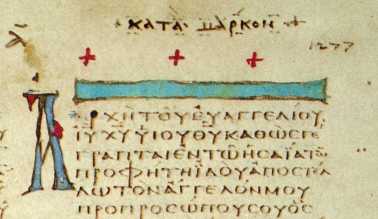
Gospel Inscriptions


When were the Gospel inscriptions (e.g., KATA MARKON ["According to Mark"]) added? Received wisdom was that they were added during the collection and ratification of the Fourfold Gospel collection in the mid-second century (A. von Harnack, T. Zahn). Some would even claim, like Rudolf Pesch, that "all the inscriptions and subscriptions in the Gospel manuscripts are late" [alle Inskriptionen und Subscriptionen in den Evangeliuenschriften sind spat]. However, this view was strongly contested by the late scholar Martin Hengel who argued that:

(1) There is no evidence that shorter readings like KATA MARKON found in codex Vaticanus were more primitive than the longer readings like EUANGELION KATA MARKON, since the earliest papyri all attest the longer reading.
(2) The title EUANGELION KATA MARKON etc. cannot be attributed to the fixing of the fourfold Gospel canon in middle to late second century in order to differentiate the books from each other because Aristides (Apol. 2; 16) and Justin (Apol. 66.3) both know of euangelia (‘Gospels’ in the plural) and in the case of Justin there is an awareness that the Gospels derive from the apostles and their followers (Dial. 103.8).
(3) Marcion’s preference for Luke (ca. 144 CE) was perhaps based on his agreement with its title and tradition that already attributed it to a disciple of Paul as opposed to the judaizing Gospels of Matthew and John.
(4) The statement attributed to Papias about the origins of the Gospels assumes a titular distinction between the Gospels. Furthermore, if Papias got his information from John the Elder around 90-100 CE, then the John Mark-Peter link found in Papias' statement cannot have been derived from 1 Pet 5.13 since 1 Peter was pseudepigraphically written during this same period at the time of Domitian in the 90s.
(5) The titles of the non-canonical Gospels, some of which can be dated to the mid-second century (e.g., Gospel of Thomas, Gospel of Peter, Gospel of the Ebionites, etc.), are to be understood as a deliberate imitation of the titles of the canonical Gospels. Likewise, Basilides, the Alexandrian Gnostic in the early second century, wrote a twenty-four volume Gospel commentary that perhaps included a titular distinction between the Gospels as well.
(6) The longer ending of Mk. 16.9-20 and the Epistula Apostolorum, dated to the first half of the second century, presuppose the circulation of the Gospels and Acts.
(7) While the Gospels are strictly anonymous at the literary level, that was possible only because their authorship and origin would have been known in its immediate setting. Anonymous works were rare in antiquity and regarded with suspicion, hence the rise of pseudepigraphy. Tertullian (Adv. Marc. 4.2.3) went so far as to say that a Gospel not bearing the name of its author was not to be received because he knew of some Gospels that had titles (canonical Gospels and perhaps others) and those that did not (Marcion). Yet the titles were probably added to the Gospels very early on in order to identify the origin of the work when the Gospels were used in liturgical practice, disseminated further afield, or arranged in Christian libraries. If the Gospels were utterly anonymous (author and provenance) and circulated with no knowledge of their origins, then, this would have led to a multiplicity of titles that we do not find at all. Thus, the titles were not added at the final redaction of the Fourfold Gospel collection in the middle of the second century, but were probably given during the dissemination of the Gospels to other communities when Christian scribes added the names based on collective knowledge about their authorship and origins.

Tuesday, March 30, 2010

New Blog: Go At A Walking Pace

There is a new blog around called Go at a Walking Place with three contributors including my former Ph.D student Jason Hood. Jason is a sharp guy living in Memphis and he is the chosen one to bring together the Methodists, Presbyterians, and Anglicans into formal and visible union. Do check out the blog.

Saturday, March 27, 2010

The Gospel According to Ferrero Rocher

Here is the introduction to my Palm Sunday Sermon for tomorrow:

Did you see the latest Ferrero Rocher chocolate add made especially for Easter? I’ve seen it and it made me laugh so hard at the stupidity of the advertising company that made the ad. But after laughing for a few moments it suddenly made me annoyed and then depressed. The ad for Ferrero Rocher chocolates features the gods of Olympus celebrating Easter by giving their succulent and heavenly Ferrero Rocher chocolates to us mortals on earth as gifts for us to enjoy. So if I understand this right, Ferrero Spa, who make the chocolates, want us to believe the pagan gods of Greek mythology are celebrating Easter by giving me chocolate. Now there are two possible problems going on here. Either: (1) Ferrero Spa doesn’t know much about Greek mythology because I’m pretty sure that Zeus wasn’t into Jesus or even the Easter Bunny; or (2) they don’t know what Easter is about because I’m pretty darn certain Jesus didn’t care a brass razoo about chocolate and the crown of thorns that Jesus was forced to wear was not his Easter bonnet. Now I can understand someone trying to take Christianity out of Easter because, let’s face it, crucifixion, sin, and redemption might not have a big market appeal these days. But to flat out paganize Easter by bringing in the gods of Olympus to sell chocolate is just … well … somewhere between loopy and beyond the pale. It is bad enough that the marketing industry has hijacked Christmas by turning it into a pagan holiday for hocking off tacky merchandise and over eating fatty foods, but now, they’re even trying quite literally to paganize Easter by bringing in pagan gods of antiquity. Instead of the God of Israel setting for his Son as a sacrifice of atonement to wipe away our sins (see Rom 3:24), Easter is being turned into a celebration of pagan gods giving us chocolate, cream, and nuts in a pretty gold foil. That’s what we’ve come to folks. But that’s not how the story goes, does it! The Easter that we’ve had for two thousand years is not about rich gourmet chocolate in shiny foil. It is the event that marks the climax of the life of Jesus of Nazareth, his final plea to Israel to accept his message of the kingdom, his final week in Jerusalem teaching the crowds and debating the Judean leaders, a final meal with his closest followers, then his arrest, crucifixion, and resurrection. Easter is about how triumph comes only through tribulation, its the victory of God over demonic powers, the conquest of God’s love over human wickedness, how God-given hope trumps human inspired hatred, its about God’s power revealed through the apex of human weakness, and its about how evil is routed by God’s forgiveness. That’s the Easter story. No Zeus, no chocolate, no gold packaging. It’s a story full of dirty roads, palm branches, religious fervor, curious people, politics, unleavened bread, power, bustling streets, scared people, sweaty people, roasted lamb, tense moments, violent people, and God who, despite all expectations, bring liberation to his people through the Messiah of Israel: Jesus of Nazareth.

Wednesday, March 24, 2010

McDonough's paraphrase of 1 Corinthians 8

Sean McDonough (Christ as Creator, 155-56) gives a helpful paraphrase of 1 Cor 8 about knowledge of the realities behind idols.

"Love, then, dominates the argument from 8:7 to 9:27. 'Let us assume,' Paul is saying, 'that your (not necessarily my) definition of the "nothingness" of idols is correct. Still, not everyone can operate at that level of theological finesse. Some of your brothers and sisters in the faith really believe that there are powerful forces in those idol precincts, and when they see you eating in there, they are going to assume that there is some genuine religious transaction going on. This is going to lead those same people - these brothers and sisters for whom Christ died! - to go and eat in temples also. But when they do it, they will actually believe that they are eating in the presence of another god. Such an act of spiritual adultery, such a level of betrayal, is going to pierce their hearts, and who knows whether their faith in Christ will ever be made whole again? Do you really want to be the one who sets that process in motion? Is eating some meat really worth the spiritual death of your family members in Christ? I would rather never touch another piece of meat if it meant destroying my brother'."

Tuesday, March 23, 2010

Jewish Origins of Gnosticism

I am becoming increasingly convinced that Gnosticism had a Jewish origin. After the Jewish revolts against Rome in 66-70 and 132-35 AD, Judaism went in one of two directions. Rabbinic Judaism that tried to compensate for the absence of the temple and expulsion from the land through a very manufactured micro-piety built on Torah and Halakah, and those that effectively tried to make Judaism palatable to the middle platonic zeitgeist by turning Judaism effectively into a pagan religion, i.e., Gnosticism.

I think support for this view, at least partly, is found in Philo. In Opificio, Philo attributes the creation of the cosmos to God, but the creation of human beings is outsourced to other heavenly beings so as to make God one step removed from the sin of human subjects (the mediating entities are "gods" and "reason" in Opif. 25, 27). This is a move clearly towards the demiurgal creationism whereby, for the sake of theodicy, God is removed from the creation and evils of humanity. In addition, the Gospel of Thomas is not a Gnostic document per se since it lacks demiurgal creationism, but it is certainly conducive to Gnostic beliefs and very probably found a home in Gnostic circles (hence its inclusion in the Nag Hammadi Codices). But despite all its rhetoric against the followers of Jesus (e.g., Matthew, Peter, etc.), Gos. Thom. 12 still holds James in relatively high regard. So I wonder if Gnosticism filtered into Christianity via second century Jewish Christianity.

Sunday, March 21, 2010

Colbert on Beck

As usual, Steve Colbert made me laugh:

Evidently Glenn Beck doesn't want Christians going to a church where they preach the same things that Jesus preached! I think it could be time for a soggy fish award!!

HT: BW3

Thursday, March 18, 2010

Authorship of Hebrews

The authorship of Hebrews is a funny question. The eastern church attributed it to Paul, Origen was ambivalent about it, suggestions have included Barnabas and Apollos, but a small cohort of scholars have suggested Luke's authorship of Hebrews or else Pauline authorship via Luke. There has been interesting proposals on this topic of late. One contribution is David Allen, Lukan Authorship of Hebrews (Nashville, TN: Broadman & Holman, forthcoming 2010) - which I have not read yet. The other contribution to the subject is an essay by Andrew W. Pitts and Joshua F. Walker entitled "The Authorship of Hebrews: A Further Development in the Luke-Paul Relationship" which is forthcoming in S.E. Porter (ed.), Paul's Social Relations (Pauline Studies 7; Leiden: Brill, 2010). I spoke to Andrew Pitts about their essay and he answers my questions below:

1. What started your thinking about the Pauline "source" of Hebrews?

We began working on this project during the 2008 annual meeting of the ETS-SBL meetings in Providence and Boston. At the meetings, we talked about the different features of Hebrews that point to authorship—style, vocabulary, its apparent oral qualities, theological viewpoints and manuscript tradition, among others. We had always thought that a Luke-Paul collaboration was possible and so we set out to examine various strands of evidence to see what direction they might point in. The somewhat recent trend toward understanding Hebrews in an oral context seemed to have some significant implications for authorship. If Hebrews is a speech, then it may have had stenographer (speech recorder). The content and manuscript (external) evidence pointed to Paul while the linguistic and literary (internal) evidence seemed to us to indicate Lukan involvement. This theory seemed to handle the bulk of the evidence presented on this matter, evidence which was often dichotomized into Luke only and Paul only data. But both sets of data, to our mind, seemed significant and neither could be easily side-stepped. We found, then, that a Pauline origin best explained the main content of Hebrews, accounting for elevated style of the document via Luke’s involvement.

2. What is the basic thesis of your chapter on the authorship of Hebrews?

The evidence we examine suggests that Hebrews likely represents a Pauline speech, probably originally delivered in a Diaspora synagogue, that Luke documented in some way during their travels together and which Luke later published as an independent speech to be circulated among house churches in the Jewish-Christian Diaspora. From Acts, there already exists a historical context for Luke’s recording or in some way attaining and publishing Paul’s speeches in a narrative context. Luke remains the only person in the early Church whom we know to have published Paul’s teaching (beyond supposed Paulinists) and particularly his speeches. And certainly by the first century we have a well established tradition within Greco-Roman rhetorical and historiographic stenography (speech recording through the use of a system of shorthand) of narrative (speeches incorporated into a running narrative), compilation (multiple speeches collected and edited in a single publication) and independent (the publication of a single speech) speech circulation by stenographers. Since it can be shown (1) that early Christians pursued parallel practices, particularly Luke and Mark, (2) that Hebrews and Luke-Acts share substantial linguistic affinities and (3) that significant theological-literary affinities exist between Hebrews and Paul, we argue that a solid case for Luke’s independent publication of Hebrews as a Pauline speech can be sustained. We don’t claim to have “solved” the problem of authorship in terms of absolutes or certainties, but we do think that this is the direction that the evidence points most clearly.

3. Could you summarize what it is about Hebrews that indicates that it is Pauline and what suggests that there is a Lucan hand involved?

To begin with, the oral literary setting for the letter, assumed by most these days, in tandem with evidence for Luke documenting Paul’s speeches in Acts is suggestive of a Luke-Paul collaboration in speech publication. Paul clearly delivered speeches on a number of occasions, some of which are documented by none other than Luke. This establishes a firm historical context for a Luke-Paul collaboration, in which Luke would record and publish Paul’s speeches, already existed in the early Church. There are speeches of others in the apostolic circle (esp. Peter) and beyond (e.g. Stephen), but Luke shows a clear preference in his history for documenting Pauline speech material. And we have further precedent for the early Christian documentation of apostolic speeches later converted in the style of the recorder in the Mark-Peter collaboration—at least, if we take Papias’s account seriously, who informs us that Peter functioned as something of a stenographer in the production of Mark’s Gospel. This is significant in light of the fact that Hebrews is the only document in the New Testament thought by many to be a single independently published speech (i.e. sermon, synagogue homily, etc.). If we begin with the contemporary assumption that Hebrews is a speech or sermon of some kind, this opens up new avenues of exploration for the authorship question that seem to us to point toward a Pauline origin with Lukan involvement.

With regard to the external evidence, we should probably expect a fairly high level of the reception history to document a Pauline origin since the scribes, stenographers and historians that circulated such speeches were rarely credited with authorship or if they were, it was merely as a co-author, as we see in many of Paul’s letters. And this is exactly what we find. We immediately think of P46 (200 A.D.), for example, the earliest Pauline canon, which situates Hebrews in the middle of the Pauline corpus. But P46 is only one part of a much wider body of external evidence. A number of further manuscripts favor locating Hebrews immediately after the Pauline letters to the churches and before those written by Paul to individuals, as we find in אB C H I P 0150 0151, a Syrian canon from c. 400 (Mt. Sinain Cod. Syr. 10) and six minuscules from the eleventh century (103). Perhaps such an organization represents the shift in register: from (1) letters to churches to (2) a speech to a church(es) to (3) letters to individuals. The early Eastern fathers also consistently identify Hebrews with Paul. Eusebius records the views of both Clement of Alexandria (Eccl. hist. 6.14.2-3) and Origen (Eccl. hist. 6.25.13) to this effect. When we turn to the primary sources for Origen, the view remains the same. Origen constantly attributes Hebrews to Paul when he cites the document (Princ. 1; 2.3.5; 2.7.7; 3.1.10; 3.2.4; 4.1.13; 4.1.24; Cels. 3.52; 7.29; Ep. Afr. 9). Origen even proposes something like a collaborative hypothesis when he says: “If I gave my opinion, I should say that the thoughts are those of the apostle, but the diction and phraseology are those of some one who remembered the apostolic teachings, and wrote down at his leisure what had been said by his teacher” (Eusebius, Eccel. hist. 6.25.11-14, NPNF2).

We also find it difficult to imagine another person in early Christianity with the background necessary to produce such a composition. We don’t have enough information to make solid judgments regarding the abilities of many proposed authors (Barnabas, Pricilla, Apollos, etc.). A number of Pauline theological features seem evident to us in the Hebrews as well, which many seem to grant. In our chapter, we shore this point up in great detail. One striking feature we observe, for example, is that parallel citation strategies are employed in Hebrews and Paul’s speeches in Acts—for example, the use and exegesis of Pslam 2. A number of other parallel theological features both in Paul’s letters and his speeches in Acts find a direct correlate in Hebrews. In our chapter, we examine these in detail.

In addition to historical considerations, it is the language and style of Hebrews that we find most indicative of Luke’s involvement. Allen goes as far as to suggest that no volume in the New Testament is more similar in its language to Luke-Acts than Hebrews. We lean heavily upon much of his evidence and a collection of additional evidence that we bring to the discussion from our own research in establishing this point.

4. How does a stenographer differ from an amanuensis?

The proposal that perhaps most closely resembles ours is suggested in a footnote by Black when, in attempting to account for the linguistic evidence in Allen’s dissertation on the Lukan authorship of Hebrews, he suggests Luke was perhaps Paul’s amanuensis. The problem with this proposal is that it assumes, contrary to the dominant perspective in scholarship that Hebrews is a letter. Even if this is not the assumption, Black’s idea remains underdeveloped and is not robust enough to in his explanation to make a compelling case. In distinction from Black, we argue that Hebrews is a Pauline speech, independently documented and circulated by Luke, probably based upon his work as a stenographer—a more precise secretarial function related to speech recording rather than the broader domain of amanuensis that Black argues for. J.V. Brown, almost a century ago, advanced a theory similar our proposal when he argued that Paul authored the text but Luke edited and published its final form. Again, we believe a more convincing case can be made through establishing a historical framework in Greco-Roman and early Christian practice in which Luke, as he was accustomed to doing, somehow attained or documented first hand Pauline speech material and published it as an independent speech to be circulated in early Christian communities within the Diaspora. Such a practice is referred to in Greco-Roman historiography and rhetoric as stenography.

5. What do you think of Claire Rothchilds thesis that Hebrews is "Pauline Pseudepigraphy"?

Rothchilds’s thesis (Hebrews as Pseudepigraphon: The History and Significance of the Pauline Attribution of Hebrews [Tubingen: Mohr/Siebeck, 2008 ) remains unconvincing for at least two reasons. First, if someone was attempting to pass Hebrews off as a Pauline letter, then why leave out many of the standard components of Paul’s other letters, such as basic epistolary structure and formulas? It seems to us to be too unique of a document to be an attempted Pauline forgery. If it was a forgery of a Pauline letter, this Paulinist sure did a bad job. But such a situation seems highly unlikely given the composer’s skill and education in literary production. Second, from a very early date the Christian community accepted this letter as an authentic Pauline letter—substantiated by the external evidenced provided above. To overturn this evidence, a significant case would need to be made, a case which Rothchilds fails to deliver on.

6. What are the implications of your thesis for the study of the formation of the NT Canon?

Good question! It seems that the inclusion of the document in a number of primitive canons implies the reception of the document at a very early stage as part of Christianity’s sacred literature. Our theory also helps ground the document’s status in the authorship criterion, which remained a decisive issue in these discussions. We could, then, imagine a reception history similar to Mark’s Gospel under Peter’s authorship or of Luke’s Gospel in light of his connection to Paul.

7. What is Veritas Evangelical Seminary where you teach?

Veritas was recently started here in Temecula, Southern California (just south of Los Angeles and just north of San Diego), where my wife (Amber) and I (Andrew) are from. When Amber and I returned to Temecula from doing Ph.D. studies (New Testament) in the Toronto area at McMaster Divinity College, the president of Veritas, Joe Holden, contacted me to discuss the Dean and Associate Professor of Biblical Studies position there, which was at that time available. He desired to bring more strength and rigor to the biblical studies department at Veritas. I was eventually offered the job and serve in this position now. It certainly is in a great location!

Monday, March 15, 2010

Rachel Hyllberg - A Woman of God

This morning we laid to rest Karla's 97 year old grandmother.  I feel compelled to share her life with you because she lived a life of faith. Rachel was born on March 5, 1913 and went home to be the Lord on March 10, 2010. We celebrated her 97th birthday just last Friday. In a testimony that was printed in the program Rachel wrote:
The one thing that I desire above all others in my life is that all my children and all my grandchildren really know and serve the Lord, as that is our sole purpose for being here - to serve the Lord. This life is very short. When you get to my age you know tha it is all just like a breath and it is over. And it does matter that your life is concerned with what lasts forever - Jesus Christ and his love. Life in Christ is not stuffy or boring, it is totally satisfying and worth while.
It was a pleasure to have walked just a little while with her in this life. I look forward to seeing her again in heaven.

A the memorial service I offered this reflection about what I'll most miss about her.

There are many dimensions to the sense of loss we feel today as we reflect on our beloved Rachel’s homegoing and what she has meant to us individually. I want to reflect on what is for me one of the most profound senses of lose I feel today. With Rachel’s passing we have lost another significant link to our past.

Last summer out on Mary’s [my mother-in-law] porch swing I asked Rachel about her memories of the adults from her childhood; her memory of her parents and their friends, neighbors and acquaintances of her family. What I discovered was that she had a living memory that extended as far back as the middle of the 19th century. She knew personally people who lived through the Civil War, who voted when Abraham Lincoln and Ulysses S. Grant became president, and knew a United States with only 30 states.

Rachel began her adolescent years, although there wasn’t such a thing in those days, in the progressive decade of the roaring twenties. This was the height of women’s suffrage when women were just given the right to vote with the 19th amendment; she was a teenager when Babe Ruth roamed right field for the Yankees.

Rachel and Charles [her husband who died nearly 15 yrs ago] were newly weds during the dark years of the Great Depression. That experience was something of which she never lived out of its shadow.

She was an adult during the New Deal, the Space Race and Great Society. She saw two world wars, wars in Korea and Vietnam, and two wars in Iraq. She was born while Woodrow Wilson was president and died with a black man, Barak Obama, as her president. In between she saw 16 presidential administrations.

With the homegoing of our beloved Rachel, we’ve lost the knowledge and experiences of our past, the history of the family and of our very society itself. Her life represented three centuries. The memories of her forbearers are now no longer living with her. While she was alive, her very presence reminded us of the rich history that we in subsequent generations have been bequeathed—a history that is, with her passing, in danger of being forgotten if it is not regularly revisited.

Rachel left each us with a gift of her living memory, and I will for my part, commit to pass it on.

Saturday, March 13, 2010

"Make disciples of all nations" Inclusive or Exclusive of Israel?

I think it is safe to say that the standard view today among Matthean scholars is that "all nations" in Matthew 28:19 includes both the nations (non-Israel) and Israel. It is often read as a revision of the earlier exclusive mission to only the "lost sheep of the house of Israel" (Mt 10:6). The evidence in favor of either view is even, although the linguistic evidence seems to nudge in the direction of an exclusive reading (see the 1975 CBQ article [37: 359-69] by Hare and Harrington "Make Disciples of all the Gentiles" [MT 28:19]). By the way, the article is very dated in terms of its theological outlook, and their argument is not as strong as they would have you believe, but the evidence is solid. It seems to me that the determining which way to read the "all nations" in Matt 28:19 has everything to do with one's view Israel in God's purposes.

For my own view on this question you can see my discussions in Matthew's Messianic Shepherd-King.

Thursday, March 11, 2010

Was Christology decisive in dividing Jews in the early decades of the church?

I've been reading a very stimulating article by Anders Runesson that appeared in JBL not long ago entitled "Rethinking Early Jewish-Christian Relations: Matthean Community History as Pharisaic Intragroup Conflict" (JBL 127.1 [2008]: 95-132). 

The essay is dense and well researched with a number of interesting and significant observations. Among the many points to ponder is Anders' argument that Pharisees should not be thought of as a sect as is so often the case. Instead he labels them with the sociological category "denomination", which is more "positive in terms of society tension" because of "their acceptance of the Jerusalem cult [the civic religion] and thus the religiously legitimate use of it by individuals other than their own members" (114-15). I'm giving only the briefest sketch of his argument. You'll need to consult the article for the full argument, but his argument is very convincing at least at first glance. 

It is the near afterthought that most caught my attention however. In the second to last paragraph of the conclusion, Anders raises a the controversial point that what divided Jews in the first century of the church was not Christology. He notes the diversity within the Pharisaic movement of the first century stating:
The Pharisees themselves, in existence since the Hasmonean period, whom we have defined sociologically as a demonination, had among them diverse groups that at times exhibited schismatic tendencies . . . This diversity calls into question the (anachronistic) tendency among many scholars to understand christology to be the distinguishing factor behind intragroup tensions that resulted in the parting of ways between people who originally belonged within the same institutional context (132). 
He appeals to two early Rabbis to advance the point. Rabbi Akiva was ridiculed by some, he notes, for acclaiming Bar Kokhba messiah, but he nonetheless became a celebrated authority in the rabbinic community. In contrast Rabbi Eliezer was excommunicated as a result of a dispute over a halakic issue (b. Bava Mesia 59a-59b). From this Anders concludes "it seems indeed that halakah was more central for Jewish identity than dogma" (132). 

What do you think of this conclusion?

Vanhoozer on Doctrine of God

The Exiled Preacher has a good interview with Kevin Vanhoozer on his new book, Remythologizing Theology: Divine Action, Passion, and Authorship. The interview is well worth reading!

HT: Jason Hood for sending me the link.

Joel Willitts is now a Fellow of SAET

I am pleased to announce that I have become a fellow of the Society for the Advancement of Ecclesial Theology. SAET is 
"An organization dedicated to assisting pastor-theologians in producing biblical and theological scholarship for the renewal of orthodox theology, for the renewal of the church".
The Society is comprised of some of the sharpest and theologically reflective young evangelical pastors I know. I encourage you to check it out and consider joining if you have an affinity with its identity and purpose.

New Richard Bauckham Homepage

One of my favourite British NT scholars is Richard Bauckham (also one of the elite few NT scholars who are actually shorter than me). Any ways, Richard Bauckham has a new website that links to articles, books, sermons, and unpublished essays by him. Well worth checking out! I can't wait to read his unpublished essay on the NT and the episcopacy! I should also mention that Richard will be presenting the annual Tyndale Fellowship NT Lecture in Cambridge in July - so go ye to the Tyndale Fellowship NT group and hear him and stack of other great exegetes as well!

Monday, March 08, 2010

McDonough - Christ the Creator

Sean McDonough
Christ as Creator: Origins of a New Testament Doctrine
Oxford: OUP, 2010.
Available at Amazon.com

In this book Sean McDonough examines the origins of the NT statements that the world was made "through" Jesus Christ (1 Cor 8.6; Col 1.15-20; John 1.1-3; Heb 1.2). For McDonough the answer lies not in the application of categories drawn from Hellenistic Judaism (who did not alone have the problem of finding mediators between heaven and earth), but was from the memory of Jesus and his redefinition of Messiahship. McDonough asks why Christ was attributed a role in creation. To which he answers: "The mighty works of Jesus, his proclamation of the kingdom of God, and the climatic events of the crucifixion and resurrection, clearly marked him as the definitive agent of God's redemptive purposes. But these mighty works could scarcely be divorced from God's creative acts. The memories of Jesus preserved in the gospels depict a man who brings order to the threatening chaotic waters, creates life out of death, and restores people to their proper place in God's world ... Reflections of these memories of Jesus, coupled with the experience of forgiveness and renewal on the part of the early Church, led to a startling but elegant (theo-)logical conclusion: If the one true God had sent Jesus the Messiah as the definitive agent of redemption, and if this redemption was at one level simply the outworking of the project of creation (a view with ample precedent in the Hebrew Bible and the Ancient Near East in general), it must be that the Messiah was the agent of creation as well" (pp. 2-3).

1. Sean, how did you come to this topic of Christ as Creator and the search for its origin?

SM: If your readers might indulge a bit of personal reminiscence, I had always been a nature lover in my youth. But when I became a Christian at the age of 18, I somehow got the idea that an appreciation for the material world must be inherently "unspiritual". It has been a long journey back to a healthy appreciation of all that God has made through Christ. So my interest in this topic is an outgrowth of a general concern with the theology of creation. Colin Gunton's book The Triune Creator sparked my thinking as much as anything. I also owe debts to my mentors Greg Beale and Richard Bauckham for shaping my thinking on creation, new creation, and Christology.

2. Often it has been thought that attribution of a Wisdom theology to Christ accounts for postulations of his role in creation. However, this view has recently fallen on hard times with numerous critiques (e.g., S. Gathercole, G. Macaskill, A. Lee). What are your own thoughts on the matter?

SM: I was never quite happy with the idea that commentators could toss out a few references to Proverbs 8 or the Wisdom of Solomon and imagine that they had thereby accounted for the problem of how creation was attributed to Christ. Ancient Jewish thinkers in fact wrote in all sorts of different ways about the way God went about creating the world: he is said to do it through his word, or by his Spirit, or by his name, as well as by his Wisdom; and there are also texts that associate his glory with the act of creation. If anything, word and Spirit are the dominant conceptions. Jewish writers typically speak of Wisdom when they want to affirm that the world is an amazing place that displays God's intelligence at every turn. I don't deny that some Wisdom texts might have contributed some vocabulary for the NT writers, but I find it extremely unlikely that there was some universally accepted idea that God created through Wisdom, full stop, and that Jesus was just slotted in there in place of Wisdom as "market positioning" for the new faith. I might add that I view "hypostatic Wisdom" as a slippery and unhelpful phrase. The majority of writers simply use personification when they speak about Wisdom, and the Wisdom of Solomon uses it as a kind of periphrasis for the power of God, akin to the Stoic logos. I don't think many Jews imagined there was really a lady up in the sky who helped God out in creating the world.

3. In chapter four you refer to creation as the beginning of the dominion of the Messiah. Could unpack on how you reach that conclusion and what role it has in your thesis?

SM: There are three main considerations here. The first is the general significance of Messiah/Christ in early Christian thought. I find it unbelievable, for instance, that the Pharisee, or ex-Pharisee, Paul could discover that Jesus is the Messiah, and then act as if this were no big deal. Imagine Paul telling Gentiles to give their lives over to "the Smeared One" (Hengel's rendering of Christos, with an appropriate sense of strangeness), and responding to queries about what that could possibly mean by saying, "Oh, don't worry about it, it's just Jesus' second name." It strikes me as exponentially more likely that Paul and the other Christians would have developed their "Christology" as a very self-conscious reflection on what it means for Jesus to be the Messiah. Of course this involved all sorts of modifications of traditional conceptions in light of Jesus' radical redefinition of what it meant to be the Messiah -- but it is still messianic thinking. The second consideration is that the key creation texts in Colossians and Hebrews focus on Jesus' role as ruler: the Hebrews passage is saturated with messianic texts from the OT, and Colossians is at pains to stress Jesus' dominion over all things -- not the beauty of creation which we typically find in Wisdom creation texts. While the world may "lie in the power of the evil one", at a deeper level Jesus' doesn't come into a foreign world and take it over for God. He rules the world he made. It is absolutely fitting that he have dominion over it because he created it in the first place. Finally, the idea that Jesus is God's agent in creation -- all things were made "through him" -- is clearly modeled on the language of God saving "through him". In both cases, we have the idea of deputized agency, which is of course the Messiah's calling card: "Sit at my right hand..." etc.

4. You point out that Stoic philosophers and Hellenistic Jews were not the first ones concerned with the mediation of the heavenly and earthly realms. How does a wider ancient near east background help you understand the distinctive creation concept of Christ'd Schopfungsmittlerschaft?

SM: As with Wisdom, I don't want to rule out the possibility that some of the Greek philosophical koine might have shaped the NT writers' choice of words. But people often write as if Greek thinkers were the first ones to notice that the divine realm seemed to rather distant from the mundane one. In the book I note one Assyrian text where the conquering king is described as the image and glory of the god Enlil; he is the god's representative, his agent on earth. This strikes me as at least as relevant for the NT as texts about divine Wisdom. Not that Paul or John was reading such ANE texts directly, of course; but they were meditating on OT texts which were themselves taking shape in an environment where the human working out of divine plans was a part of the landscape. Naturally there are significant differences in the NT and ANE conceptions of divine kingship, but the ANE still provides a more helpful template for working through the problem than abstract philosophical conceptions.

5. In chapter eleven you refer to your own perspective on Christ and primal creation as rather close to Karl Barth's. What was Barth's view and distinguishes your view from his?

SM: I was delighted to find after years of reflection that Barth had managed in a four page excursus in his Church Dogmatics (III.1.51ff) to state clearly what I had been straining to say for so long. Barth's key insight was that all the putative background material is essentially irrelevant to understanding why the early Christians said that Christ was creator. Jesus through his words and deeds created the fundamental problem; he showed himself to be who God is, and then the early church puzzled over how to articulate what they in one sense already knew. They didn't start with a philosphical problem of a world estranged from God and then pump up Jesus until he closed the gap. I don't have any huge distinction from Barth on these essentials (apart from laying much greater weight on the messianic dimension of the NT presentation); I was simply able to address the question at greater length with more of a historical focus.

College Ministry Pastor

I wanted to share the good news with you that I have accepted a part-time pastoral position at Christ Community Church in St. Charles, IL as their College Ministry Pastor. I'm very excited about the opportunity and believe that God has led me to this new ministry venture. Truth be told this is something I had always envisaged as a complement to my academic ministry in the university. Those of you that know me know that I came to academics through the church ministry and have felt that it would again have a place in my vocational life. 

Christ Community Church is a place my wife and I know well. We were on staff here in the mid-to-late 1990's as a youth pastor. I left CCC in 1999 to pursue high education. This pursuit took me back to DTS and to Cambridge, England. In God's providence, however, we're back the far-western suburbs of Chicago and back at CCC. God is very cool. 

CCC is a very different place than when we were here over a decade ago, although James Nicodem is still pastoring the church he began over 25 years ago. The church has over 5000 attenders with 2 extenstion campuses and a 3rd planned for this year. The college ministry called Crave has a great amount of potential with about 80 students currently attending a weekly meeting. But with not much more going on than that we're looking to take it to the next level. The major university in our  sphere of mission is Northern Illinois University (NIU) in Decalb with a number of other community colleges dotted around.

I'm sure with this new component to my vocational life I'll be blogging a good deal about ministry in addition to the scholarly stuff.

New Testament Theology: Many Witnesses, One Gospel

New Testament Theology: Many Witnesses, One GospelI. Howard Marshall
Downers Grove: IVP, 2004.

Now I may be behind the times a bit, but I am just now getting around to interacting with I. Howard Marshall's New Testament Theology. Many of you I'm sure have already had occasion to consult this volume and know its strengths. In this short notice, I wish to highlight one of the key contributions this book makes and why it is a very good, albeit lengthy, theological introduction to the NT. 

For me what puts this introduction to the front of what is becoming a crowded shelf of NT introductions is its missional and evangelistic focus. Marshall writes:
The situation of the early Christians was one in which they were communicating the good news about Jesus to people who were not believers. It is worth remembering that people were believers only if they had become believers. The good news was news, something fresh that had not been heard before. Therefore, any people who became believers did so only as a result of the gospel being communicated to them. Whether deliberately or other wise, whether consciously or otherwise, the early Christian church grew through sharing the message of Jesus with people who were not believers . . . Consequently, the writings that we have arose out of that mission (709).

He further concludes: 
It can be affirmed that mission is the origin of the New Testament documents. At the same time, the documents are concerned in part with the forwarding of the actual evangelism and contribute to a theology of evangelism.
Marshall then cautions those of us who theologize:
Focusing  on this activity can carry with it the temptation to ignore the task of mission as the sharing of the gospel with those who have not yet heard it or beleived it . . . Even today believers may find their attention diverted to teh study of theology and other aspects of Christian living to teh detriment of evangelism, and this presupposition may give them a skewed reading of the New Testament (710).
Marshall's caution here is so very important. Have we been tempted to forget or ignore the mission of the church while fixated on the study of its foundational documents? Has our understanding of those documents been "skewed"? These are significant questions indeed.

There are far to many details covered in the 765 pages of text to do it justice here. Still, although I had an ocassional quibble, the scholarship is solid as you would expect from Marshall and it is clearly the by product of a life time of work in the New Testament. What's more, with the above stated focus the this volume is sure to be an asset to any pastor whose looking for a introduction to the NT that is self-conscious about the mission of the church.

Wednesday, March 03, 2010

Passing of E. Earle Ellis

This morning I was sadly informed by Jim Hamilton that Prof. E. Earle Ellis has passed away. Ellis was a wonderful Baptist scholar of the NT and a committed churchman. He was respected by colleagues in the UK and Germany for his various works in NT studies. His various articles and monographs on the NT use of the OT are still worth reading even decades after their initial publication. His book The Making of the New Testament Documents is a valuable resource about the formation of the New Testament and something that I turn to again and again for information. Ellis was also a key founder of the Institute for Biblical Research. The second festschift for Ellis edited by Sang-Won Son (History and Exegesis) includes a biographical sketch of Ellis written by Gerald F. Hawthorne which is available on Google Books. Sadly, I fear that we are now to be denied the publication of his 1 Corinthians commentary in the ICC series (though T&T Clark may yet be able to make something of what he had already done to date - we can only hope). May he enjoy his heavenly rest!

Update: SWBTS has a tribute to Ellis here.

Things to Click

Things to note on the blogosphere:

Peter Enns on how Adam is Israel.

Christopher Skinner is beginning some blog posts on Paul and the Gospel of Thomas.

Scot McKnight critiques Brian Maclaren's new book as old liberalism.

Monday, March 01, 2010

What is "orginality"?

I came across a great quote recently that should be an encouragement to anyone embarking on a doctoral thesis. The quote speaks to the perennial concern for originality. In a field like NT studies where every inch of the territory has been excavated numerous times one feels the great fear of whether it is even possible to say anything original. This is even communicated by some professors when they interview potential doctoral candidates. "Don't study the NT", I was once told, "nothing new has been said in over 500 years. Study something like the Shepherd of Hermes!" While I think that more people should study the Shepherd, this was very deflating. By the way, at the time I didn't really even know what the Shepherd was so the thought of spending years studying it was beyond incredible. I don't feel that way now of course. Well to the quote. George B. Stevens, a NT scholar of the late 19th century once said:
"Originality does not consist of thinking new things but of thinking for ourselves."

W.D. Davies's Paul and Rabbinic Judaism

While it is clear that in the five decades since  its publication the discussions in Pauline studies have eclipsed or superseded the language and concerns of this book at points (e.g. calling Paul a Christian), Paul and Rabbinic Judaism: Some Rabbinic Elements in Pauline Theology, which was first published in 1948, remains as fresh a perspective on Paul as it ever was. In fact using Zetterholm's recent taxonomy of perspectives of Paul and Judaism in his Approaches to Paul, Davies's book would is clearly a Radical New Perspective before the New Perspective.

For those of us who are sympathetic to the idea that Paul was a first-century Torah observant Jew, Davies's book must be seen as our great grandfather. As best I can tell, Davies's book does not get the credit today that it should as being a ground breaking work. In fact it is with the so-called Radical New Perspective that Davies's central thesis is now coming into its own. It is time to read it again or as in my case for the first time.

I quote Davies's conclusion at length:
Both in his life and through, therefore, Paul's close relations to Rabbinic Judaism has become clear, and we cannot too strongly insist again that for him the acceptance of the Gospel was not so much the rejection of the old Judaism and the discovery of a new religion wholly antithetical to it, as his polemics might sometimes pardonably lead us to assume, but the recognition of the advent of the true and final form of Judaism, in other words, the advent of the Messianic Age of Jewish expectation.

It is in this light that we are to understand the conversion of Paul. We have above referred cursorily to that interpretation of his conversion which depicts Paul in his pre-Christian days as suffering from agonies of discontent with the Torah, a discontent which was more particularly characteristic of Diaspora Judaism, as Montefiore has argued, and which Paul sought to suppress and hid by zeal in persecution. But, as we have previously written, there is little evidence that this was the case. Doubtless Paul, looking back on his pre-Christian days not only from the height of his Christian experience but also past many a bitter memory, could depict them as a period of dissatisfaction and frustration.

Nevertheless, things are seldom in fact what they appear to be in retrospect. It is far more probable . . . that Paul's persecution of the Church was due not to his dissatisfaction with Judaism but to his zeal on its behalf. It was not the inadequacy of Judaism, not the fact that Judaism which Paul knew was an inferior product of the Diaspora that accounts for Paul's conversion, but the impact of the new factor that entered into his ken when he encountered Christ. It was at this point that Paul parted company with Judaism, at the valuation of Jesus of Nazareth as the Messiah with all that this implied.


While, therefore, our study has led us to the recognition of Paul's debt to Rabbinic Judaism, it has also led us to that challenge which Pauline Christianity, and indeed all forms of essential Christianity, must issue to Judaism no less than other religions: What think ye of Christ? (324)